Agentic AI: Revolutionizing Enterprise Translation with Communication Design
Discover Agentic AI Translate, a prototype reshaping machine translation from text conversion to strategic communication design, leveraging Translation Studies metalanguage for nuanced, purpose-driven outputs.

Traditional machine translation (MT) has long focused on optimizing the "what" of translation: achieving lexical and grammatical fidelity between a source text and its target equivalent. While advanced statistical and neural systems, including Large Language Models (LLMs), have brought segment-level fluency and idiomaticity to near-human levels, the frontier of true translation value is now shifting. It's moving towards the "how"—the subtle nuances of register, audience design, voice, cultural framing, and genre conventions that have always been critical for professional translators but often overlooked by computational approaches.
A groundbreaking academic paper, "Agentic AI Translate: An Agentic Translator Prototype for Translation as Communication Design" by Masaru Yamada and Translation Lab Inc., proposes a significant paradigm shift. It introduces a prototype that moves beyond simple text conversion, reframing translation as a deliberate act of communication design. This innovative approach leverages the rich metalanguage of Translation Studies (TS) as an instruction code for generative AI, transforming theoretical concepts into actionable parameters for the machine. This redefines the translator’s role from a manual drafter to a designer and verifier of AI-generated content (Source: Yamada & Translation Lab, 2026).
The Evolution of Translation: From Fidelity to Function
For decades, the success of machine translation was measured primarily by its ability to accurately reproduce the source text. Systems continuously improved, striving for perfect lexical and grammatical equivalence. However, as AI capabilities advanced, particularly with the advent of Large Language Models (LLMs), basic accuracy has become a "must-have" feature, no longer a differentiator. The challenge isn't just generating coherent text; it's ensuring that the generated text effectively serves a specific communicative purpose within its target cultural and business context.
This shift highlights an "automation paradox": the easier it becomes for AI to generate text, the more critical it becomes to precisely guide that generation to meet a defined communicative goal. This is where the traditionally academic vocabulary of Translation Studies (TS)—terms like skopos (purpose), register (style and formality), audience, equivalence, foreignization, domestication, and genre—becomes incredibly valuable. These concepts, once used to analyze and understand translation practice, can now be directly operationalized as specific instructions for generative AI.
Translators Reimagined: Designers and Verifiers
The paper argues for a fundamental reconfiguration of the translator's role in the GenAI era. Rather than merely converting text, translators are envisioned as "designers" and "verifiers." As designers, they compose highly precise, metalinguistic "situational analyses" that define the translation's purpose (skopos), target audience, desired register, and genre conventions. This also involves providing operational artifacts like glossaries, paired examples, and parallel texts to condition the generative system.
As verifiers, translators move beyond simple surface-level error correction. Their task becomes a functional and epistemic judgment: Does the AI-generated output resonate with the target audience? Does it maintain factual accuracy and structural integrity? Does it perfectly align with the meticulously crafted translation specification? This new role requires deep understanding of both linguistic nuances and communicative intent, making the theoretical apparatus of TS an essential operational infrastructure.
Agentic AI Translate: A Blueprint for Purpose-Driven Translation
The Agentic AI Translate prototype embodies this vision with a sophisticated, layered architecture. It moves away from the simplistic "text-in/text-out" model of traditional MT, introducing an interactive specification phase followed by a four-stage agentic cycle, all while maintaining document-level coherence. This system represents an executable argument that translation in the generative AI era is fundamentally communication design.
The architecture is built on three concentric layers:
- An interactive specification phase where the user, with model assistance, defines a structured translation brief.
- A four-stage agentic cycle that processes the translation.
- A persistent state mechanism that preserves document-level coherence across long inputs.
Crafting the Translation Brief: Interactive Specification
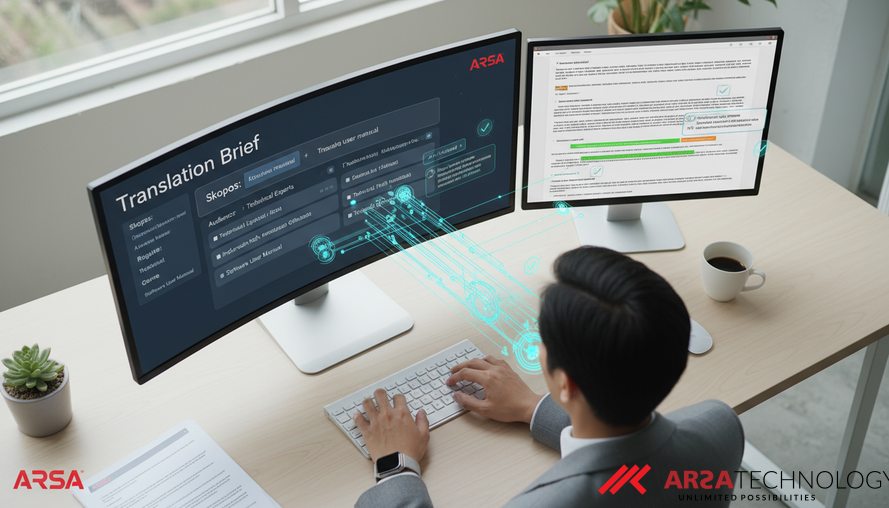
Before any text generation begins, Agentic AI Translate engages the user in an interactive "specification phase." Here, the user doesn't just provide the source text; they actively compose a detailed "translation brief." This brief is guided by concepts from Translation Studies, ensuring that the AI understands the deeper communicative goals. Through model-assisted dialogue, users define critical parameters such as:
- Skopos (Purpose): What is the ultimate goal of this translation? Is it to inform, persuade, entertain, or instruct?
- Audience: Who is the target reader? What are their cultural assumptions, technical background, and expectations?
- Register: What level of formality, tone, and style is appropriate? (e.g., academic, colloquial, journalistic).
- Genre Conventions: What are the specific structural and linguistic expectations for this type of document (e.g., legal contract, marketing brochure, academic paper)?
- Stance and Voice: How should the author's attitude be conveyed, and what distinct voice should the text adopt?
This structured input transforms abstract theoretical concepts into concrete, actionable instructions for the AI, ensuring the translation is fit for purpose. Enterprises can utilize this for consistent brand messaging or critical compliance documentation. For companies seeking to integrate advanced AI capabilities into their language processes, custom AI solutions like those offered by ARSA Technology can build similar structured input frameworks tailored to specific operational needs.
The Four-Stage Agentic Cycle
The core of Agentic AI Translate is its innovative four-stage agentic pipeline, designed to provide transparency and control over the translation process:
1. Identification: The process begins with an LLM analyzing the source text to automatically extract key situational parameters. This includes identifying the inherent skopos, target audience characteristics, implied register, genre, and authorial stance, then formatting these insights into a structured JSON output. This initial analysis forms the foundational understanding for the subsequent stages.
2. Prompting: A deterministic Python component then meticulously constructs a comprehensive translation prompt. This prompt synthesizes all available information: the user's detailed translation specification, any provided reference materials (such as glossaries or parallel texts), the initial LLM identification output, and the system's persistent document-level memory. This multi-faceted approach ensures the generative AI receives highly contextualized and precise instructions.
3. Generation: With the meticulously crafted prompt, a single Large Language Model (LLM) call is made to produce the draft translation. The temperature parameter, set to 0.3 in this prototype, indicates a preference for more deterministic and less creative output, suitable for functional translation tasks where accuracy and adherence to specifications are paramount.
4. Verification: This crucial stage employs an LLM acting as an independent "judge." It evaluates the generated translation against the original specification using the GEMBA-MQM error-span protocol. This protocol identifies errors (e.g., accuracy, fluency, style, terminology) by category, severity (critical, major, minor), and provides explanations. A numerical score is deterministically calculated (e.g., -25 for critical, -5 for major, -1 for minor errors), and a verdict is computed against a predefined threshold. If the translation fails to meet the threshold, the identified errors are fed back into the Prompting stage for refinement, allowing for up to two iterative revisions. This feedback loop ensures continuous quality improvement.
Preserving Document-Level Coherence
Longer documents often suffer from inconsistencies in terminology and style when translated segment by segment. Agentic AI Translate addresses this through a "DelTA-lite memory" system, inspired by recent advancements in document-level MT. This memory continuously tracks proper nouns and maintains a running bilingual summary, ensuring that crucial elements remain consistent and coherent throughout the entire translated document. This is vital for enterprise clients who rely on precision across extensive reports, legal documents, or technical manuals. ARSA's AI Box - Traffic Monitor, for example, processes real-time video streams maintaining context across continuous data, much like how document-level memory preserves context in translation.
The Power of Decomposition: Inspectable AI Outputs
A key design choice in Agentic AI Translate is the decomposition of the translation task into distinct stages. Unlike a single, monolithic LLM prompt that might produce fluent but opaque output, this multi-stage approach offers significant advantages:
Transparency: Each stage produces an inspectable artifact—from the Identification JSON to the assembled prompt and the Verification error spans. This allows users and researchers to understand why* the AI made certain choices.
- Debugging and Refinement: The visibility into each step makes it easier to identify where a translation might deviate from the desired outcome, facilitating targeted adjustments.
- Pedagogical Value: For training new translators or AI prompt engineers, seeing the structured breakdown of the process helps in understanding the interplay of communicative design principles and AI instruction.
- Reliability: By breaking down complexity, the system can more reliably execute complex, multi-faceted translation tasks.
Practical Implications for Global Enterprises
The shift to "translation as communication design" has profound implications for global enterprises operating across various industries.
- Consistent Brand Voice: Companies can ensure their messaging remains consistent and culturally appropriate across all languages, preserving brand integrity.
- Enhanced Compliance: For regulated industries, precise control over legal and technical terminology, tone, and factual accuracy becomes achievable, reducing compliance risks.
- Targeted Communication: Marketing materials, user manuals, and internal communications can be tailored precisely to specific regional audiences, maximizing impact and engagement.
- Operational Efficiency: While the system is still a prototype, the underlying principles promise significant efficiency gains by automating the nuanced aspects of translation that previously required extensive human intervention or post-editing.
- Quality Assurance: The structured verification process provides a robust framework for assessing translation quality against explicit business requirements, moving beyond subjective linguistic evaluations.
This agentic approach aligns with the demand for intelligent systems that deliver not just output, but purpose-driven outcomes. Companies that adopt such a strategic view of translation can gain a significant competitive advantage in the global market. ARSA Technology has been experienced since 2018 in developing and deploying practical AI solutions, providing expertise in integrating complex AI systems for specific enterprise challenges.
Challenges and Future Directions
As a research prototype, Agentic AI Translate's contribution is currently conceptual and architectural. Future work will involve rigorous empirical validation, including comparative MQM studies against unstructured prompting, to quantify the benefits of this structured approach. The development roadmap also includes extensions for even more structured specifications, further deepening the integration of TS metalanguage into the AI's operational instructions.
The explicit design tensions—such as balancing user interactivity with automation, or the trade-offs between a single end-to-end prompt versus a decomposed agentic workflow—are central to the project's ongoing research. These explorations will refine how AI can best serve as an intelligent partner in complex communication tasks.
Transforming Global Communication with AI
The Agentic AI Translate prototype marks a crucial step in the evolution of machine translation, elevating it from a mere language conversion utility to a sophisticated tool for communication design. By embedding the deep insights of Translation Studies directly into AI's operational framework, it empowers translators and enterprises to produce highly contextualized, purpose-driven, and impactful multilingual content. This paradigm shift offers a future where AI not only understands what to say but how to say it to achieve specific strategic goals.
To explore how advanced AI and IoT solutions can transform your enterprise operations, from enhancing communication strategies to optimizing industrial processes, we invite you to contact ARSA for a free consultation.
**Source:** Yamada, M., & Translation Lab Inc. (2026). Agentic AI Translate: An Agentic Translator Prototype for Translation as Communication Design. arXiv preprint arXiv:2605.17041. https://arxiv.org/abs/2605.17041