AI-Powered Autonomous Agents: Revolutionizing Web Testing and Security with Natural Language
Discover how AI-powered autonomous agents transform web testing and security, leveraging natural language to build resilient test suites and detect vulnerabilities with high accuracy.

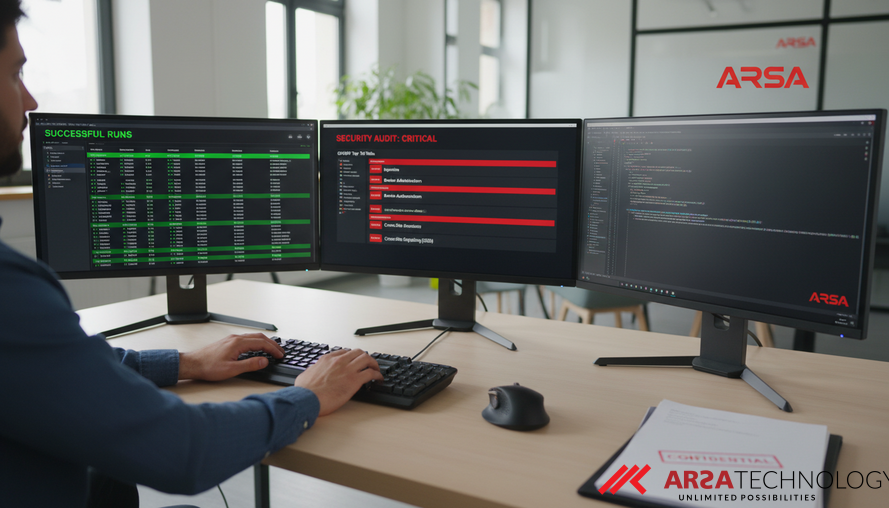
Traditional web application testing often grapples with a significant challenge: test suites that "rot" over time. A seemingly minor user interface (UI) refactor can break how automated tests locate elements on a page, while subtle timing changes can lead to unpredictable failures known as race conditions. Developers frequently find themselves spending more time maintaining these fragile test suites than actually shipping new features. This common frustration spurred research into AI-driven autonomous testing frameworks, aiming to deliver robust and self-healing solutions that simplify the entire process, including the crucial aspect of security validation.
The Fragility of Conventional Web Testing
Automated web tests, often built using tools like Selenium, are susceptible to rapid degradation. "Locators," which are the pathways tests use to find specific UI elements (e.g., a button, a text field), are easily broken by even small changes in a page's structure. Similarly, "race conditions" occur when tests proceed faster than the application can render or respond, causing elements to be missed or interactions to fail. The result is a high rate of false negatives or positives, eroding developer confidence and leading to neglected test suites. Initial attempts to leverage large language models (LLMs) for test generation showed promise but struggled with reliability, achieving only about 55% success due to ambiguous navigation, missing wait conditions, and "hallucinated" element IDs, as detailed in recent academic work (Source). This highlighted the need for more sophisticated strategies to make AI truly practical for web automation.
Introducing Autonomous AI Agents for Robust Web Automation
To overcome these limitations, a new framework integrates five critical strategies into an AI-driven autonomous testing pipeline. This approach significantly boosts script generation success from an initial 55% to an impressive 93%. It operates on a "containerized worker" architecture, meaning tests run in isolated, scalable environments, decoupling the central control from the actual browser execution. This architectural choice enhances stability and performance, allowing for efficient parallel processing and robust resource management.
The framework's ingenuity lies in its ability to proactively address common failure modes, moving beyond reactive fixes. It not only streamlines the creation of reliable test scripts but also extends its capabilities to security validation, transforming plain English attack descriptions into actionable browser probes.
Five Core Strategies for Enhanced Reliability
The success of this autonomous testing framework hinges on a meticulously designed, five-strategy enhancement pipeline that refines AI-generated test scripts for real-world reliability.
Strategy 1: Enhanced Navigation Reliability
Many modern web applications, particularly those built with single-page application (SPA) frameworks like React, can present multiple identical links leading to the same destination. A simple "click" instruction on such a link can become ambiguous. This strategy proactively identifies navigation-based click actions and converts them into direct URL accesses. For instance, if a test aims to navigate to a "contact" page, the agent will extract the direct URL and command the browser to load it, rather than clicking a potentially ambiguous link. This straightforward but impactful change dramatically reduced navigation failures from 40% to just 5%, highlighting how simple, intelligent adjustments can yield significant reliability gains.
Strategy 2: Context-Aware Selector Generation
Even with reliable navigation, locating the correct UI element remains a challenge. LLMs often generate minimal "selectors"—brief descriptions of elements (e.g., "submit button")—which can match multiple elements on complex pages, leading to "element not found" errors. This strategy enhances the web scraper to gather more "parent context," such as surrounding section headings, form labels, or ARIA landmarks. When an initial selector is ambiguous, the system prepends this additional context, creating a more specific and accurate locator. This refinement reduced element location failures from 30% to approximately 10%.
Strategy 3: Pre-Execution Validation
Before committing valuable compute resources to execute a test, it's efficient to identify potential failures beforehand. This strategy introduces a "static analysis gate" that scores each generated script based on anti-patterns. For example, it flags attempts to click invisible elements, fill read-only fields, or navigate to routes not present in the observed Document Object Model (DOM). Scripts scoring above a certain threshold (e.g., 90) proceed, while those below a lower threshold (e.g., 60) trigger regeneration with more context. This proactive validation catches about 85% of scripts that would otherwise fail during execution.
Strategy 4: Intelligent Wait Injection
Web applications are dynamic, with animations, asynchronous API calls, and lazy loading introducing unpredictable delays. LLMs often fail to account for these latencies, leading to "timing failures" where an action is attempted before an element is ready. This strategy automatically injects "smart waits" into the script. Based on learned heuristics, these waits pause execution after common asynchronous events, such as navigation, clicks that might trigger route changes, or form submissions, before proceeding with assertions. While sometimes leading to slight over-waiting, this approach reduced timing-related failures from 25% to 5%.
Strategy 5: Continuous Failure Learning
Even with the best proactive measures, some tests will inevitably fail. This final strategy turns failures into learning opportunities. When an execution fails, the system logs structured records, capturing details such as the failed step number, the attempted selector, the exact error message, and the page state at the time of failure. This data feeds back into the AI generation process, helping the model learn from its mistakes and improve future script generation.
Beyond Testing: Natural Language-Driven Security Assurance
A notable innovation of this framework is its seamless extension to security testing. Security analysts can describe attack scenarios in plain English, such as "try accessing another user's invoice." The autonomous agent then translates these natural language descriptions into "OWASP Top 10-aligned browser probes." The OWASP Top 10 is a widely recognized standard listing the most critical web application security risks. These probes are automated security checks executed within the browser's context, simulating real attack vectors.
This natural language approach significantly democratizes security testing, making it accessible even to non-security experts. The framework demonstrated remarkable effectiveness, detecting 85% of authentication bypass vulnerabilities and 95% of input validation flaws, with false positive rates kept below 12%. This represents a novel contribution to the field, offering an intuitive yet powerful method for identifying critical security vulnerabilities.
Architecting for Performance, Privacy, and Control
The underlying "containerized worker architecture" is crucial for the framework's scalability and reliability. By running each test or security probe in an isolated container, the system can efficiently handle a large volume of concurrent tasks without interference. This also ensures a clean execution environment for each run. This kind of distributed processing at the "edge" or within controlled environments aligns with the principles ARSA Technology applies in its own solutions, such as the AI Box Series, which offers pre-configured edge AI systems for rapid, on-site deployment and local data processing, emphasizing data privacy and low latency.
This architecture enables robust "failure learning" mechanisms by clearly isolating problems and providing detailed logs without impacting other ongoing tests. It provides the necessary flexibility for enterprise deployments where infrastructure requirements, data sovereignty, and performance are paramount.
The ARSA Technology Advantage in AI-Driven Automation
ARSA Technology leverages deep expertise in AI and IoT, delivering practical, production-ready systems that solve complex operational challenges for global enterprises, as reflected by our journey experienced since 2018. While the research discussed focuses on web testing and security, the principles of transforming complex inputs into actionable, intelligent automation with integrated assurance are central to ARSA’s offerings.
Whether it’s deploying AI Video Analytics for security and operational monitoring, or developing Custom AI Solutions tailored to intricate enterprise needs, ARSA focuses on measurable impact. Our solutions prioritize accuracy, scalability, privacy-by-design, and operational reliability, mirroring the rigorous demands of advanced autonomous systems. We believe that AI must work effectively in the real world, under real industrial constraints, turning complex data into decisive intelligence.
Transform your enterprise operations and security posture with intelligent automation. To explore how ARSA Technology can deliver tailored AI and IoT solutions for your specific challenges, we invite you to contact ARSA for a free consultation.
Source: Pasupuleti, V., Bayyavarapu, S. R. K. V., & Tyagi, S. (2026). Autonomous Intelligent Agents for Natural-Language-Driven Web Execution with Integrated Security Assurance. arXiv preprint arXiv:2605.15281.