AI-Powered Co-Design: Revolutionizing Thermodynamic Cycles for Unprecedented Energy Efficiency
Explore how a graph-based hierarchical reinforcement learning approach automates the co-design of high-performance thermodynamic cycles, uncovering novel configurations with superior energy efficiency.

The Critical Need for Smarter Energy Conversion
As the global push for decarbonization intensifies, the efficient conversion and utilization of energy have become paramount across all sectors, from industrial operations to smart buildings and transportation. The demand for energy continues to climb, driving a critical need for thermal systems that are not only efficient but also flexible and scalable to support carbon neutrality goals. At the heart of these systems lie thermodynamic cycles – the fundamental processes that govern how energy is transformed, whether in power plants, refrigeration units, or heating systems. Optimizing these cycles is key to reducing operational costs, minimizing environmental impact, and unlocking new levels of performance.
Traditionally, the design of these complex cycles has relied heavily on expert knowledge and painstaking manual optimization. Engineers would often start with a predefined cycle structure, such as a Brayton or Rankine cycle, and then spend considerable time fine-tuning its parameters (like temperatures and pressures) to achieve the best possible thermodynamic and economic outcomes. While this approach has yielded incremental improvements, it inherently limits the scope of innovation. By sticking to known configurations, designers miss out on potentially revolutionary, high-performance cycle architectures that could significantly push the boundaries of energy efficiency. This reliance on expert assumptions curtails the exploration of the vast design space, hindering the discovery of truly novel solutions.
Algorithmic Approaches and Their Limitations
To overcome the inherent constraints of expert-driven design, researchers have explored various algorithmic methodologies. These include heat exchanger network (HEN) methods, which aim to optimize heat and cold streams; superstructure approaches, which frame component selection as complex mathematical problems; and graph theory techniques, which abstract cycles as directed graphs for topological optimization. Another method involves thermodynamic process synthesis, constructing cycles by assembling fundamental energy conversion processes.
While these approaches represent a significant step forward, transitioning from human-intensive design to algorithmic generation, they still face notable challenges. Their computational demands can be prohibitive, and their "algorithmic intelligence" often falls short of truly autonomous learning and optimization. They struggle with the dual challenge of simultaneously optimizing discrete structural decisions (e.g., which components to include and how to connect them) and continuous operating parameters (e.g., the precise temperature or pressure settings). This complex interplay of choices creates a high-dimensional optimization problem that traditional algorithms find difficult to navigate efficiently.
Hierarchical Reinforcement Learning: A New Paradigm
The complexity of co-designing both the structure and parameters of thermodynamic cycles presents a significant hurdle. Evaluating system performance, which is crucial for optimization, often requires extensive simulations after continuous parameter tuning, leading to delayed and computationally expensive feedback. To address this, a new approach leveraging hierarchical reinforcement learning (HRL) offers a promising solution. HRL is a sophisticated form of artificial intelligence that tackles complex tasks by breaking them down into simpler, manageable subtasks. Imagine a "manager" AI that oversees the big-picture strategy and a "worker" AI that handles the specific tactical details. This decomposition significantly reduces complexity and enhances the efficiency of the learning process.
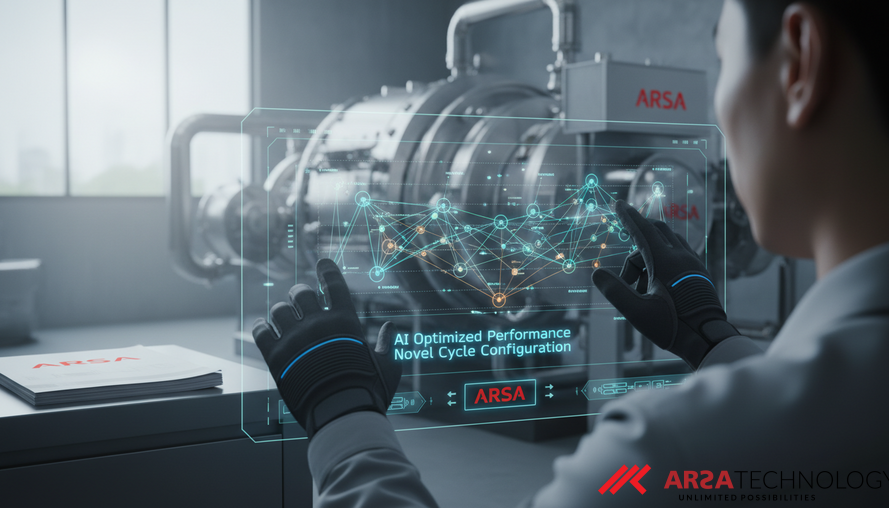
This innovative methodology applies HRL to thermodynamic cycle design by encoding cycles as graphs. In this representation, individual components (like compressors, turbines, or heat exchangers) become "nodes," and the pipelines connecting them are "edges." These graphs are built with specific grammatical rules, ensuring that the generated designs are thermodynamically valid. A deep learning-based thermophysical surrogate model plays a crucial role here, acting as a fast and accurate predictor of cycle performance. This "surrogate" can quickly evaluate a proposed cycle's efficiency without needing time-consuming, full-scale thermodynamic simulations. This rapid feedback mechanism is vital for efficient AI learning.
How AI Redefines Cycle Design and Optimization
The core of this AI-powered co-design lies in a hierarchical reinforcement learning framework. A high-level AI, known as the "manager," takes on the strategic role of exploring the structural evolution of the cycle. It proposes new configurations or modifications to existing ones, effectively exploring the vast design space. Once the manager proposes a candidate structure, a low-level AI, the "worker," springs into action. The worker's task is to optimize the continuous operating parameters (like pressures, temperatures, and flow rates) for that specific structural configuration, aiming to maximize its performance.
The worker then provides a "performance reward" back to the manager, indicating how well the proposed structure, with its optimized parameters, performed. This feedback loop allows the manager to learn and refine its strategy, steering the search towards regions that yield increasingly high-performance designs. This integrated approach, combining graph representation, a rapid thermophysical surrogate, and the manager-worker learning framework, establishes a fully automated pipeline for encoding, decoding, and co-optimizing thermodynamic cycles. This system can iterate through countless designs much faster and more intelligently than human experts or traditional algorithms, overcoming prior limitations in computational efficiency and algorithmic intelligence. Such intelligent automation aligns with the custom AI solutions ARSA Technology develops for complex industrial challenges.
Unlocking Novel and Superior Energy Systems
The practical application of this graph-based hierarchical reinforcement learning method has yielded remarkable results. Taking heat pump and heat engine cycles as case studies, the AI not only successfully replicated classic, well-established cycle configurations – demonstrating its understanding of fundamental thermodynamic principles – but also discovered entirely new designs. The system identified 18 novel heat pump cycles and an impressive 21 novel heat engine cycles.
The performance gains achieved by these AI-discovered novel configurations are particularly significant. Compared to their classical counterparts, the new heat pump cycles demonstrated performance improvements of 4.6%. More strikingly, the novel heat engine configurations showcased an astonishing 133.3% improvement in performance. These substantial enhancements underscore the method's ability to transcend traditional design limitations and uncover genuinely innovative and superior energy conversion systems. For enterprises across various industries, such breakthroughs mean reduced energy consumption, lower operational costs, and increased sustainability.
Real-World Impact Across Industries
The implications of this AI-driven approach extend far beyond theoretical advancements. By balancing efficiency with broad applicability, it offers a practical and scalable intelligent alternative to expert-driven thermodynamic cycle design. These innovations are poised to impact a wide range of critical sectors:
- Heat Pump Systems: This method can lead to more efficient heat pumps for industrial steam generation, metal processing, industrial drying, crude oil heating, and building heating. Imagine industrial facilities significantly cutting their energy bills by deploying next-generation heat pump technology.
- Heat Engine Systems: For power generation, the AI can design highly efficient heat engines for concentrated solar thermal power, Organic Rankine Cycle (ORC) applications, and geothermal power generation, maximizing electricity output from renewable and low-grade heat sources.
- Integrated Energy Systems: The ability to rapidly design and optimize cycles will be crucial for the development of highly efficient integrated energy systems, incorporating renewable energy sources, optimizing power grid regulation, and enhancing energy storage solutions.
This intelligent co-design capability reduces the time and cost associated with research and development, accelerating the deployment of advanced energy technologies. It allows engineers to focus on implementation and further refinement, rather than being bogged down in the initial, iterative design phase. The enhanced performance directly translates into tangible business outcomes such as improved ROI from energy investments, reduced carbon footprint, and a competitive edge in an increasingly energy-conscious global market.
By providing a fully automated pipeline for encoding, decoding, and co-optimization, this method ushers in a new era for thermodynamic cycle design, making it more intelligent, efficient, and capable of groundbreaking discoveries.
Ready to transform your energy systems with practical, proven AI? Explore ARSA Technology's innovative solutions and discover how our expertise can drive measurable impact for your enterprise. For a tailored discussion, contact ARSA today.