AI-Powered Exoskeletons: Reinforcement Learning to Reduce Physical Strain in Industrial Squatting
Explore how reinforcement learning-driven exoskeletons are revolutionizing industrial ergonomics by significantly reducing physical effort during repetitive squatting tasks, improving worker safety and efficiency.

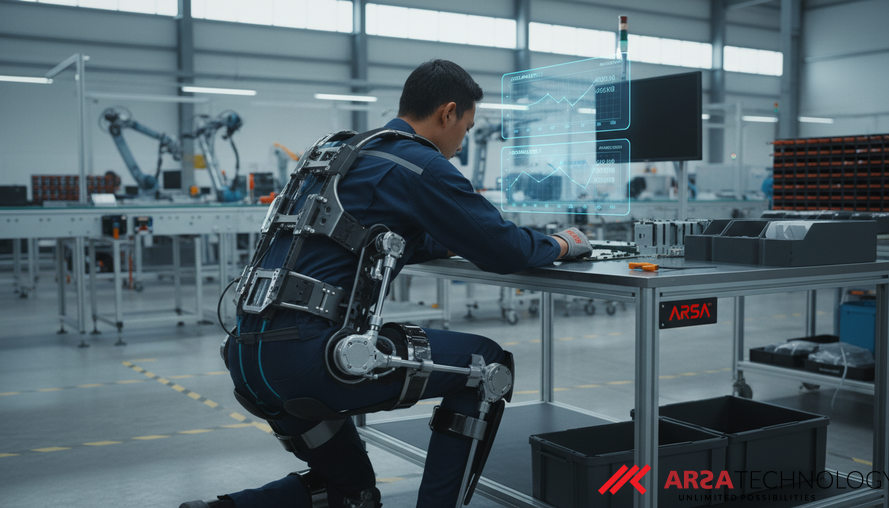
The Pervasive Challenge of Repetitive Squatting in Industry
Squatting is a fundamental lower-limb movement, yet its frequent and repetitive execution in industrial and assembly environments poses significant ergonomic challenges. Workers performing tasks that require constant bending, lifting, and repetitive squatting are often subjected to substantial muscular effort and coordination demands. This exposure can lead to elevated musculoskeletal risks, particularly when combined with heavy loads or high repetition rates. The resulting mechanical loading on the knee and hip joints contributes directly to muscular fatigue, increasing the likelihood of overuse injuries and chronic musculoskeletal disorders. These issues not only impact worker health but also lead to reduced productivity, increased absenteeism, and higher operational costs for enterprises.
Addressing these physical demands is crucial for maintaining a healthy workforce and optimizing operational efficiency. Traditional approaches often involve job rotation or ergonomic redesign, but these might not fully alleviate the strain of inherently demanding tasks. This is where advanced technologies, particularly lower-limb exoskeletons, emerge as promising solutions. While exoskeletons have been investigated for mitigating work-related musculoskeletal disorders (WMSDs), many existing systems rely on static, predefined assistance strategies. Such rigid approaches often fail to account for the vast individual variability among workers—differences in anthropometry, movement patterns, and squatting speeds—limiting their real-world effectiveness. Furthermore, motion at one joint often influences adjacent joints, a complexity frequently overlooked by single-joint control strategies.
Advancing Exoskeleton Control with Reinforcement Learning
To overcome the limitations of traditional, fixed-assistance exoskeletons, a new paradigm is emerging: learning-based control strategies, with reinforcement learning (RL) at the forefront. Unlike systems that follow predefined patterns, RL enables an exoskeleton to learn optimal assistance policies through continuous interaction with its user and environment. This adaptive approach means the exoskeleton can personalize its support, responding to the user's unique biomechanics and real-time needs. Such dynamic adaptability is critical for delivering truly effective and comfortable assistance in diverse industrial scenarios.
Recent research highlights the potential of RL for complex human-exoskeleton interactions. For instance, predictive simulations have been used to optimize assistance, followed by neural network training to map individual parameters to assistive torque profiles. Building on these advancements, a study evaluated an RL-trained neural network controller designed for a modular hip-knee exoskeleton to provide real-time, adaptive assistance during repetitive squatting tasks. This approach signifies a leap towards creating truly intelligent wearable robotics that can seamlessly integrate into various demanding occupational contexts, making human-robot collaboration more efficient and safer.
The Modular Hip-Knee Exoskeleton: Hardware and Integration
At the heart of this innovation is a modular hip-knee exoskeleton, engineered for practical deployment in real-world settings. This backdrivable lower-limb device, weighing approximately 8.5 kg, is designed to deliver medium-level torque support across both the hip and knee joints in the sagittal plane. Its structural frame incorporates an aluminum waist assembly, a semi-rigid back plate, and telescopic carbon-fiber thigh links, ensuring adjustability to accommodate a wide range of body sizes. Comfort and secure fit are prioritized through a soft waist belt, padded shoulder straps, and adjustable thigh cuffs, minimizing relative motion between the user and the device.
The exoskeleton's modular design allows for precise alignment of its actuator axes with the user's anatomical hip and knee joints. Actuation is managed by four integrated motor modules, each comprising a pancake BLDC motor, a planetary reduction gearbox, an embedded field-oriented control driver, and an 18-bit magnetic encoder. While each module can deliver substantial peak torque, assistance in this study was limited to 10 Nm per joint to ensure user comfort and safety. A Raspberry Pi 4B microcomputer runs the real-time neural network controller, communicating with the actuators via a CAN bus. Crucially, anatomical joint kinematics are estimated using inertial measurement units (IMUs) worn by the user, providing true biological joint angles rather than relying solely on motor encoders. This robust hardware foundation, combined with smart sensing, creates a platform capable of intricate and responsive assistance. You can explore how ARSA Technology develops similar sophisticated Custom AI Solutions for demanding environments.
How AI Learns to Assist: The Reinforcement Learning Framework
The intelligence behind the exoskeleton's adaptive assistance comes from a sophisticated reinforcement learning (RL) framework. This framework trains an Exoskeleton Control Network (ECN), which is an independent neural network designed to interact with the human-exoskeleton system within a physics-based simulation. The ECN, akin to an "AI brain," continuously receives input on recent joint-angle and angular-velocity histories from the user's hips and knees. Based on these inputs, it predicts normalized assistive torque outputs for each joint, effectively learning how much and when to assist.
A key aspect of this design is its emphasis on simplifying the "sim-to-real transfer," which is the process of moving an AI model from a simulated training environment to a physical device. This is achieved by modeling the human-exoskeleton interaction as idealized joint-torque assistance and allowing the ECN to directly use human hip and knee joint angles and velocities as its input, obtained via wearable IMU sensors. This independence from device-specific parameters means the controller can potentially be adapted across different exoskeleton platforms, accelerating training and reducing real-world implementation complexity. The ECN's neural network architecture, with multiple hidden layers and specific activation functions, is optimized through supervised learning to produce desired torque profiles, balanced by regularization to prevent excessive force and enforce the natural bilateral symmetry of squatting motions.
Experimental Validation: Measuring Reduced Effort
To assess the practical effectiveness of the RL-based controller, an experimental study was conducted involving five healthy adults. Participants performed three-minute metronome-guided squats under three distinct conditions: (1) without the exoskeleton (No-Exo), (2) wearing the exoskeleton but with zero torque assistance (Zero-Torque), and (3) with the exoskeleton providing active, RL-driven assistance (Assistance). This comparative setup allowed researchers to isolate the impact of the intelligent assistance.
Physiological effort, a critical metric for evaluating physical strain, was meticulously assessed using indirect calorimetry to measure net metabolic rate and concurrent heart rate monitoring. The results were compelling: the active assistance condition led to an approximate 10% reduction in net metabolic rate when compared to both the Zero-Torque and No-Exo conditions. Minor reductions in heart rate were also observed, further indicating a decrease in overall physiological exertion. While assisted trials did show a minor reduction in squat depth—reflected by smaller hip and knee flexion—the primary finding underscored the controller's ability to adapt and generate personalized torque profiles, significantly lowering the metabolic cost of repetitive squatting. Such data-driven insights are vital for optimizing operational tasks, a focus area for ARSA, which leverages advanced AI Video Analytics and dashboards to monitor real-time performance.
Business Implications: Enhancing Workplace Safety and Productivity
The preliminary findings from this study have significant implications for various industries, particularly those involving repetitive lower-limb tasks like manufacturing, logistics, and construction. A 10% reduction in metabolic effort, along with adaptive, personalized assistance, translates directly into tangible business benefits:
- Reduced Musculoskeletal Injuries: Lower physiological strain means less fatigue, directly mitigating the risk of WMSDs and chronic injuries. This leads to fewer worker compensation claims, reduced medical costs, and a healthier workforce.
- Increased Productivity and Endurance: Workers can perform demanding tasks for longer periods with less exertion, maintaining consistency and quality throughout their shifts. This directly boosts overall productivity.
- Improved Worker Morale and Retention: Providing advanced tools that protect worker health can significantly enhance job satisfaction and reduce turnover in physically demanding roles.
- Enhanced Compliance and Safety Records: Deploying such exoskeletons can help companies meet stringent safety regulations and improve their occupational health and safety records.
- Adaptive Solutions for Diverse Workforces: The RL-based controller's ability to adapt to individual kinematics means it can effectively support a diverse workforce, addressing variations in body size, strength, and movement patterns without complex manual recalibration.
- Future-Proofing Operations: Investing in AI-powered wearable technology positions enterprises at the forefront of Industry 4.0, fostering innovation and creating more intelligent, human-centric workplaces.
The Future of Adaptive Robotic Assistance
This research marks a significant step towards realizing the full potential of AI-powered exoskeletons in occupational settings. The demonstrated ability of a reinforcement learning controller to adapt to individuals and reduce metabolic effort during squatting opens doors for more widespread adoption of intelligent assistive robotics. While the initial findings are promising, ongoing development will focus on refining hardware design for even greater comfort and range of motion, improving control strategies to maintain natural movement patterns, and expanding the scope of assistance to other demanding industrial movements.
As technology progresses, future iterations of these systems could integrate with larger IoT ecosystems for predictive maintenance of the exoskeletons themselves, or leverage advanced sensors for even more granular understanding of human biomechanics. These advancements will continue to reduce physical demands on workers, fostering safer, more productive, and sustainable industrial environments. Organizations seeking to implement such transformative AI and IoT solutions to optimize their operations and enhance workplace safety can explore ARSA Technology's offerings and contact ARSA for a free consultation.
Source: Ratnakumar, N., Tohfafarosh, M. H., Jauhri, S., & Zhou, X. (2026). Reinforcement-Learning-Based Assistance Reduces Squat Effort with a Modular Hip–Knee Exoskeleton. arXiv preprint arXiv:2602.17794. https://arxiv.org/abs/2602.17794