AI-Powered Image Dehazing: Revolutionizing Clarity in Non-Homogeneous Environments
Discover how multi-branch AI networks are overcoming the challenges of non-homogeneous haze, delivering unprecedented image clarity for critical enterprise applications like autonomous driving and surveillance.

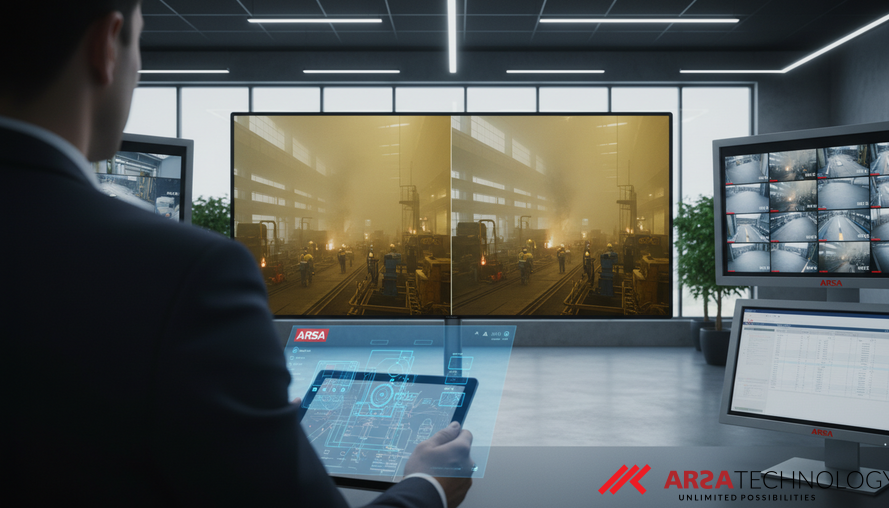
The Critical Challenge of Haze in Computer Vision
Outdoor environments often present significant visual hurdles for both human observers and advanced computer vision systems. Phenomena like smoke, dust, and particularly haze, can severely degrade image quality, obscuring critical details, distorting colors, and diminishing structural contrast. This degradation isn't merely an aesthetic issue; it has profound operational impacts across various industries. For instance, in autonomous driving, hazy conditions can compromise the detection of obstacles and road signs, posing serious safety risks. Similarly, in remote sensing and surveillance, compromised image clarity leads to inaccurate object recognition and monitoring, affecting security, public safety, and operational efficiency. The need for robust image dehazing has thus become a foundational preprocessing step for many real-world visual systems, ensuring that downstream tasks can operate effectively.
Early approaches to image dehazing often relied on physics-based models, such as the atmospheric scattering model (ASM), which mathematically describes how haze forms and affects light. Pioneering methods like the "dark channel prior" (DCP) used statistical observations about haze-free images to estimate haze density and remove it. These techniques, though innovative for their time, were constrained by their reliance on human-defined rules and often struggled to adapt to the complex, diverse conditions found in real-world scenarios. The rise of deep learning, particularly convolutional neural networks (CNNs), significantly advanced the field, allowing systems to learn directly from data how to remove haze, often by predicting components of the atmospheric model or by directly mapping hazy images to clear ones. However, even these advanced methods faced a common, critical limitation.
Beyond Uniform Haze: The Non-Homogeneous Reality
Despite the remarkable progress in deep learning-based image dehazing, most existing solutions operate under a key assumption: that haze is uniform across an entire image. This "homogeneous haze" assumption rarely holds true in real-world settings. Imagine a scene where a distant cityscape is shrouded in dense fog, while a foreground building is only lightly obscured, and a patch of clear sky breaks through above. This is "non-homogeneous haze"—where haze concentration varies dramatically and unpredictably across different spatial locations, with abrupt density transitions. Models designed for dense haze tend to over-enhance regions with light haze, leading to artificial artifacts. Conversely, models optimized for light haze fail to adequately restore heavily obscured areas. This fundamental mismatch between model design and environmental reality presents a significant challenge for truly practical, production-ready dehazing solutions.
Addressing this complexity requires a new paradigm, moving beyond single-pathway processing that treats every pixel uniformly. The real world demands a nuanced approach that can identify and adapt to varying haze levels within a single frame. This adaptive capability is crucial for systems that require high fidelity and reliability, whether in monitoring critical infrastructure, ensuring safety compliance, or enabling advanced automation. A solution that can intelligently segment and process areas based on their specific haze characteristics would unlock unprecedented levels of clarity and reliability for AI Video Analytics across diverse applications.
CPIFNet: A Multi-Branch Approach to Dehazing
To tackle the inherent limitations of conventional dehazing methods, a novel framework known as the Concentration Partitioning and Image Fusion Network (CPIFNet) has been proposed. The core innovation of CPIFNet, detailed in the academic paper "Multi-Branch Non-Homogeneous Image Dehazing via Concentration Partitioning and Image Fusion," lies in its ability to decompose the complex problem of non-homogeneous dehazing into a series of more manageable "homogeneous sub-problems." This approach is rooted in the insight that even a seemingly non-homogeneous hazy image can be understood as a composite of multiple local regions, each exhibiting its own, approximately uniform haze characteristics. By breaking down the problem this way, CPIFNet can apply targeted, specialized restoration to different parts of an image.
The framework employs a sophisticated two-stage architecture: the Image Enhancement Network (IENet) stage and the Image Fusion Network (IFNet) stage. This modular design allows for specialized processing at different levels, mirroring how a human might instinctively focus on different areas of a hazy scene to discern details. This multi-branch strategy is a significant leap from previous methods, which often tried to force a single solution onto a multi-faceted problem. For organizations deploying AI systems in dynamic, unpredictable outdoor conditions, this capability translates directly into more reliable data, improved decision-making, and enhanced operational integrity.
How CPIFNet Works: Stages of Intelligent Restoration
The first stage of CPIFNet involves multiple IENet branches. Each of these branches is independently trained on datasets containing homogeneous haze of different concentration levels. This means one branch might become an expert at clearing light haze, another at dense fog, and so on. The result is a suite of enhancement models, each specifically tuned to excel at restoring regions that match its particular haze density. When a non-homogeneous image is input, each IENet branch generates its own dehazed version, effectively producing multiple "expert opinions" on how to clear the image, each strong in specific areas based on haze concentration.
In the second stage, the IFNet takes these multiple enhanced outputs from the IENet branches and intelligently aggregates them. Through a process called deep feature stacking and merging, the IFNet identifies and combines the "advantageous regions" from each IENet output. This is akin to piecing together the best parts from several attempts to create a single, superior result. The IFNet doesn't just average the outputs; it learns to discern which parts of each IENet's restoration are most accurate and visually appealing, especially at boundaries where haze concentrations shift dramatically. This intelligent fusion produces a unified, high-quality dehazed image that maintains structural contrast and natural color reproduction across all regions, regardless of the original haze variability. The entire process is rigorously supervised by a comprehensive loss function that ensures accuracy in reconstruction, perceptual quality, structural integrity, and color fidelity, leading to superior visual results.
From Theory to Application: Real-World Impact
The capabilities of advanced dehazing technologies like CPIFNet have profound implications for various industries that rely on clear visual data. Consider critical infrastructure monitoring, where security cameras need to detect intrusions or anomalies around the clock, regardless of weather conditions. A system powered by such advanced dehazing can ensure that perimeter security is maintained even when fog rolls in, providing reliable real-time alerts. For example, ARSA Technology, with expertise developed since 2018, leverages advanced AI to provide solutions across various industries, including public safety and defense. The ability to enhance visibility in non-homogeneous hazy environments directly contributes to improved accuracy in identifying threats, ensuring compliance with safety protocols, and supporting robust decision-making.
In smart cities and traffic management, clear vehicle detection, classification, and congestion monitoring are paramount. Haze can severely impede these functions, leading to traffic inefficiencies or delayed emergency responses. Dehazing technology can clarify traffic camera feeds, allowing real-time dashboards to provide accurate information to city operators. Similarly, in industrial and construction settings, where safety is paramount, PPE compliance monitoring and restricted zone detection rely heavily on clear visual input. The precise dehazing of images can enable systems like the AI BOX - Basic Safety Guard to maintain high accuracy in identifying safety violations, reducing accidents, and supporting compliance audits, even under challenging environmental conditions. By providing consistently clear images, these AI-powered solutions lead to tangible ROI through reduced operational risks, enhanced productivity, and optimized resource allocation.
The Technical Edge: Enhancing Accuracy and Fidelity
The efficacy of CPIFNet is not just theoretical; it has been rigorously tested and demonstrated significant improvements over existing state-of-the-art methods. Extensive experiments on both synthetic benchmarks (such as FiveK-Haze, SOTS-indoor, and SOTS-outdoor) and diverse real-world datasets show superior performance. For instance, CPIFNet surpassed the second-best method by 5.29 dB in PSNR (Peak Signal-to-Noise Ratio, a common metric for image quality) on FiveK-Haze, 2.52 dB on SOTS-indoor, and 2.83 dB on SOTS-outdoor. These numerical improvements translate into visibly superior results, characterized by enhanced structural contrast and more natural color reproduction in dehazed images.
This high level of performance is attributable not only to the multi-branch architecture but also to the comprehensive loss function employed during training. This function meticulously incorporates reconstruction loss (ensuring the dehazed image closely matches the original clear image), perceptual loss (focusing on visual quality as perceived by humans), structural loss (preserving edges and forms), and color loss (maintaining true-to-life colors). Such a holistic approach to optimization ensures that the dehazed output is not only technically accurate but also aesthetically pleasing and practically useful for downstream computer vision tasks. The ability to achieve such reliable results across varied and complex haze conditions signifies a major step forward for systems that require consistent clarity, even when deployed at the edge using solutions like the ARSA AI Box Series.
Conclusion: Clearer Vision for a Smarter Future
The advancement of AI-powered image dehazing, particularly solutions like CPIFNet, marks a pivotal moment in computer vision. By intelligently decomposing and fusing information from multi-branch networks, we can now overcome the long-standing challenge of non-homogeneous haze. This breakthrough provides not just clearer pictures, but also more reliable data for mission-critical enterprise applications, from enhancing safety and security to optimizing complex industrial operations. As the demand for robust and dependable AI solutions grows, the ability to deliver high-quality visual intelligence regardless of atmospheric conditions will be a key differentiator.
Source: arXiv:2605.00885
Ready to enhance your operations with cutting-edge AI vision technology that performs in any environment? Explore ARSA Technology's innovative solutions and request a free consultation today.