AI-Powered Material Modeling: Unlocking the Secrets of Ultra-Compressible Hyperelasticity
Explore how data-adaptive AI and spline-based models revolutionize the understanding of complex, ultra-compressible materials, revealing constitutive asymmetries and non-unique representations for enhanced industrial design.

The Challenge of Modeling Next-Gen Materials
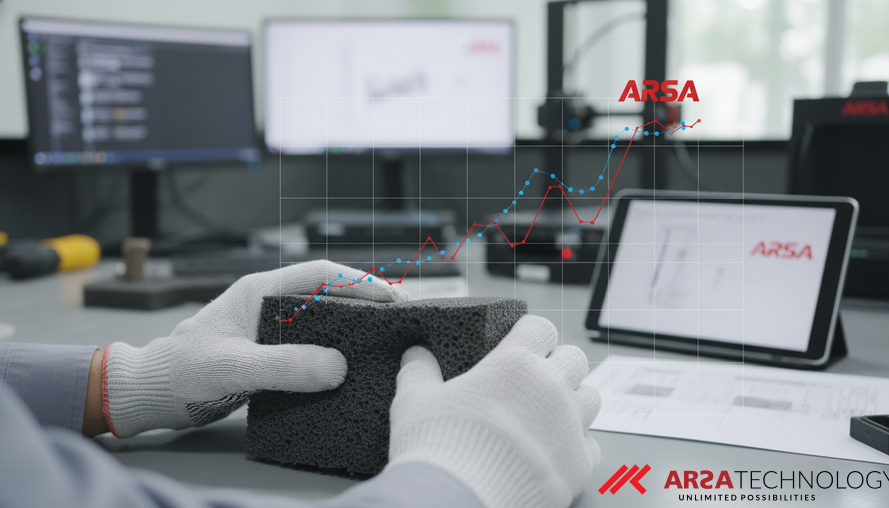
Modern engineering relies heavily on advanced materials, and among the most intriguing are ultra-compressible solids like foams. These materials possess unique properties, such as being extremely lightweight yet capable of absorbing significant energy. However, accurately predicting their behavior under various conditions presents a substantial challenge for engineers and material scientists. One of the most significant complexities is their "tension-compression asymmetry"—meaning a foam behaves very differently when stretched compared to when it's squeezed.
Traditional mathematical models, known as constitutive models, struggle to capture these intricate responses comprehensively. These models are crucial for designing everything from advanced sports equipment, like racing shoes, to safety components in vehicles and infrastructure. Without precise models, predicting material performance, ensuring product reliability, and driving innovation becomes inherently difficult.
Beyond Traditional Models: Data-Adaptive AI for Hyperelasticity
To overcome these limitations, a new wave of data-adaptive methods is emerging, leveraging Artificial Intelligence (AI) to enhance material modeling. The field of hyperelasticity describes materials that can undergo large deformations and still return to their original shape, such as rubber or foam. At its core, a material's hyperelastic behavior is characterized by a strain-energy density function (SEDF), which mathematically defines the energy stored within the material as it deforms. This function is typically expressed in terms of invariants – mathematical descriptions of how a material's shape and volume change. These include isochoric invariants, describing shape changes without volume alteration, and the Jacobian (J), which quantifies volumetric change.
Rather than relying on fixed, predefined equations, researchers are now employing tools like spline-based SEDFs. Splines are flexible mathematical curves that can adapt themselves precisely to experimental data. This "data-adaptive" approach, akin to advanced forms of supervised learning, allows for a much more accurate representation of complex material responses than was previously possible with rigid, low-parameter formulations. This method is explored in a recent preprint by Moreno-Mateos et al. (2026), demonstrating its power in modeling elastomeric foams. Such data-driven approaches are a cornerstone of custom AI solutions that transform raw data into actionable insights for diverse applications.
Unmasking Non-Uniqueness in Material Behavior
One surprising, yet critical, finding in advanced material modeling is the phenomenon of "non-uniqueness." This means that multiple, seemingly different, constitutive models—each with its own mathematical structure—can explain the same observed stress-strain behavior of a material with almost identical accuracy. This isn't a flaw in the models but rather an intrinsic characteristic, particularly when experimental data might not fully probe all possible deformation modes a material can undergo.
The traditional response has often been to try and "prune" or hide this non-uniqueness. However, the latest research suggests that exposing it is far more informative. It helps engineers understand which aspects of a material's behavior are truly revealed by existing experiments and which remain open to interpretation. This perspective shifts the focus from finding a single "correct" model to understanding the inherent ambiguities and using them diagnostically to improve experimental design and model robustness. For enterprises seeking to apply AI to complex physical systems, understanding such fundamental modeling challenges is vital for building reliable and interpretable solutions across various industries.
The Critical Role of Volumetric-Isochoric Coupling
A key insight from studying ultra-compressible materials is the necessity of "coupling terms" within their strain-energy density functions. While some models treat shape change (isochoric deformation, represented by invariants like ¯I1 and ¯I2) and volume change (volumetric deformation, represented by J) as independent, this simplification often fails for materials like foams. For these highly deformable solids, how they change shape significantly influences how they respond to volume changes, and vice-versa.
The research highlights that terms coupling these effects, such as Ψ(¯I1, J) or Ψ(¯I2, J), are not mere mathematical refinements; they are essential for the model to accurately capture the pronounced tension-compression asymmetry. These coupling terms provide the constitutive mechanism for the material to "know" whether it is being stretched or compressed, allowing for a more nuanced and accurate prediction of its behavior under diverse load paths. Without them, models tend to be too stiff or simply fail to represent antagonistic deformation modes consistently.
Practical Implications for Industrial Innovation and Design
The ability to accurately model materials with complex hyperelastic properties has profound implications across numerous industries. For product designers, this means creating more durable, safer, and higher-performing products. In sectors such as automotive, aerospace, and medical devices, where materials must withstand extreme conditions and critical failures are unacceptable, precise material characterization is paramount. For example, understanding the exact response of a foam in a car seat or helmet can directly impact passenger safety.
Beyond product design, these advanced modeling techniques also bolster manufacturing processes and quality control. By leveraging powerful tools like AI Video Analytics, manufacturers can monitor material integrity and predict potential weaknesses, leading to enhanced quality assurance and reduced waste. The insights gained from highly data-adaptive models can also inform the development of entirely new smart materials with tailor-made properties, driving a new era of industrial innovation and competitive advantage.
ARSA's Approach to Advanced AI/IoT Solutions
At ARSA Technology, we recognize the critical role that advanced AI and IoT play in transforming complex industrial challenges into intelligent solutions. Our expertise in Artificial Intelligence, including predictive analytics and computer vision, positions us to help enterprises navigate the intricacies of material science and engineering. We specialize in designing and deploying production-ready AI systems that move beyond theoretical experimentation to deliver measurable impact in real-world operational environments.
Our philosophy aligns with the principles of data-adaptive modeling: leveraging sophisticated AI algorithms to extract deep insights from complex data, enabling precise predictions and optimizing performance. Whether it’s through custom AI solutions for complex simulations or edge AI systems for real-time monitoring, we focus on engineering reliable, scalable, and privacy-by-design technologies that address specific business outcomes, from cost reduction to enhanced security and new revenue streams.
Conclusion: Engineering the Future with Intelligent Material Insights
The journey to truly understand and predict the behavior of advanced materials like ultra-compressible foams is complex, but the advent of data-adaptive AI techniques, such as spline-based hyperelasticity models, marks a significant leap forward. By embracing approaches that expose constitutive asymmetries and non-unique representations, we gain a more honest and comprehensive view of material mechanics. This understanding is not just academic; it directly translates into tangible benefits for industry, driving innovation, enhancing product reliability, and optimizing operational efficiency. As industries push the boundaries of material science, the fusion of AI and advanced engineering will be indispensable in shaping the future of product development and industrial automation.
To learn more about how intelligent AI/IoT solutions can transform your operations and address your specific material modeling or industrial challenges, do not hesitate to contact ARSA for a free consultation.