AI-Powered Orchestration: Revolutionizing Industrial Design with Closed-Loop CAD-CAE Optimization
Discover how AI-augmented agents are bridging the CAD-CAE semantic gap, enabling robust, closed-loop optimization in industrial design. Learn about COSMO-Agent's innovations for efficient, constraint-driven engineering.

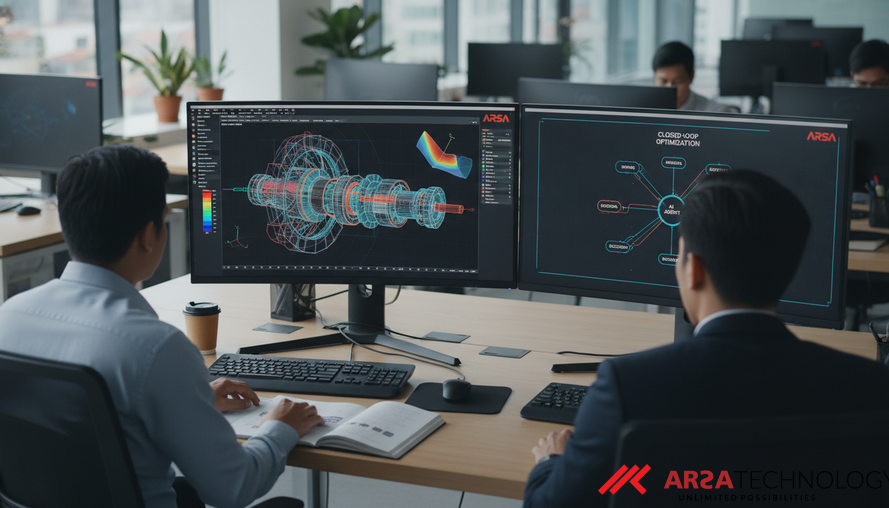
In the intricate world of modern industrial design, creating functional components often involves a complex, iterative dance between conceptualization and validation. Engineers use Computer-Aided Design (CAD) software to define precise geometries and then rely on Computer-Aided Engineering (CAE) tools for physics-based simulations, like finite element analysis, to verify performance. This continuous cycle of design, simulate, and revise is critical but notoriously slow and prone to bottlenecks. The core challenge lies in the "CAD-CAE semantic gap" – the difficulty in translating detailed simulation feedback into practical, executable modifications to the parametric CAD model, especially when dealing with diverse, interconnected constraints and the frequent failures of software toolchains.
Traditional automation methods have only partially addressed this issue. While derivative-free optimizers can adjust parameters to meet objectives, they often overlook the crucial aspects of design executability and the ability to recover from unexpected tool failures. Similarly, advanced differentiable or surrogate-based methods, while efficient, frequently use approximations that might not align with real-world production CAD-CAE pipelines and often fail to produce history-consistent, executable edits in native parametric CAD software. This ongoing struggle transforms what should be a straightforward optimization problem into a lengthy, sequential decision-making process burdened by hard executability constraints and unpredictable tool malfunctions. The academic paper "Tool-Augmented Agent for Closed-loop Optimization, Simulation, and Modeling Orchestration" (Deng et al., 2026) introduces a groundbreaking solution to this industry-wide challenge.
Bridging the CAD-CAE Semantic Gap with AI Agents
The concept of "tool-augmented agents" offers a promising path forward. These are sophisticated Artificial Intelligence (AI) agents, often powered by Large Language Models (LLMs), that can understand natural language instructions and orchestrate external software tools to achieve complex objectives. Instead of attempting to perform every task intrinsically, these agents learn to effectively use specialized tools, much like an engineer leverages a suite of software. In the context of industrial design, this means an LLM can be taught to interact with CAD software, CAE simulators, result parsers, and other utilities, effectively extending its capabilities beyond text generation to real-world engineering tasks.
The key innovation lies in casting the entire iterative design process – from CAD generation and CAE solving to result parsing and geometry revision – as an interactive reinforcement learning (RL) environment. In this setup, an LLM acts as a central "agent" that learns through trial and error. It proposes design edits, which are then fed into the CAD tool for validation and subsequently into CAE for simulation. The agent receives feedback from these tools, including performance metrics and any errors encountered, and uses this information to refine its next set of actions. This closed-loop system allows the AI to iteratively improve designs until all specified constraints, such as structural integrity, material properties, or manufacturing costs, are satisfied.
Introducing COSMO-Agent: A Framework for Robust Design
At the heart of this advancement is COSMO-Agent (Closed-loop Optimization, Simulation, and Modeling Orchestration), a novel framework that directly addresses the persistent challenges of reliability and industrial applicability in design automation. The developers behind COSMO-Agent understood that for an AI system to be truly useful in industrial settings, it needed to be robust not only in generating designs but also in navigating the complex and often unpredictable landscape of real-world engineering software.
To achieve this stability and industrial usability, COSMO-Agent employs a unique multi-constraint reward function during its training. This reward system doesn't just encourage finding a feasible design; it jointly optimizes for three critical aspects:
- Feasibility: Ensuring the design actually meets all specified engineering and performance constraints.
- Toolchain Robustness: Teaching the agent to successfully execute the entire toolchain (CAD, CAE, parsing) and, crucially, to recover gracefully from common failures like regeneration breakdowns, meshing errors, or solver non-convergence. This is vital in an environment where unexpected errors are a reality.
- Structured Output Validity: Guiding the agent to produce design edits that are not only numerically favorable but also structurally valid and executable within the parametric CAD framework. This prevents "reward hacking," where an AI might find a theoretically good solution that cannot be practically implemented.
This comprehensive approach allows COSMO-Agent to learn how to operate effectively even in partially reliable pipelines, turning traditional hurdles into opportunities for the AI to learn resilience and adaptability.
Real-World Application and Impact
The practical implications of COSMO-Agent are substantial for industries reliant on complex design and simulation workflows. By automating the iterative design-simulate-optimize cycle, companies can significantly accelerate product development, reduce engineering costs, and achieve higher-performing designs. For instance, in manufacturing, this could mean faster iteration on component designs to improve durability or reduce material usage. In smart city infrastructure, it could optimize the structural integrity of new urban elements or the flow dynamics of traffic systems.
ARSA Technology, as an AI & IoT solutions provider, understands the demand for practical AI deployed with measurable impact. Our custom AI solutions are built to address mission-critical operational challenges, similar to how COSMO-Agent tackles the intricacies of industrial design. We leverage deep expertise in computer vision, industrial IoT, and data analytics to design systems that work in the real world, ensuring accuracy, scalability, and operational reliability, mirroring the principles embedded in advanced AI orchestration frameworks.
Benchmarking and Performance
To truly validate COSMO-Agent's capabilities and ensure its relevance to industry, the researchers contributed an extensive, industry-aligned benchmark dataset. This dataset comprises approximately 20,000 executable CAD-CAE tasks spanning 25 different component categories. Each task comes with an initial parametric CAD model, a specific toolchain configuration, and a range of constraints (physics, geometry, and cost). Importantly, the benchmark includes standardized interfaces and fixed budgets for tool calls and retries, allowing for rigorous and reproducible evaluation of an agent's performance across key metrics: feasibility, efficiency (number of iterations and tool calls), and stability (ability to recover from failures).
Experiments using this benchmark showed compelling results. COSMO-Agent training significantly enhanced the performance of small open-source LLMs, allowing them to surpass both larger open-source models and even strong closed-source alternatives in terms of feasibility, efficiency, and stability under the specified protocol. This indicates that the strategic combination of reinforcement learning, tool augmentation, and a robust reward function can unlock superior performance even with more modest computational resources. Such breakthroughs enable AI to reliably automate complex engineering workflows, turning passive design specifications into active intelligence.
For enterprises looking to integrate advanced AI into their operations, solutions leveraging principles of edge AI and real-time analytics are crucial. ARSA Technology's ARSA AI Box Series and AI Video Analytics software are examples of systems designed for on-premise processing and immediate insights, without cloud dependency, ensuring data privacy and low latency in critical environments—qualities essential for the robust, real-time feedback loops discussed in the COSMO-Agent framework.
The Future of Design Automation
The development of tool-augmented agents like COSMO-Agent marks a significant step towards a more autonomous and efficient future for industrial design. By explicitly modeling complex tool interactions, handling stochastic failures, and optimizing for real-world executability, these AI systems are poised to revolutionize how functional components are conceived, iterated upon, and brought to market. They empower engineers to focus on higher-level innovation, leaving the iterative and often frustrating optimization loops to intelligent automation.
ARSA Technology has been experienced since 2018 in developing and deploying production-ready AI and IoT systems that solve real operational problems and drive measurable impact. Our expertise aligns with the strategic approach of integrating AI intelligence into core business functions, ensuring that technology serves as a true competitive advantage.
To explore how advanced AI and IoT solutions can transform your industrial design and operational processes, we invite you to contact ARSA for a free consultation.
**Source:** Deng, L., Deng, S., Chen, Y., Dai, Y., Zhong, Z., Li, L., Sun, X., Shi, Y., & Huang, H. (2026). Tool-Augmented Agent for Closed-loop Optimization, Simulation, and Modeling Orchestration. arXiv preprint arXiv:2605.20190. https://arxiv.org/abs/2605.20190