AI-Powered Planetary Discovery: Revolutionizing Crater Analysis with Instance Retrieval
Explore CraterBench-R, a new benchmark revolutionizing planetary crater analysis using AI for instance-level retrieval. Learn how Vision Transformers and efficient token aggregation enhance discovery.

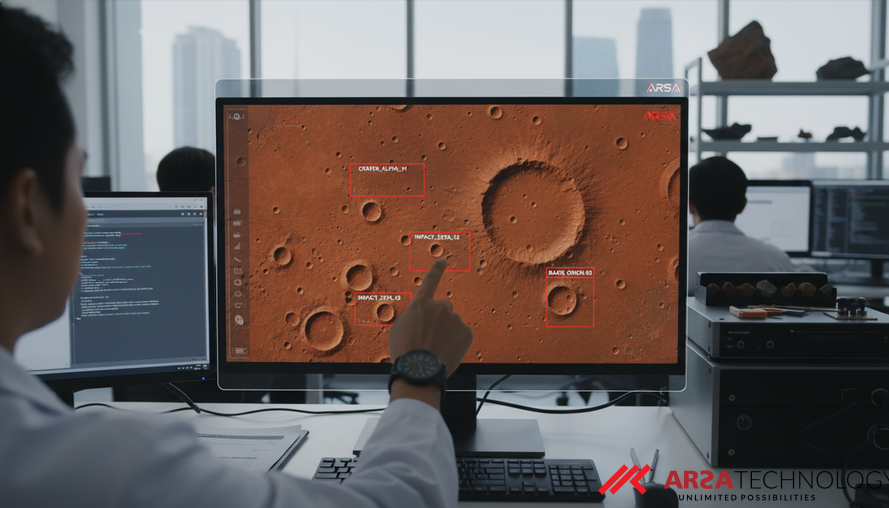
Beyond Crater Detection: The Next Frontier in Planetary Science
Impact craters are fundamental to understanding the geological history and age of planetary surfaces. While traditional deep learning methods have made significant strides in merely detecting craters—identifying their locations and sizes—the true depth of scientific inquiry demands more sophisticated analysis. Planetary scientists need to perform complex tasks such as cross-referencing craters across different observations, deduplicating entries in vast catalogs, and finding craters with similar geological features. These operations are inherently retrieval tasks, not just detection.
The sheer volume of modern orbital imaging, capturing millions of crater-like structures with immense variations in size, illumination, and preservation states, has overwhelmed manual analysis capabilities. This challenge underscores the critical need for advanced AI methodologies. A recent academic paper, "CraterBench-R: Instance-Level Crater Retrieval for Planetary Scale" (source: arXiv:2604.06245), addresses this by reframing crater analysis as an instance-level image retrieval problem. It introduces a novel benchmark and innovative AI techniques to meet the demands of planetary-scale analysis.
CraterBench-R: A New Benchmark for Instance Retrieval
To systematically study and advance instance-level crater retrieval, researchers developed CraterBench-R. This benchmark is a meticulously curated dataset specifically for Mars CTX imagery, featuring approximately 25,000 unique crater identities and 50,000 gallery images that capture craters in multi-scale contexts. Crucially, it includes 5,000 manually verified multi-view queries designed to stress test AI systems against extreme variations in scale and environmental conditions.
The focus on instance retrieval—matching different images of the exact same physical crater—provides an objective, unambiguous ground truth for evaluation. This contrasts with more subjective tasks like analog retrieval (finding morphologically similar craters), which, while scientifically valuable, are harder to benchmark consistently. CraterBench-R paves the way for AI models to not only locate craters but to understand their unique identities across a planet's surface, enabling more accurate and efficient scientific workflows.
The Challenges of Planetary-Scale Data
Retrieving specific crater instances from orbital imagery presents profound challenges. Martian craters, for example, exhibit extreme visual complexity. This complexity stems from diverse degradation states—ranging from pristine, sharp rims to heavily eroded structures—and various infilling mechanisms, such as sand dunes, dust, or lava. Furthermore, radical illumination changes between different orbital passes can drastically alter a crater's appearance, making it difficult for AI to recognize the same feature. These structural and photometric variations, compounded by large scale shifts and the scarcity of repeat observations, create a challenging environment for conventional AI models.
Initial evaluations on CraterBench-R revealed a critical bottleneck in applying general AI models to planetary science retrieval. Standard approaches, which collapse detailed visual information from Vision Transformers (ViTs) into a single, compact "global descriptor," significantly limit accuracy. This compression, often done via techniques like CLS token pooling or Generalized Mean (GeM) pooling, discards too much spatial detail, effectively putting a low ceiling on retrieval performance. Furthermore, attempts to fine-tune these models using standard supervised metric learning often degrade accuracy, likely because the limited number of distinct views per crater in the dataset provides insufficient diversity for effective representation learning.
Unlocking Detail with Vision Transformers and Token-Level Matching
To overcome the limitations of heavily compressed visual descriptors, the research highlights the effectiveness of Vision Transformers (ViTs). Unlike traditional convolutional neural networks (CNNs), ViTs process images by dividing them into "patches" and treating each patch as a "token," similar to how words are treated in natural language processing. This token-based approach allows the model to retain a rich set of detailed local features.
The key to achieving higher accuracy lies in late-interaction matching. Instead of compressing all these individual patch tokens into a single summary vector for comparison, late-interaction matching involves comparing a multitude of these detailed tokens from one crater view against another. This granular comparison dramatically improves retrieval accuracy because it preserves fine spatial details crucial for recognizing the same physical crater despite drastic changes in appearance. However, storing all 196 tokens (a typical number for a single image) for every crater at a planetary scale quickly becomes computationally and storage-wise inefficient, posing a significant operational challenge for real-world deployment.
Innovating for Efficiency: Training-Free Instance-Token Aggregation
To bridge the gap between efficiency and accuracy, the researchers propose a novel, training-free method called instance-token aggregation. This innovative pipeline compresses the dense ViT patch tokens into a much smaller set of highly discriminative "instance tokens" (K ≪ 196) without the need for extensive retraining. The process is deterministic and operates on frozen features, meaning it doesn't need to learn new parameters, thus avoiding the pitfalls of fine-tuning on limited planetary views.
Instance-token aggregation works by first selecting 'K' salient "seed tokens" that represent key features of the crater. The remaining tokens are then assigned to these seeds based on their cosine similarity, effectively clustering similar visual elements. Each cluster is then aggregated into a single representative token. This method elegantly preserves local crater morphology without the blurring effect often seen with classical K-means clustering centroids. For example, at K=16, this aggregation boosts mean average precision (mAP) by an impressive +17.9 points over raw token selection. Even more remarkably, at K=64, it can match the accuracy of using all 196 tokens while requiring significantly less storage. This innovation is critical for making planetary-scale retrieval feasible, delivering near-dense token accuracy at a fraction of the storage footprint and search time. For organizations needing advanced, efficient AI for image analysis, ARSA Technology offers AI Video Analytics and custom AI solutions that can incorporate such sophisticated feature extraction and aggregation techniques.
A Practical Pipeline for Planetary-Scale Retrieval
Implementing dense-token matching across a planetary-scale database is prohibitively expensive for a first-stage search. To address this, the paper introduces a practical two-stage retrieval pipeline. The first stage employs a highly efficient single-vector shortlisting mechanism, such as FAISS (Facebook AI Similarity Search). This stage quickly filters down the massive database to a manageable candidate set using the compact global descriptors that, while less accurate on their own, are fast to search.
In the second stage, instance-token reranking is performed on this small candidate set. This involves the more detailed, late-interaction matching using the efficiently aggregated instance tokens. This two-stage approach effectively recovers 89-94% of the accuracy achieved by an exhaustive, full late-interaction search, while only requiring a detailed analysis of a small subset (e.g., S=100 candidates) of the database. At a slightly larger candidate set of S=500, accuracy can reach up to 96%. This pipeline delivers millisecond-scale per-query latency and demonstrates remarkable robustness to data compression, proving its viability for real-world operational deployments. Companies seeking robust and efficient edge AI systems for similar high-volume, low-latency applications might explore the capabilities of the ARSA AI Box Series, designed for on-site processing.
Broader Implications for GeoAI and Beyond
The methodology developed in CraterBench-R extends far beyond the realm of planetary science. It addresses a general challenge in GeoAI—the application of AI to geospatial data—specifically, how to scale instance-level retrieval over vast embedding corpora produced by powerful geo-foundation models. The techniques—late-interaction matching, deterministic post-hoc token compression, and a two-stage coarse-to-fine search strategy—are domain-agnostic.
This means they are directly applicable to a wide array of Earth observation tasks, including:
- Change Detection: Identifying specific changes in landscapes over time.
- Scene Deduplication: Ensuring unique identification of geographic locations across different images.
- Geographic Localization: Pinpointing exact locations with high precision.
Mars served as an ideal testbed because it isolates the retrieval challenge under extreme domain shifts, free from terrestrial confounders like seasonal variation, cloud cover, or label noise. This makes the developed pipeline exceptionally robust, proving its resilience when confronted with visually complex and unfamiliar geographies. Such robust AI capabilities are crucial for global enterprises seeking reliable and scalable solutions across various industries, from environmental monitoring to logistics. The pipeline’s ability to generalize ensures that frozen ViT features can be matched efficiently at scale in virtually any environment.
Conclusion
The CraterBench-R benchmark and its accompanying methodologies mark a significant leap forward in AI-powered planetary surface analysis. By moving beyond simple detection to sophisticated instance-level retrieval, and by developing efficient, training-free token aggregation and a practical two-stage retrieval pipeline, researchers have paved the way for faster, more accurate, and operationally feasible scientific discovery. These advancements hold immense potential not only for exploring distant worlds but also for enhancing critical Earth observation applications, setting a new standard for GeoAI scalability and precision.
For enterprises looking to implement advanced AI and IoT solutions, whether for complex environmental monitoring, industrial automation, or secure identity management, ARSA Technology provides production-ready systems engineered for accuracy, scalability, and privacy. To learn how these cutting-edge AI capabilities can be tailored to your specific operational needs, we invite you to contact ARSA for a free consultation.