AI-Powered Sepsis Prediction: Revolutionizing ICU Care with Federated Learning and Knowledge Graphs
Discover how ARSA Technology is leveraging federated learning, knowledge graphs, and temporal transformers for early sepsis prediction in ICUs, ensuring patient privacy and superior accuracy.

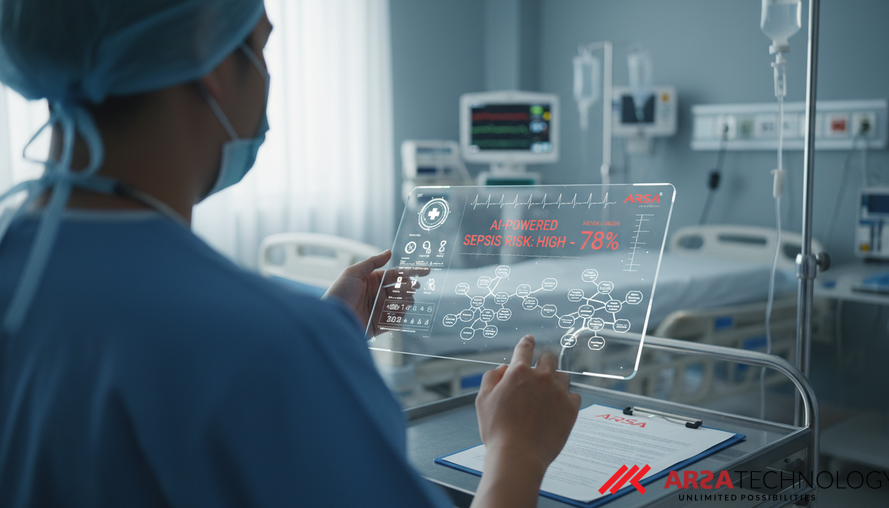
Sepsis remains a critical, life-threatening condition in Intensive Care Units (ICUs) globally, demanding rapid detection and intervention to improve patient survival rates. Its insidious nature, coupled with the fast-deteriorating health of patients, makes early and accurate prediction a cornerstone of modern critical care. However, efforts to develop advanced predictive models have historically faced significant hurdles, primarily centered around data access and patient privacy.
The Challenge of Early Sepsis Prediction in ICUs
The challenge in combating sepsis begins with its complexity. It is a severe organ dysfunction triggered by a dysregulated response to infection, where every hour of delayed treatment dramatically increases mortality risk. Traditional diagnostic methods can be slow, making predictive tools invaluable. Yet, creating highly accurate AI models for sepsis prediction is complicated by two major obstacles: data fragmentation and stringent privacy regulations. Patient data is often siloed across different hospitals and healthcare systems, meaning a single institution rarely possesses enough diverse data to train a robust, generalizable AI model. Simultaneously, strict data privacy laws, such as GDPR and HIPAA, rightfully restrict the sharing of raw patient information across these institutions, making centralized data pooling—a common approach for AI training—ethically and legally problematic.
While standard federated learning (FL) offers a promising distributed training paradigm that maintains data locality, it often falls short in fully capturing the rich, structured relationships between various clinical concepts and the complex, irregular temporal dynamics inherent in ICU data streams. These nuances are essential for high-fidelity sepsis prediction. To truly harness AI's potential in this area, a more sophisticated, holistic approach is required—one that addresses privacy, clinical semantics, temporal patterns, and the inherent heterogeneity of data across different medical centers.
A Novel Framework for Privacy-Preserving AI in Healthcare
Addressing these critical limitations, a novel framework has been proposed that synergistically combines four advanced AI components: federated learning, medical knowledge graphs, temporal transformers, and meta-learning. This integrated system is designed to overcome the "data silo" problem and privacy concerns while enhancing the predictive power and adaptability of AI models for early sepsis detection in multi-center ICUs. This comprehensive integration creates a robust system capable of handling data privacy, understanding complex clinical semantics, capturing temporal dynamics, and adapting to the unique characteristics of each hospital’s data.
The core innovation lies in enriching patient representations not just with raw clinical data, but with a deep understanding of medical relationships, and then processing this information to detect subtle, time-sensitive patterns. This approach sets a new standard for collaborative AI in healthcare, enabling institutions to contribute to powerful predictive models without ever compromising sensitive patient information. For organizations seeking to deploy cutting-edge, secure AI in their operations, exploring specialized custom AI solutions is a crucial step.
How the Integrated AI System Works
The framework's power comes from the thoughtful integration of its distinct components, each addressing a specific challenge in medical data analysis:
- **Federated Learning: Collaborative AI for Data Privacy**
At its foundation, the system employs federated learning, a distributed machine learning paradigm. Instead of pooling all patient data into a central server, each hospital trains a local AI model using its own patient data. Only the updates or parameters of these local models are shared with a central server, not the raw, sensitive patient information. This ensures patient privacy and compliance with regulations. The server then aggregates these updates to create a global model, which is sent back to the local hospitals for further training. This iterative process allows for continuous learning and improvement across the network without any institution exposing its proprietary data. This concept is a cornerstone of modern privacy-preserving AI.
- **Medical Knowledge Graphs: Adding Clinical Context**
Clinical data, while abundant, often lacks explicit connections between different medical concepts. To enrich this, the framework incorporates a medical knowledge graph. Imagine this as a sophisticated, structured dictionary of medical entities—diseases, symptoms, medications, lab tests—and the defined relationships between them. By integrating information from established medical ontologies like SNOMED CT and ICD-10, the system can understand deeper semantic relationships within patient records. For example, it learns that "tachycardia" is a symptom often related to "sepsis" or that certain "medications" are prescribed for specific "conditions." This contextual understanding helps the AI make more informed predictions, improving interpretability and accuracy, especially given the diverse ways medical data might be structured across different institutions.
- **Temporal Transformers: Understanding Time-Series Data**
ICU patient data is fundamentally time-series data, meaning it changes over time. Vital signs, lab results, and medication administrations all occur at irregular intervals, with frequent missing values. Traditional AI models often struggle to capture long-range dependencies in such "messy" temporal data. The solution uses temporal transformer architectures, which are particularly adept at this task. Inspired by how humans process language, transformers employ a "self-attention" mechanism, allowing the model to weigh the importance of different observations across a patient's entire timeline, regardless of how far apart they occurred. To account for irregular sampling, the model includes learnable temporal encodings that explicitly recognize the time elapsed between measurements, giving it an awareness of the passage of time. ARSA's expertise in AI video analytics showcases similar capabilities in processing complex, time-based visual data for real-time insights.
- **Meta-Learning: Adapting to Local Hospital Nuances**
Even with federated learning, differences in equipment, patient demographics, or clinical practices across hospitals (known as data heterogeneity or non-IID data) can lead to a global model performing sub-optimally at a local site. To counter this, the framework integrates Model-Agnostic Meta-Learning (MAML). This technique trains the global model to be an excellent "learner" itself. It finds an optimal starting point (initialization) for the global model that can then be quickly and efficiently adapted to the specific data distribution of any individual hospital with only a few local training steps. This rapid personalization ensures that the global model performs exceptionally well across all participating institutions.
Proven Performance and Real-World Impact
The efficacy of this advanced framework was rigorously evaluated using two extensive real-world datasets: MIMIC-IV and eICU. The results were compelling, demonstrating superior predictive capabilities for early sepsis detection. The proposed method achieved an impressive Area Under the Curve (AUC) of 0.956. This represents a substantial 22.4% improvement in accuracy compared to conventional centralized models, which centralize all data (and thus compromise privacy), and a 12.7% improvement over standard federated learning approaches that lack the integrated knowledge graph, temporal modeling, and meta-learning components.
These significant performance gains translate directly into tangible benefits for healthcare systems and, most importantly, for patients. Earlier and more accurate sepsis prediction means:
- Improved Survival Rates: Timelier intervention can dramatically reduce mortality.
- Reduced Healthcare Costs: Early treatment can prevent the need for more intensive and prolonged care.
- Enhanced Operational Efficiency: Hospitals can allocate resources more effectively by identifying at-risk patients sooner.
- Reliable, Privacy-Preserving Collaboration: Healthcare institutions can collaboratively build powerful AI models without breaching patient confidentiality, fostering a new era of medical research and development.
ARSA Technology, experienced since 2018, consistently delivers enterprise-grade AI solutions that meet demanding standards for accuracy, scalability, and privacy across various industries.
The Future of Collaborative Healthcare AI
This research, detailed further in the academic manuscript "A federated learning framework with knowledge graph and temporal transformer for early sepsis prediction in multi-center ICUs" (Source: arXiv:2603.15651), paves the way for a future where advanced AI can be deployed responsibly and effectively in highly sensitive domains like healthcare. By seamlessly integrating federated learning for privacy, knowledge graphs for context, temporal transformers for dynamic data understanding, and meta-learning for adaptability, this framework offers a powerful blueprint for developing robust, ethical, and highly accurate predictive models. It highlights how AI can drive significant improvements in patient care, ensuring that life-saving insights are derived from collective intelligence while upholding the highest standards of data protection.
For enterprises and public institutions seeking to leverage the power of advanced AI and IoT solutions for mission-critical applications, ARSA Technology offers expertise in designing and deploying intelligent systems tailored to unique operational realities. To explore how these innovations can transform your operations and to request a free consultation, contact ARSA today.