AI-Powered Video Analytics: Transforming Performance Evaluation in High-Stakes Training
Discover how AI video analytics is revolutionizing training performance evaluation in industries. Get objective insights into skills, teamwork, and compliance from existing CCTV infrastructure.

Revolutionizing Performance Assessment in Complex Training Scenarios
In today's dynamic business landscape, mastering complex operational procedures and ensuring high levels of employee proficiency are paramount. Industries from manufacturing to healthcare rely heavily on effective training to build critical psychomotor skills, enhance situational awareness, and foster seamless team coordination. However, objectively evaluating performance in high-stakes training environments, such as simulating emergency response, heavy equipment operation, or intricate assembly processes, has always presented significant challenges. Traditional assessment methods often fall short, struggling with subjectivity, high costs, and an inability to capture nuanced behavioral data.
Enter AI-powered video analytics, a groundbreaking approach poised to transform how organizations evaluate and refine their training programs. By harnessing the capabilities of advanced computer vision, businesses can now extract deep performance insights from standard video footage, turning passive surveillance into an active data asset. This innovation promises to deliver unprecedented levels of objectivity and detail, leading to more effective training outcomes and a truly data-driven approach to human capital development.
The Limitations of Traditional Training Evaluation
For years, the gold standard for performance evaluation in practical training has involved expert human observers. While invaluable, human observation is inherently subjective, prone to bias, and can miss subtle, yet critical, performance indicators over prolonged periods or across multiple sessions. Scaling this approach for large organizations or frequent drills becomes prohibitively expensive and logistically complex, often requiring a high trainer-to-trainee ratio. Furthermore, traditional methods rarely provide detailed, quantifiable data that can be tracked over time or used for precise feedback.
Alternative sensor-based systems, such as motion capture suits or eye trackers, offer more objective data but come with their own set of drawbacks. These systems are typically costly to procure, require complex setup and calibration, demand specialized personnel for operation and maintenance, and can be intrusive, potentially disrupting the natural flow and realism of the training exercise. Such limitations hinder their widespread adoption, leaving many organizations without a scalable, accurate, and non-intrusive method for performance assessment.
Unlocking Insights from Existing Video Infrastructure
The emergence of sophisticated AI and computer vision models now offers a pragmatic solution to these long-standing challenges. Instead of investing in expensive, specialized sensors, companies can leverage their existing video surveillance infrastructure—their CCTV cameras—to conduct highly detailed performance evaluations. This approach effectively transforms passive video streams into rich sources of actionable data, all without requiring additional hardware or disrupting the training environment.
By processing video feeds through intelligent algorithms, organizations can gain a comprehensive understanding of individual and team performance during drills. This non-intrusive method significantly reduces implementation costs and complexity, making advanced performance analytics accessible for a broader range of applications. Companies like ARSA Technology specialize in deploying advanced AI Video Analytics solutions that turn conventional cameras into powerful tools for data-driven assessment and operational improvement.
How AI Transforms Video into Actionable Performance Data
The core of this transformative approach lies in advanced computer vision. AI models are trained to "see" and interpret human movement and interaction within video frames. This involves several key steps:
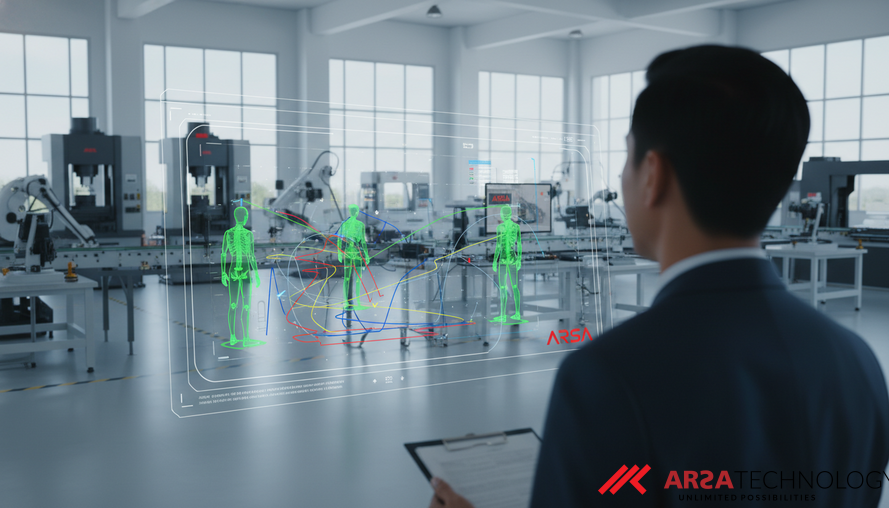
- 2D Skeleton Extraction: The system identifies and tracks key body points, creating a digital "skeleton" for each participant. This allows for precise measurement of posture, movement fluency, and body mechanics.
- Gaze Vector Estimation: AI can analyze head and eye movements to infer where individuals are looking, providing crucial insights into their situational awareness and attention allocation during complex tasks.
- Movement Trajectory Analysis: By tracking the path of each participant over time, the system can map movement efficiency, adherence to protocols, and spatial coordination within a training environment.
These raw data points are then fed into task-specific metrics designed to quantify aspects like psychomotor fluency (how smoothly and efficiently someone moves), situational awareness (how well they perceive their environment), and team coordination (how effectively individuals interact). For instance, in an industrial safety drill, the system can detect if a worker's head is correctly oriented towards a potential hazard or if a team member moves into an unsafe zone. This data-driven approach, often integrated into a Cognitive Task Analysis (CTA) hierarchy, provides objective scores for complex cognitive and teamwork constructs, replacing subjective guesswork with verifiable insights.
Practical Applications Across Diverse Industries
The benefits of video-based performance evaluation extend far beyond military training scenarios, finding invaluable applications across a wide spectrum of industries:
- Manufacturing & Industrial Operations: Training for complex machinery operation, assembly line procedures, and safety protocols can be rigorously assessed. AI can detect deviations from standard operating procedures (SOPs), monitor PPE compliance, and analyze worker movement efficiency to identify bottlenecks or unsafe practices. ARSA's AI BOX - Basic Safety Guard, for example, can automatically detect if personnel are wearing required personal protective equipment.
- Healthcare: Surgical training, emergency room simulations, and patient care drills can be analyzed to improve procedural accuracy, team communication, and critical decision-making under pressure. Gaze tracking can reveal if a surgeon is focusing on the correct area or if a nurse is observing patient vital signs effectively.
- Logistics & Warehousing: Training for forklift operation, inventory management, and loading/unloading procedures can be optimized. AI can identify inefficient movement patterns, potential collision risks, and adherence to safety lanes.
- Construction: Site safety drills, heavy equipment maneuvers, and scaffolding assembly training can be enhanced. The system can monitor worker proximity to hazards, compliance with safety zones, and the correct execution of lifting procedures.
- Emergency Services: Firefighting, search-and-rescue, and disaster response training benefit immensely from objective evaluation of team coordination, tactical movements, and situational awareness in high-stress environments. ARSA also provides VR-based training for industry, offering immersive, risk-free environments to practice such complex scenarios, further complementing video analytics for skill validation.
This comprehensive, data-driven feedback allows organizations to refine training modules, tailor interventions for individual trainees, and significantly improve overall operational safety and efficiency across various industries.
Real-time Feedback and Continuous Improvement
A significant advantage of this video-based assessment pipeline is its ability to provide immediate and objective feedback, particularly valuable for After Action Reviews (AARs). Instead of relying on general recollections, trainers and trainees can review specific video segments highlighted by the AI, showing precisely where protocols were followed or where improvements are needed. This granular feedback, presented through interactive dashboards, makes AARs more impactful, enabling targeted skill refinement and faster knowledge retention.
The automation of performance metrics also addresses the challenge of scalability. Large-scale training programs, previously difficult to assess comprehensively, can now benefit from consistent, objective evaluation across numerous participants and sessions. This continuous data collection allows for long-term trend analysis, helping organizations understand the effectiveness of their training programs over time and make data-backed adjustments to curriculum or methodologies. ARSA Technology has been experienced since 2018 in delivering such impactful AI and IoT solutions.
Overcoming Challenges and Future Horizons
While video-based performance evaluation offers immense potential, it is important to acknowledge ongoing areas of development. Challenges such as ensuring robust tracking in complex, dynamic environments, and rigorous validation of AI-derived metrics against established human expert assessments (ground-truth validation) are critical for widespread adoption. Researchers are continually refining these models to handle occlusions, varying lighting conditions, and diverse human actions with greater accuracy.
Looking ahead, the integration of 3D video data analysis promises even more precise insights into spatial relationships and complex movement patterns. As AI models become more sophisticated, the scope for scalable, automated performance evaluation within synthetic training environments will continue to expand. This continuous evolution means that businesses can look forward to increasingly powerful tools to optimize their workforce's skills, ensure compliance, and drive productivity through intelligent, adaptive training.
Ready to transform your company’s training and operational efficiency with cutting-edge AI-powered video analytics? Explore ARSA Technology’s solutions and contact ARSA for a consultation.
Siap Mengimplementasikan Solusi AI untuk Bisnis Anda?
Tim ahli ARSA Technology siap membantu transformasi digital perusahaan Anda dengan solusi AI dan IoT terkini. Dapatkan konsultasi gratis dan demo solusi yang tepat untuk kebutuhan industri Anda.