AI Unlocks Coral Reef Secrets: How Physics-Informed Neural Networks Map Thermal Stress at Depth
Discover how Physics-Informed Neural Networks (PINNs) fuse satellite data with sparse in-situ loggers to map depth-resolved coral reef thermal stress, enhancing bleaching monitoring.

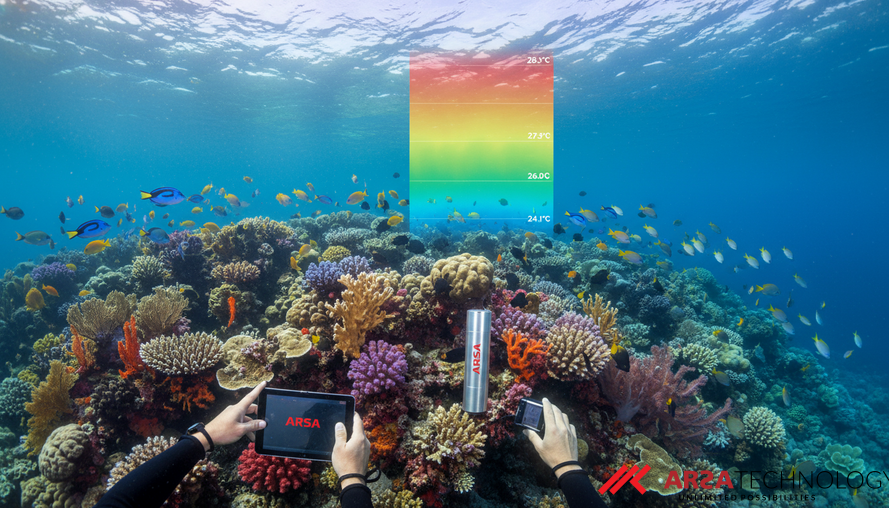
The Silent Crisis Beneath the Surface: Coral Bleaching and Data Gaps
Mass coral bleaching has tragically become a recurring global crisis, particularly evident on iconic reefs like the Great Barrier Reef (GBR). These devastating events are primarily triggered by prolonged periods of elevated ocean temperatures, often referred to as marine heatwaves. While satellite sea surface temperature (SST) data, such as that provided by NOAA Coral Reef Watch, has revolutionized our ability to monitor and forecast bleaching at a planetary scale, it presents a critical limitation: it only measures the ocean's "skin" temperature. Corals, however, thrive across a wide range of depths, from shallow flats to slopes extending over 20 meters, where temperatures can be significantly cooler—sometimes by 1-3°C—than the surface. Applying surface temperature uniformly across all depths, therefore, risks overestimating the thermal stress experienced by deeper corals, potentially misguiding conservation efforts and management decisions, including the identification of crucial depth refugia.
The Challenge of Depth in Coral Bleaching Monitoring
The discrepancy between surface and subsurface temperatures creates a significant blind spot in current coral bleaching assessments. In-situ temperature loggers offer precise point measurements at specific depths, but even extensive networks like the AIMS program on the GBR only cover a limited number of sites and depths. This sparsity makes it incredibly difficult to create a continuous, accurate picture of thermal conditions across the entire depth range of a reef. Traditional interpolation methods, while useful for filling small data gaps, often struggle when observations are extremely sparse or when extrapolating beyond the sampled depths. These methods also lack embedded physical constraints, meaning their reconstructions might not align with the actual thermal dynamics of the ocean.
Physics-Informed Neural Networks: A Breakthrough for Environmental Data
Addressing this complex challenge requires a sophisticated approach that can bridge the gap between sparse observations and continuous, physically consistent data. Physics-Informed Neural Networks (PINNs) offer a powerful solution. PINNs are a class of artificial neural networks that integrate governing physical laws directly into their training process. Unlike conventional neural networks that learn solely from data, PINNs are "informed" by the underlying physics, meaning their outputs not only fit the observed data but also approximately satisfy the fundamental equations that describe the system. For environmental applications like coral reef temperature mapping, where the physics (e.g., heat transfer, light attenuation) is well understood but observational data can be scarce, PINNs provide a robust framework to reconstruct plausible and accurate thermal fields. This approach ensures that even in data-sparse regions, the generated data adheres to scientific principles, leading to more reliable insights.
How the PINN Model Works for Coral Reefs
The specific PINN framework developed for this study (as detailed in this academic paper) ingeniously fuses satellite SST data with sparse in-situ temperature logger measurements. It embeds the one-dimensional vertical heat equation, which describes how temperature changes with depth due to vertical mixing and solar heating, directly into the neural network. Satellite SST acts as a "hard boundary condition" at the ocean surface, providing a fixed, reliable temperature anchor. Simultaneously, the model uses sparse in-situ logger data to learn and refine two crucial physical parameters: effective thermal diffusivity (κ) and light attenuation (K d ). Thermal diffusivity represents how quickly heat spreads through the water column, while light attenuation describes how sunlight diminishes with depth, impacting the heat absorbed at different levels. By learning these parameters from real-world data, the PINN can reconstruct continuous, depth-resolved temperature profiles that accurately reflect the complex thermal environment of coral reefs. This advanced data fusion allows for a comprehensive understanding of thermal gradients, even in previously unmonitored depths. Businesses needing similarly sophisticated data integration for environmental or operational challenges can explore custom AI solutions that leverage advanced models like PINNs.
Unveiling Subsurface Thermal Stress: Key Findings and Impact
Validation across four Great Barrier Reef sites, encompassing 30 separate experiments, demonstrated the PINN's impressive accuracy, achieving an RMSE (Root Mean Square Error) between 0.25 and 1.38°C at unseen depths. Even under extreme data sparsity—using as few as three training depths—the PINN maintained robust accuracy, with RMSE values around 0.27°C at 5 meters and 0.32°C at 9.1 meters, significantly outperforming traditional statistical baselines that collapsed to over 1.8°C error.
Crucially, the PINN generated continuous Degree Heating Day (DHD) profiles, a metric for cumulative thermal stress. These profiles revealed that thermal stress significantly attenuates with depth. For instance, at Davies Reef, DHD dropped from 0.29 at the surface to zero by 10.7 meters, aligning well with actual logger observations. This contrasts sharply with satellite-only DHD, which remained constant at 0.31 across all depths, clearly overestimating stress at greater depths. While the PINN did slightly underestimate absolute DHD values at shallow depths due to its smoothing effect on short-duration temperature peaks (which are critical for DHD calculations), its results provide conservative lower bounds and accurately capture the qualitative depth structure of thermal stress. These findings confirm that physics-constrained data fusion can extend accurate coral bleaching assessment to the depth dimension using existing observational infrastructure, offering invaluable insights for reef conservation. As a company experienced since 2018, ARSA Technology understands the importance of building robust, data-driven systems for complex applications across various industries.
Practical Implications for Coral Reef Conservation and Management
The ability to accurately map depth-resolved thermal stress has profound practical implications for coral reef conservation. By identifying areas where thermal stress is naturally attenuated, conservationists can pinpoint potential depth refugia—deeper reef sections that may offer protection during bleaching events. This insight can guide decisions about marine protected area design, reef prioritization for restoration efforts, and the strategic deployment of intervention technologies. Managers can use these depth-resolved thermal fields to better interpret bleaching surveys, understanding whether observed bleaching is widespread across depths or concentrated in shallower, more vulnerable areas. This shift from surface-centric monitoring to a volumetric understanding of thermal stress empowers more precise and effective conservation strategies.
The Future of Environmental Monitoring with AI
This research exemplifies how advanced AI techniques, specifically PINNs, can transform our understanding and management of critical environmental systems. By integrating physical laws with diverse data sources, AI can overcome the limitations of sparse observations, providing comprehensive and accurate insights into complex natural phenomena. Beyond coral reefs, similar PINN-driven approaches could be applied to a myriad of environmental challenges, from predicting ocean currents and pollutant dispersion to monitoring climate change impacts on ecosystems. The demand for such sophisticated data analytics and predictive modeling is growing across various sectors, from research to industrial operations. This is where AI and IoT solutions providers like ARSA Technology can play a crucial role, developing tailored AI platforms and AI API integrations that enable organizations to deploy cutting-edge computational intelligence for their most pressing environmental and operational needs.
The integration of physics with neural networks represents a powerful leap in scientific modeling, allowing us to derive robust, continuous insights from fragmented data. For coral reefs, this means a clearer, more nuanced understanding of thermal stress, offering a vital tool in the ongoing battle against climate change impacts.
To explore how advanced AI and IoT solutions can transform your operational or environmental monitoring challenges, we invite you to contact ARSA for a free consultation.
**Source:** Saleh, A., & Azghadi, M. R. (2026). Depth-Resolved Coral Reef Thermal Fields from Satellite SST and Sparse In-Situ Loggers Using Physics-Informed Neural Networks. arXiv preprint arXiv:2604.13131. Available at: https://arxiv.org/abs/2604.13131.