AI's Eye on the Job Site: How Vision-Language Models Enhance Construction Safety and Efficiency
Explore how advanced Vision-Language Models are revolutionizing construction by accurately detecting worker actions and emotions, paving the way for safer, smarter job sites.

The Future of Construction: Human-AI Collaboration for Enhanced Safety
The construction industry is on the cusp of a significant transformation, with robotics and automation becoming increasingly prevalent across job sites. From drones surveying terrain to autonomous vehicles moving materials and quadruped robots inspecting structures, these technological advancements promise enhanced efficiency and safety. However, for seamless integration and effective collaboration, these robotic systems need more than just obstacle avoidance capabilities. They must develop a profound understanding of human behavior, interpreting both worker actions and their emotional states to operate safely alongside human counterparts.
Traditionally, monitoring human behavior in complex, dynamic environments like construction sites has been a labor-intensive and challenging task. Factors such as human error, operator fatigue, and the sheer volume of data from numerous surveillance points often lead to delayed threat identification and ineffective response. This challenge is further compounded by the scarcity of highly specialized, labeled datasets needed to train conventional computer vision models for specific construction scenarios. The good news is that innovative Artificial Intelligence (AI) solutions are emerging to bridge this gap, promising a future where human and machine can work in greater harmony.
Understanding Vision-Language Models (VLMs) in a Nutshell
At the forefront of this innovation are Vision-Language Models (VLMs), a sophisticated class of AI that combines the power of visual and linguistic processing. Unlike traditional computer vision models, which often require extensive, domain-specific labeled datasets for each new task, VLMs are designed to interpret complex visual scenes through natural language reasoning. This means they can understand and describe what’s happening in an image or video based on a vast, general knowledge base learned from both images and text. This capability makes them remarkably versatile and able to generalize across different contexts without extensive retraining.
For construction, VLMs offer a robust alternative to overcome the limitations of traditional computer vision. The dynamic and often unpredictable nature of construction sites, coupled with the difficulty and cost of acquiring large volumes of annotated data for every conceivable worker activity or condition, has historically hindered the widespread adoption of AI monitoring. VLMs bypass much of this data dependency, offering a more flexible and adaptable solution for recognizing human actions and emotional cues, which are critical for maintaining safety and productivity in real-time.
The Study: Assessing AI's Eye on Construction Worker Behavior
An exploratory study recently evaluated the performance of three leading Vision-Language Models – GPT-4o, Florence 2, and LLaVa-1.5 – in understanding construction worker actions and emotions. Using a meticulously curated dataset of 1,000 static images captured from various construction sites, researchers annotated these images across ten distinct action categories (e.g., "lifting," "welding," "operating machinery") and ten emotion categories (e.g., "focused," "stressed," "fatigued"). The goal was to determine if these general-purpose VLMs could accurately detect these human behaviors without any domain-specific fine-tuning.
The results highlighted GPT-4o as the top performer, consistently achieving the highest scores in both action and emotion recognition. It demonstrated an average F1-score of 0.756 and an accuracy of 0.799 for action recognition, and an F1-score of 0.712 and accuracy of 0.773 for emotion recognition. Florence 2 showed moderate performance, while LLaVa-1.5 exhibited the lowest overall scores. A key finding from the analysis was that all models struggled to differentiate between "semantically close" categories—for example, distinguishing "Collaborating in teams" from "Communicating with supervisors," or "Focused" from "Determined." This points to a current limitation of general-purpose VLMs in tasks requiring highly nuanced visual interpretation within a specialized domain. Nevertheless, the study confirms that these VLMs offer a strong baseline capability for human behavior recognition in construction environments.
Translating Insights to the Construction Site: Practical Applications
The implications of this research are significant for the construction industry. By leveraging the baseline capabilities of VLMs, companies can implement systems that automatically monitor worker safety and well-being, moving beyond reactive measures to proactive prevention. Imagine a system that can detect early signs of worker fatigue, potential non-compliance with Personal Protective Equipment (PPE) rules, or unusual activity patterns that might indicate a developing hazard. This capability directly translates into reduced risk of accidents, improved operational efficiency, and a safer work environment for everyone.
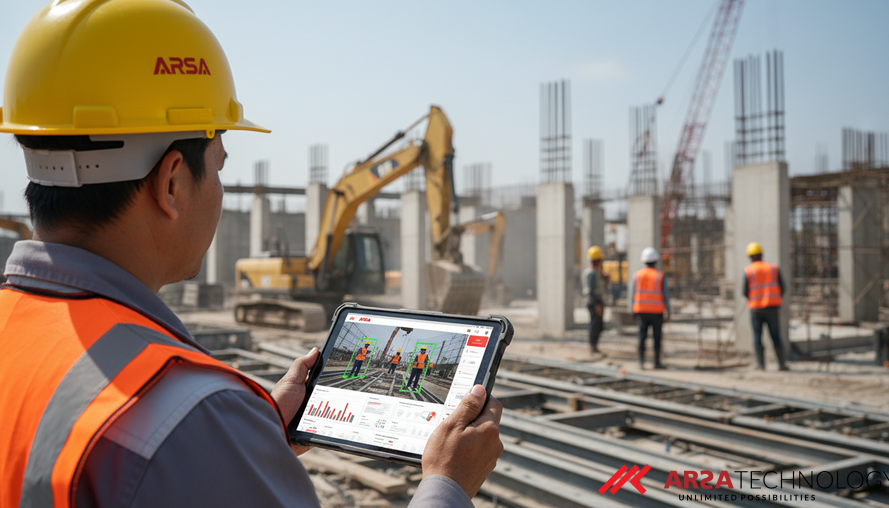
For instance, companies can deploy advanced AI Video Analytics to transform their existing CCTV infrastructure into intelligent surveillance systems. These systems can go beyond basic security to offer features like activity detection, crowd analytics, and even automatically identifying if workers are adhering to safety protocols. ARSA Technology's solutions, such as the AI BOX - Basic Safety Guard, leverage similar AI vision principles to ensure compliance with PPE usage, detect unauthorized access, and flag safety violations in real-time, greatly enhancing workplace safety. Furthermore, solutions built on the principles of edge AI, like the AI Box Series, ensure that data processing happens locally, maximizing privacy and providing instant insights without cloud dependency. These systems are adaptable for a wide range of operational challenges across various industries.
Next Steps for Robust AI in Construction
While the study demonstrates the promise of VLMs for human behavior recognition in construction, it also highlights areas for future development. For real-world reliability, further enhancements are necessary, including domain adaptation to fine-tune models specifically for construction site nuances, temporal modeling to analyze sequences of actions (rather than just static images), and multimodal sensing that incorporates data from various sensors beyond just visual input.
The goal is to develop human-aware AI systems that can not only observe but also understand, predict, and ultimately facilitate safer and more efficient human-robot collaboration. These advancements will pave the way for real-time monitoring systems that can provide adaptive decision support, optimize resource allocation, and respond dynamically to unforeseen circumstances, fundamentally enhancing the digital transformation of construction.
The insights from this exploratory study provide a crucial benchmark for how readily available AI models can contribute to a safer, smarter future for the construction industry. As AI technology continues to evolve, its ability to understand and respond to the human element will be paramount in creating truly intelligent and collaborative work environments.
Ready to explore how advanced AI and IoT solutions can transform safety and efficiency on your construction sites? We invite you to explore ARSA's innovative solutions and discover how our expertise can address your specific industry challenges. To learn more or to schedule a consultation, please contact ARSA today.