Autonomous Anomaly Detection: Bringing TinyML Intelligence to Resource-Constrained Devices
Explore Z-Score based TinyML for fully autonomous, on-device anomaly detection using power side-channel data. Learn how AI on microcontrollers enhances efficiency, privacy, and reliability without cloud dependency.

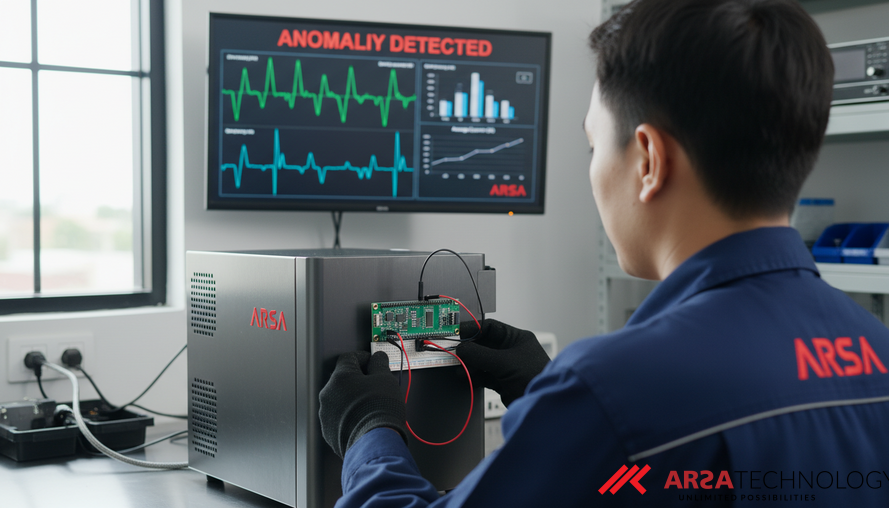
In an era dominated by cloud computing, a quiet revolution is unfolding at the very edge of our digital networks: Tiny Machine Learning, or TinyML. This burgeoning field is making it possible for sophisticated AI capabilities to run directly on miniature, low-power microcontrollers (MCUs) – the brains inside countless everyday devices and industrial equipment. This shift is particularly impactful for anomaly detection, where identifying unusual patterns in real-time can be critical for security, predictive maintenance, and operational efficiency. A recent academic paper highlights a significant advancement in this area, demonstrating a fully autonomous TinyML system capable of on-device anomaly detection using power side-channel data, entirely independent of cloud connectivity (Source: XXX-X-XXXX-XXXX-X/XX/$XX.00 ©20XX IEEE).
The Power of Autonomous AI at the Edge
Traditional IoT anomaly detection often relies on sending data to the cloud for analysis, leading to potential issues with latency, data privacy, and vulnerability to network disruptions. For mission-critical applications, or those in remote environments, this cloud dependency can be a significant drawback. TinyML addresses these challenges by bringing machine learning inference – and in this innovative case, even training – directly to the edge device. This on-device processing means faster response times, enhanced data security as sensitive information never leaves the local network, and greater reliability even when internet connectivity is intermittent or non-existent.
The ability to perform both model training and inference on a resource-constrained microcontroller is a game-changer. It transforms passive devices into intelligent, self-learning systems that can adapt to their environment and operational norms. This self-sufficiency is crucial for scaling IoT deployments, reducing operational costs associated with data transmission and cloud processing, and ensuring continuous monitoring without external intervention.
Unlocking Insights with Power Side-Channel Analysis
One of the most elegant and non-intrusive ways to understand the behavior of an electrical appliance or embedded system is through its power consumption. This technique, known as power side-channel analysis, involves monitoring the electrical current flow to infer internal operational states. Changes in current consumption act like a digital fingerprint, revealing when a device turns on or off, performs a specific task, or even when it begins to malfunction. For instance, a refrigerator's current draw will vary distinctly between its compressor's "ON" and "OFF" cycles. Anomalies, such as a compressor running too long or not at all, directly manifest as deviations in this power signature.
The beauty of using current sensing for anomaly detection lies in its simplicity and versatility. It doesn't require complex, purpose-built sensors for every parameter; a single current sensor can provide a wealth of information about a device's health and operational patterns. This makes it an ideal candidate for integration into low-cost, resource-limited environments where adding multiple sensors would be impractical or expensive. ARSA Technology, for example, leverages various sensing modalities in its AI Video Analytics to gain similar deep insights from visual data, transforming passive feeds into active intelligence.
Revolutionizing Anomaly Detection: On-Device Learning
The core innovation presented in the research is a fully autonomous Z-Score–based anomaly detection system. The Z-Score is a statistical measure that quantifies how many standard deviations an observation or data point is from the mean. In simple terms, it tells you how "unusual" a specific measurement is compared to the average behavior. For example, if a fridge's compressor usually runs for 15 minutes, and suddenly it runs for 45 minutes, a Z-Score calculation can quickly flag this as an anomaly because it deviates significantly from the established normal duration. Its statistical simplicity makes it computationally lightweight, perfectly suited for the limited processing power and memory of an MCU.
Unlike many existing solutions that require models to be trained on powerful external servers or in the cloud before being deployed for inference, this system performs both the initial learning (training phase) and the continuous detection (inference phase) directly on the microcontroller. During the training phase, the device collects data to establish a baseline of "normal" operation, calculating statistical parameters like the mean and standard deviation of various metrics. Once a sufficient baseline is established, it seamlessly transitions into inference mode, continuously comparing new data points against its learned normal profile. This self-contained approach is a significant step towards truly intelligent and resilient embedded systems.
How the Autonomous System Works
The system operates through a streamlined, two-phase workflow that maximizes efficiency on a microcontroller platform. In the initial Training Phase, the MCU diligently collects Root Mean Square (RMS) current data from the monitored appliance over a specified period. The RMS value provides an effective measure of the magnitude of the alternating current, allowing the system to accurately characterize different operational states, such as the compressor being "ON" or "OFF" for a mini-fridge. During this phase, the MCU computes key statistical parameters—specifically the mean and standard deviation—for the duration of these operational cycles, establishing a robust baseline for normal behavior.
Following the training period, the system enters the Inference Phase. Here, for every completed compressor ON cycle, the MCU calculates a Z-Score based on the cycle’s duration. If this computed Z-Score exceeds a predefined threshold, it signals an anomaly, indicating a deviation from the learned normal pattern. To address broader operational irregularities, the system also incorporates a lightweight watchdog rule, flagging a "power-off" anomaly if the compressor remains inactive for an excessively long period, such as 60 minutes. This entire process—from sensing and RMS computation to statistical analysis and anomaly flagging—is executed on-device, with a real-time clock for accurate timestamping and local MicroSD storage for persistent data logging. The use of pre-configured edge AI systems like ARSA’s AI BOX - Basic Safety Guard demonstrates a similar plug-and-play approach for rapid deployment in various settings.
Real-World Impact and Proven Performance
The effectiveness of this autonomous TinyML anomaly detection system was rigorously evaluated using a 14-day dataset from a household mini-fridge, covering both normal operation and controlled anomalous conditions. The results were impressive, demonstrating perfect detection performance with Precision and Recall of 1.00. This means the system accurately identified all actual anomalies without generating any false positives or false negatives.
Beyond accuracy, the system excelled in efficiency, exhibiting inference latencies on the order of tens of microseconds. This near-instantaneous detection capability is critical for applications requiring immediate action, such as industrial safety monitoring or critical infrastructure protection. Furthermore, the memory footprint was remarkably small, utilizing approximately 3.3 KB of SRAM and 63 KB of Flash memory. These figures underscore the feasibility of deploying robust, intelligent anomaly detection on low-cost, resource-constrained microcontrollers, making advanced AI accessible for widespread use in various industries including smart homes, manufacturing, and logistics. This minimizes the need for costly external hardware or cloud subscriptions, delivering significant ROI.
Future Directions and Broader Applications
While the paper primarily focuses on the mini-fridge application, the implications of this fully autonomous TinyML approach extend far beyond. The framework's core principle—on-device training and inference using lightweight statistical models—is highly adaptable. Future work, as suggested by the researchers, includes incorporating additional lightweight models and exploring multi-device learning scenarios. This could involve networks of MCUs collaboratively learning and identifying anomalies across a larger system without centralizing data.
Imagine this technology applied to:
- Industrial IoT: Monitoring motors, pumps, and other machinery for early signs of wear or malfunction, enabling predictive maintenance that prevents costly downtime.
- Smart Buildings: Detecting unusual energy consumption patterns that could indicate faulty HVAC systems or security breaches.
- Healthcare Technology: Monitoring medical equipment for operational deviations in remote clinics where cloud connectivity is unstable.
- Smart City Infrastructure: Ensuring the continuous, reliable operation of streetlights, traffic signals, or environmental sensors.
The ability to derive powerful insights from simple, non-intrusive power side-channel data, combined with the autonomy of TinyML, opens up new possibilities for creating highly reliable, privacy-preserving, and cost-effective intelligent systems across diverse sectors. ARSA Technology has been experienced since 2018 in developing and deploying such practical AI and IoT solutions, emphasizing real-world impact over experimental concepts.
This breakthrough in autonomous, on-device anomaly detection offers a compelling vision for the future of embedded intelligence, where devices can independently learn, adapt, and secure their environments with minimal resources and maximum efficiency.
Ready to harness the power of autonomous AI for your enterprise? Explore ARSA Technology’s solutions and contact ARSA for a free consultation on how our expertise in AI and IoT can transform your operations.
Source: Abdulrahman Albaiz and Fathi Amsaad, "Fully Autonomous Z-Score–Based TinyML Anomaly Detection on Resource-Constrained MCUs Using Power Side-Channel Data", (Source URL: https://arxiv.org/abs/2604.08581)