Beyond License Plates: How AI Can Identify Vehicle Make, Model, and Color
In the realm of vehicle identification, license plate recognition has long been the primary focus of security and surveillance systems…
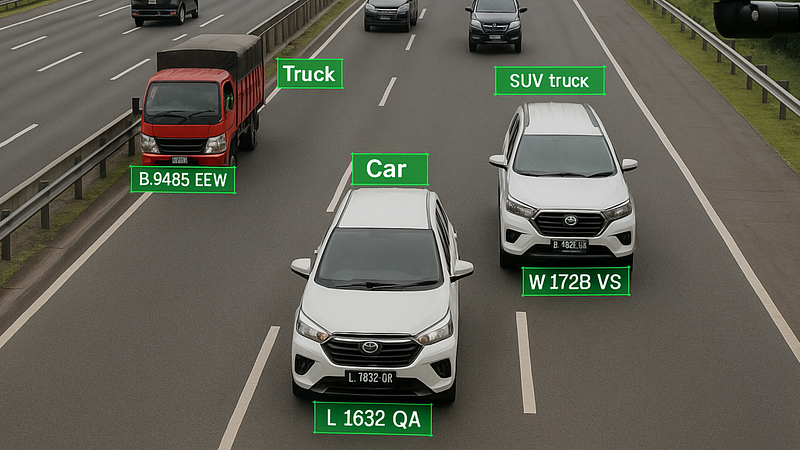
In the realm of vehicle identification, license plate recognition has long been the primary focus of security and surveillance systems. However, modern AI technologies have expanded these capabilities far beyond simple alphanumeric recognition. Today’s advanced systems, like ARSA Technology’s AKSAYANA Vision AI, can identify a vehicle’s make, model, color, and even specific features — creating a comprehensive vehicle “fingerprint” that dramatically enhances security and analytics capabilities.
The Limitations of License Plate-Only Recognition
While license plate recognition (LPR) technology has proven invaluable for traffic management, law enforcement, and access control, relying solely on license plate data presents several challenges:
- Plate Obstruction: License plates can be obscured, damaged, or removed, rendering LPR systems ineffective.
- Fraud Vulnerability: Plates can be stolen, swapped, or counterfeited to bypass traditional security measures.
- Limited Context: A license plate alone provides minimal information about the vehicle and its potential uses.
- Inconsistent Formats: Different regions have varying plate formats, which can complicate recognition systems.
These limitations highlight the need for more comprehensive vehicle identification technologies that can operate effectively even when license plate data is unavailable or compromised.
The AI Revolution in Vehicle Identification
Advanced computer vision algorithms and deep learning techniques have revolutionized vehicle identification by enabling systems to recognize multiple vehicle attributes simultaneously. This approach creates a multi-factor identification system that is significantly more robust and informative than traditional LPR.
How AI Vehicle Identification Works
Modern vehicle identification systems like AKSAYANA Vision AI employ sophisticated neural networks trained on vast datasets of vehicle images. These networks learn to identify distinctive features across different vehicle categories:
- Vehicle Type Classification: Distinguishing between sedans, SUVs, trucks, buses, motorcycles, and other vehicle types.
- Make and Model Recognition: Identifying specific brands and models based on distinctive design elements.
- Color Analysis: Accurately determining vehicle colors under various lighting conditions.
- Feature Detection: Recognizing specific features such as roof racks, spoilers, window tints, and modified components.
This multi-layered approach creates a unique vehicle profile that is much harder to falsify than license plate information alone.
Technical Innovations Enabling Advanced Vehicle Identification
Several technological advancements have made comprehensive vehicle identification possible:
1. Convolutional Neural Networks (CNNs)
CNNs excel at image processing tasks by filtering images through multiple layers that progressively identify more complex features. In vehicle identification, early layers might identify basic shapes and edges, while deeper layers recognize specific vehicle characteristics like grille designs or headlight configurations.
AKSAYANA Vision AI employs custom-designed CNN architectures optimized specifically for vehicle identification, achieving high accuracy even in challenging conditions.
2. Transfer Learning and Fine-Tuning
Building effective vehicle recognition models requires exposure to millions of vehicle images across thousands of makes and models. Transfer learning allows us to leverage pre-trained models on large general image datasets, which are then fine-tuned for specific vehicle recognition tasks.
This approach dramatically reduces the training data requirements while maintaining high accuracy, particularly for less common vehicle models.
3. Attention Mechanisms
Modern neural networks incorporate attention mechanisms that focus computational resources on the most relevant parts of an image. For vehicle identification, these mechanisms automatically focus on distinctive areas like front grilles, headlight designs, and body contours.
This selective attention improves both accuracy and computational efficiency, allowing our systems to process multiple video streams simultaneously.
4. Temporal Integration
By analyzing vehicles across multiple frames, AKSAYANA can integrate information over time to improve identification confidence. This approach is particularly valuable for moving vehicles or when initial frames provide only partial visibility.
Real-World Applications and Benefits
The ability to identify vehicle attributes beyond license plates creates numerous opportunities across different sectors:
Security and Law Enforcement
- Enhanced Investigative Capabilities: When a vehicle is involved in an incident but the license plate is obscured or reported incorrectly, other attributes can help identify the vehicle.
- Stolen Vehicle Recovery: Even if thieves replace license plates, the vehicle’s make, model, and color remain harder to change.
- Pattern Recognition: Identifying vehicles that repeatedly appear in sensitive areas, even if they use different license plates each time.
Traffic Management and Urban Planning
- Comprehensive Traffic Analysis: Gathering data on the types of vehicles using specific routes helps with infrastructure planning.
- Environmental Monitoring: Identifying older vehicle models or specific engine types for emissions management.
- Congestion Analysis: Understanding the mix of private, commercial, and public transport vehicles to optimize traffic flow.
Commercial Applications
- Targeted Marketing: Shopping centers can analyze customer vehicle demographics to inform retail strategies.
- Parking Optimization: Understanding the types of vehicles using parking facilities to better design spaces and allocate resources.
- Insurance Applications: Verifying vehicle information for policy issuance and claims processing.
Case Study: Vehicle Working Condition Detection
One innovative application of AKSAYANA’s technology is the ability to detect whether vehicles are in a working or idle state. This capability has significant implications for:
- Fleet Management: Monitoring active versus idle times for delivery or service vehicles.
- Construction Sites: Tracking equipment utilization and identifying inefficiencies.
- Mining Operations: Ensuring optimal use of expensive heavy machinery.
- Security Applications: Identifying vehicles that remain idle in security-sensitive areas for prolonged periods.
By analyzing subtle cues like exhaust emissions, engine vibrations, and positional changes, the system can accurately determine vehicle operational status without requiring access to vehicle telematics systems.
Privacy and Ethical Considerations
As vehicle identification systems become more powerful, privacy considerations become increasingly important. At ARSA Technology, we design our systems with privacy in mind:
- Data Minimization: Only necessary data is collected and retained based on the specific application requirements.
- Purpose Limitation: Vehicle data is used only for intended purposes that are clearly defined.
- Access Controls: Strict authentication and authorization protocols govern who can access vehicle identification data.
- Transparency: Clear communication about the capabilities and limitations of our systems to all stakeholders.
The Future of Vehicle Identification
Looking ahead, several emerging trends will shape the evolution of vehicle identification technologies:
1. Integration with Connected Vehicle Data
As vehicles become increasingly connected, identification systems may integrate with vehicle-broadcast data for enhanced accuracy and additional insights. This could include information about vehicle occupancy, destination, or purpose.
2. Behavioral Analysis
Beyond static attributes, next-generation systems will analyze driving behaviors to identify patterns associated with specific drivers or activities. This could include acceleration profiles, turning behaviors, or route preferences.
3. Multi-Sensor Fusion
Future systems will likely incorporate data from multiple sensor types beyond cameras, including radar, lidar, acoustic sensors, and environmental monitors. This multi-sensor approach will further enhance identification accuracy in challenging conditions.
4. Edge AI Evolution
Advancements in edge computing will allow for more sophisticated analysis directly on camera devices, reducing bandwidth requirements and enabling faster response times.
Conclusion
The evolution of vehicle identification technology from simple license plate recognition to comprehensive attribute detection represents a significant advancement in security and analytics capabilities. By leveraging advanced AI techniques, AKSAYANA Vision AI provides a multi-factor approach to vehicle identification that is more robust, informative, and adaptable than traditional systems.
As these technologies continue to mature, they will play an increasingly important role in security, traffic management, urban planning, and commercial applications. At ARSA Technology, we remain committed to advancing these capabilities while ensuring they are deployed responsibly and ethically, with appropriate attention to privacy concerns and regulatory compliance.
This article is part of Machine State — ARSA Technology’s official publication exploring intelligent systems and future tech.
Ditulis oleh Hilmy Izzulhaq
Founder @ ARSA Technology — 7 years building AI Vision & IoT solutions in heavy industry, parking, and smart city.