Beyond the Hype: Why "Big AI" Isn't the Only Measure of Power for Businesses
Uncover the "LLM Mirage" and understand why relying solely on large computing power for AI overlooks critical factors like specialized data and efficient algorithms for real-world business impact.

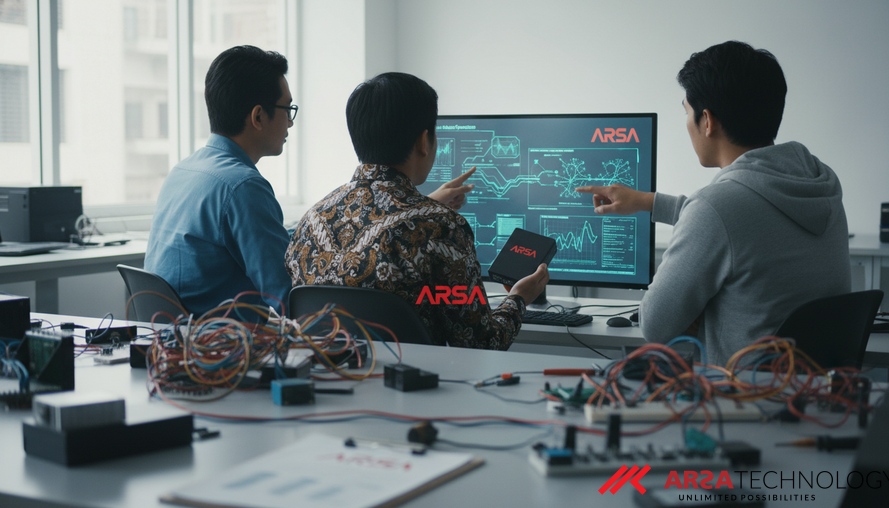
The "LLM Mirage": Misjudging AI's True Impact
In the rapidly evolving world of Artificial Intelligence, a pervasive misconception, often termed the "LLM Mirage," risks misguiding businesses and policymakers alike. This mirage suggests that the true power and potential risks of AI primarily scale with the sheer computational resources used to train large, frontier language models (LLMs). While massive computing power certainly drives some advanced AI, this singular focus can lead to strategic blind spots, causing enterprises to overlook equally potent, task-specific AI systems that deliver tangible business value through optimized algorithms and specialized data, even on more accessible hardware. For businesses navigating digital transformation, understanding this distinction is crucial to making informed investments and building robust, effective AI strategies.
The journey toward this compute-centric view of AI began with observations that larger datasets and more computational power often led to better model performance. Early research highlighted the "unreasonable effectiveness of data," suggesting that vast amounts of information could enable even simpler algorithms to perform well. This was reinforced by the "Bitter Lesson," which posited that scalable training pipelines and general architectures, leveraging extensive computation and experience, tend to outperform highly specialized, human-engineered approaches over time. These insights, combined with empirical scaling laws showing predictable performance gains with increased model size and training compute, solidified the belief that raw computational scale was the primary driver of AI progress.
The Foundational AI Triad: Data, Algorithms, and Compute
However, to truly understand AI's capabilities and risks, we must look beyond just compute and consider the complete "AI Triad": data, algorithms, and compute. The effectiveness of any AI system is a complex interplay of these three elements. Focusing solely on compute, while it offers an easily quantifiable metric, risks neglecting the immense power of specialized data and highly efficient algorithms. For instance, an AI system designed for a very specific task, such as monitoring production lines for defects or analyzing traffic patterns, can achieve high accuracy and impactful results with a carefully curated dataset and algorithms finely tuned for that particular domain. This approach bypasses the need for the enormous, general-purpose compute resources often associated with frontier LLMs.
The "LLM Mirage" strategically miscalculates risk and opportunity. While high-end compute controls may restrict access to the largest general AI models, adversaries or competitors can still develop potent, "weaponizable" (in the broad sense of potentially harmful or misused) AI capabilities using task-specific systems. These systems leverage specialized data, algorithmic efficiency, and widely available, less restricted hardware. For businesses, this means that even without access to supercomputers, significant operational improvements can be achieved. Solutions like the ARSA AI BOX - Basic Safety Guard, for example, demonstrate how edge computing can deliver real-time safety compliance and security monitoring by optimizing algorithms for specific detection tasks, rather than requiring massive data centers.
Task-Specific AI: Delivering Real-World Business Value
The practical implications for enterprises are profound. Instead of chasing the most computationally intensive AI, businesses should prioritize solutions tailored to their specific operational challenges. Task-specific AI, powered by optimized algorithms and targeted data, can offer highly effective and cost-efficient ways to enhance security, boost productivity, and drive new revenue streams. Consider the retail sector: an AI system for customer analytics doesn't need to understand complex human language to optimize store layouts or manage queues. Instead, it relies on precise object detection and movement analysis from specialized data.
ARSA Technology, for example, offers solutions that exemplify this principle. The AI BOX - Smart Retail Counter transforms existing CCTV infrastructure into intelligent customer analytics platforms. This system processes real-time data to provide insights into visitor counts, queue lengths, and store heatmaps, all without requiring the immense compute of a general-purpose LLM. Similarly, our AI Video Analytics solutions leverage computer vision to provide actionable insights for various industries, from detecting PPE non-compliance in manufacturing to analyzing traffic flow in urban environments. This focus on practical, specialized applications ensures that AI delivers measurable ROI, rather than just impressive processing benchmarks.
Beyond Scale: Focusing on Capability and Responsible Deployment
Ultimately, the true measure of an AI system's power and potential impact, whether positive or negative, lies in its actual capabilities and the intent behind its deployment, not just its computational scale. An AI that can accurately identify critical safety hazards in a factory, detect unauthorized access, or streamline traffic flow using modest compute resources is far more valuable and potentially impactful than a massive LLM that cannot be effectively applied to these specific problems. Policies and business strategies that fail to account for the full AI Triad—data quality, algorithmic efficiency, and appropriate compute—risk misallocating resources and underestimating the potential of targeted AI applications.
As we move forward, a more nuanced understanding of AI development and deployment is critical. For businesses, this means embracing solutions that integrate sophisticated algorithms with specialized data and edge computing capabilities to solve real-world problems efficiently and securely. ARSA Technology has been experienced since 2018 in developing and deploying such solutions across various industries, focusing on tangible outcomes rather than just raw processing power.
Ready to harness the true potential of AI for your business? Explore how ARSA Technology's intelligent AI & IoT solutions can transform your operations, enhance security, and drive efficiency. To discuss your specific needs and discover tailored solutions, please contact ARSA today for a free consultation.