BMW 7 Series: Driving into the Future with Neue Klasse AI and the Ultimate Computing Platform
Explore how BMW's redesigned 7 Series, built on the Neue Klasse architecture, transforms into a sophisticated mobile computing platform, integrating advanced AI, diverse powertrains, and a luxurious digital experience.

The Dawn of the Digital Driving Experience
BMW's "Neue Klasse" electric vehicle architecture, first announced in 2021, has finally made its much-anticipated debut in the brand's flagship 7 Series. This pivotal moment, marked by recent unveilings in New York City and Beijing, signals a profound transformation for the Bavarian automaker. While certain styling elements, such as the distinctive grille, continue to spark debate, the underlying technology and raw power of these luxury sedans—starting well over $100,000—are poised to redefine the segment. BMW is making a bold statement, evolving its decades-old slogan from "the Ultimate Driving Machine" to "the Ultimate Computing Platform," signaling a future where the driving experience is intricately intertwined with advanced digital intelligence.
This strategic shift means the 7 Series is no longer just about horsepower and handling; it's about seamlessly integrated AI, robust connectivity, and an immersive digital ecosystem. This article delves into the technological marvels that underpin BMW's new vision, exploring how this flagship model leverages cutting-edge advancements to deliver a sophisticated, intelligent, and supremely luxurious experience. The move reflects a broader industry trend where software and connectivity are becoming as crucial as mechanical engineering, and BMW is positioning itself at the forefront of this evolution.
Power and Performance: A Multitude of Choices
In a shrewd move reflecting diverse global market demands, BMW is launching the new 7 Series with an array of powertrain options. This includes two fully electric variants, the i7 50 xDrive and i7 60 xDrive, alongside traditional internal combustion models like the 740 and 740 xDrive. A plug-in hybrid, the 750e xDrive, will also be available, with a powerful V8 M performance model slated for 2027. This multi-pronged approach acknowledges the varying pace of EV adoption worldwide, ensuring the 7 Series can cater to a wide spectrum of customer preferences and regional infrastructure realities.
The electric i7 variants benefit from a strategic partnership with Croatia’s Rimac, incorporating new Gen6 cylindrical batteries. These advanced batteries boast a 20 percent increase in energy density, providing a usable capacity of 112.5 kWh. BMW estimates an impressive EPA range exceeding 350 miles, placing the i7 competitively in the long-range EV segment. For charging convenience, the maximum rate has been boosted to 250 kW, enabling a 10–80 percent charge in approximately 28 minutes. Furthermore, the integration of a native NACS charging port will grant i7 owners access to an extensive network of Tesla Superchargers, significantly alleviating range anxiety. Performance figures are equally compelling: the i7 60 xDrive delivers 536 horsepower and 549 lb-ft of torque, accelerating from 0–60 mph in a swift 4.6 seconds, while the i7 50 xDrive offers 449 horsepower and 487 lb-ft, achieving 0–60 mph in 5.3 seconds. Both electric models feature a dual-motor, all-wheel-drive configuration, a notable shift for BMW that emphasizes enhanced traction and dynamic capabilities.
Design Philosophy: Blending Innovation with Familiarity
Externally, the new 7 Series retains some of BMW's signature design elements, including the bold, illuminated kidney grilles, now complemented by subtle accent light eyebrows. While the grille design remains a topic of conversation, BMW's decision to maintain it is reportedly backed by strong sales figures, indicating customer acceptance. However, beneath this familiar aesthetic lie significant advancements in lighting and material innovation. The adaptive LED headlights are ingeniously integrated, appearing almost invisible until activated, and can be optioned with 12 diamond-cut crystal lights for a truly luxurious touch. Adding to the vehicle's grand entrance, new "light carpets" project 194,000 pixels onto the ground upon entry. A "world first" painting process, involving over 75 hours of manual work per car, combines matte and metallic finishes, underscoring BMW's commitment to exquisite craftsmanship.
A key design principle introduced with the Neue Klasse is "shy tech." This philosophy dictates that certain sensors and hardware remain subtly integrated into the cabin, only becoming visible or active when their function is required. This approach aims to maintain a serene and uncluttered interior, preventing sensory overload for the driver. Instead of a constant array of buttons and screens, shy tech ensures that digital elements and controls emerge intuitively, enhancing the user experience without sacrificing aesthetic simplicity. This intelligent design allows for complex functionality to be present without being constantly obtrusive.
The Intelligent Interior: A Command Center of Screens and AI
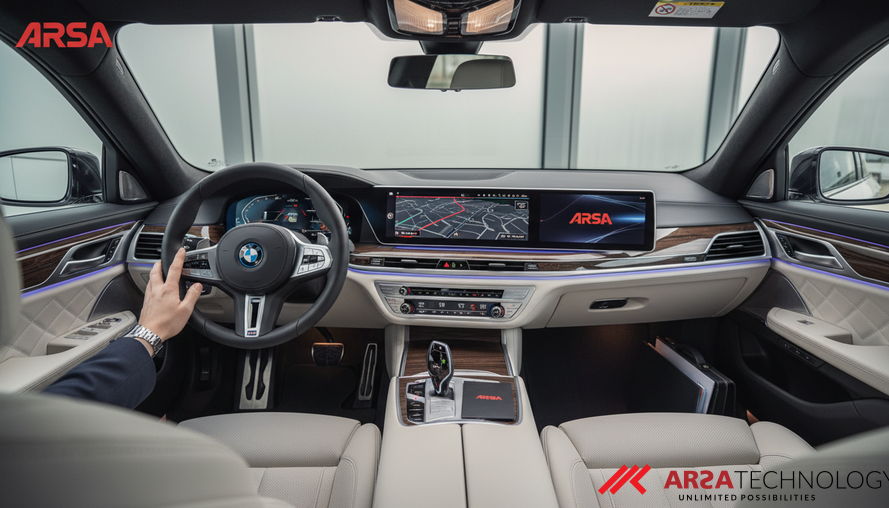
The heart of the 7 Series' transformation into an "Ultimate Computing Platform" lies within its sophisticated interior and its advanced "superbrain." This revolutionary architecture consolidates various compute modules into four central units, vastly improving processing power and responsiveness. These superbrains drive an array of advanced features, including an Alexa Plus AI-enhanced voice assistant that offers intuitive control over vehicle functions. Furthermore, advanced driver-assist systems such as automatic lane changes and self-parking capabilities are seamlessly integrated, enhancing safety and convenience. Regular over-the-air (OTA) software updates ensure the 7 Series' software remains current, adaptive, and continually improving throughout its lifespan, much like modern smart devices. For enterprises looking to build similar robust AI-driven operational intelligence systems, deploying sophisticated AI Box Series solutions or custom-tailored Custom AI Solutions can provide the necessary edge processing and integrated intelligence.
While "shy tech" aims for subtlety in hardware, BMW is anything but shy about its screen real estate. The 7 Series boasts four major displays, with two additional screens for rear passengers, creating an unparalleled digital environment. The front cabin features a striking 17.9-inch "floating" central display with an irregular hexagon shape, complemented by a 14.6-inch multi-touch display for the front passenger, enabling media streaming and interactive entertainment. A truly innovative addition is BMW's "Panoramic Vision," a high-contrast, opaque projection surface spanning the width of the dash at the base of the windshield. This serves as the primary instrument cluster, offering critical navigation, drive mode, and speed information, alongside widgets for time and temperature, visible to all occupants. In the rear, the option for a massive 31.3-inch 8K Theater Screen descends from the headliner, powered by Fire TV, providing access to a wide array of streaming services via the car's integrated 5G connection. Control is intuitive, with both touchscreen functionality and small touchpad controls embedded in the armrests. This level of integrated intelligence and digital display, reminiscent of comprehensive AI Video Analytics dashboards, transforms the cabin into a mobile command center and entertainment lounge.
Market Positioning and Value Proposition
The pricing structure for the new 7 Series reflects its premium positioning and advanced capabilities. The gas-powered 740 starts at $99,800, while the AWD 740 xDrive is priced at $102,800. The electric journey begins with the i7 50 xDrive at $106,200, topping out with the i7 60 xDrive at $124,700. These figures represent a modest increase over previous models, justified by the revolutionary Neue Klasse software architecture and the next-generation battery technology. This positions the 7 Series competitively within the luxury sedan market, where it will face formidable rivals such as the refreshed Mercedes-Benz EQS and the Lucid Air sedan.
BMW's strategic decision to offer a diverse range of powertrains—electric, internal combustion, and plug-in hybrid—might provide a distinct advantage. This flexibility caters to a broader customer base, appealing to those ready for full electrification as well as those who prefer traditional power or a transitional hybrid option. The combination of established luxury, cutting-edge technology, and a variety of choices could prove to be a winning formula as the automotive industry navigates its complex digital transformation.
Source: The Verge
For businesses seeking to implement advanced AI and IoT solutions, from intelligent video analytics to custom hardware and software integrations, ARSA Technology offers expertise proven in various industries. Discover how ARSA can help transform your operations into an intelligent, efficient, and secure ecosystem by exploring our solutions and initiating a free consultation.