DarwinNet: Architecting Self-Evolving Networks for the AI Era
Explore DarwinNet, a bio-inspired network architecture that enables communication protocols to evolve autonomously. Learn how AI and edge computing are reshaping network flexibility and security.

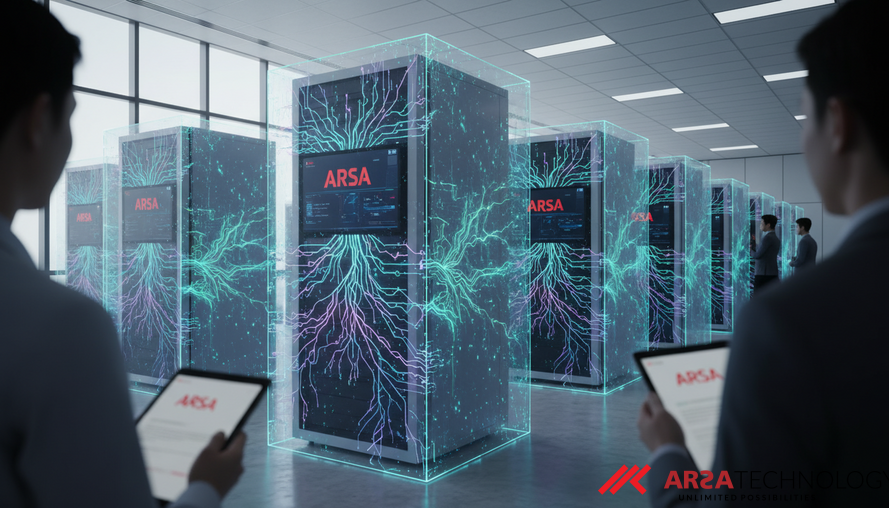
In the rapidly advancing landscape of artificial intelligence and the Internet of Things, traditional network architectures are encountering significant challenges. Decades of reliance on static, human-defined communication rules, such as those embedded in the TCP/IP architecture, have led to a phenomenon known as "protocol ossification." This rigidity makes networks slow to adapt to new technologies, unforeseen environmental conditions, or the probabilistic reasoning capabilities of modern autonomous agents. A recent academic paper, "DarwinNet: An Evolutionary Network Architecture for Agent-Driven Protocol Synthesis," published on arXiv (arXiv:2604.01236), introduces a groundbreaking concept designed to overcome these limitations.
The Challenge of Static Protocols in a Dynamic World
For a long time, computer networks were built on the premise of deterministic, complete rules. This approach, while facilitating the internet's widespread adoption, inadvertently created brittle systems that struggle with change. When faced with novel situations—like extreme congestion in a smart city or new threat patterns in an industrial IoT deployment—these rule-based systems often fail or operate inefficiently without human intervention. The process of standardizing new protocols or even minor adjustments can take years, hindering innovation and agility.
The emergence of Large Language Models (LLMs) and autonomous agents further highlights this bottleneck. Today's computing nodes are evolving beyond passive instruction executors into intelligent entities capable of understanding intent and making probabilistic decisions. Legacy protocols, designed for human readability, impose what the paper terms "Carbon Hegemony"—constraints tied to human-centric cognitive structures—on machine-to-machine communication. This limits efficiency and the potential for truly autonomous, high-dimensional machine interaction.
Introducing DarwinNet: Networks That Evolve
DarwinNet proposes a radical paradigm shift: instead of protocols being designed at a fixed point in time, they are grown and evolved at runtime. This bio-inspired, self-evolving network architecture aims to transition communication protocols from a static paradigm to a dynamic growth model, fostering anti-fragility where the system actually improves when exposed to volatility and anomalies. Essentially, network disruptions are no longer failures but catalysts for autonomous evolution, driving the system towards higher efficiency and resilience.
This visionary approach doesn't abandon existing network foundations but augments them. DarwinNet is envisioned as a high-order enhancement for future network generations (e.g., 6G), particularly suited for hyper-heterogeneous edge scenarios where traditional manual standardization reaches its limits, while still relying on the foundational global reachability provided by established network layers.
DarwinNet's Tri-Layered Architecture
The structural foundation of DarwinNet is a tri-layered decoupling designed for adaptability and robust operation:
- Layer 0: The Immutable Physical Anchor: This foundational layer comprises immutable physical and mathematical constraints, representing the fundamental laws governing the network's operation. It ensures stability and adherence to core principles.
- Layer 1: The WebAssembly (WASM)-based Fluid Cortex: Acting as the adaptive execution body, this layer leverages WebAssembly (WASM) bytecode. WASM provides a safe, efficient, and portable way to execute code, allowing DarwinNet to dynamically deploy and execute specialized communication logic. This "fluid cortex" can change and adapt in real-time.
- Layer 2: The LLM-driven Darwin Cortex: This is the intelligent "brain" of DarwinNet. Driven by Large Language Models, it's responsible for intelligent decision-making and protocol synthesis. It translates high-level business intents—the desired outcomes or goals—into executable bytecode for Layer 1.
This layered approach allows for a "dual-loop Intent-to-Bytecode (I2B)" mechanism. An outer loop handles the cognitive synthesis of new protocols based on environmental feedback and intent. An inner loop manages millisecond-level "Hot Swaps"—rapid changes in protocol logic—within a secure, zero-trust sandbox environment, ensuring that new logic is deployed safely and efficiently. For enterprises developing bespoke AI applications, a custom AI solution that leverages such sophisticated intent-to-action capabilities is invaluable. ARSA Technology specializes in developing custom AI solutions that bridge complex logic with executable outcomes, similar to DarwinNet's I2B mechanism.
From Intent to Action: Protocol Solidification
A core innovation in DarwinNet is the Protocol Solidification Index (PSI). This novel metric quantifies the evolutionary maturity of the system. It tracks the process of "Protocol Liquefaction," where the network's high-latency intelligent reasoning (analogous to human "Slow Thinking" or System 2) gradually collapses into highly efficient, compiled execution paths (like "Fast Thinking" or System 1) as common interaction patterns stabilize.
In simpler terms, when DarwinNet encounters a new situation, it might initially "think slowly," using its LLM-driven cortex to synthesize new protocols. As it repeatedly solves similar problems, the most effective solutions become solidified into efficient, near-native executable bytecode. This dynamic process ensures continuous optimization, allowing the network to learn and harden its protocols over time, making future responses to similar anomalies even faster and more efficient. This real-time, adaptive processing mirrors the capabilities of ARSA's AI Box Series, which performs AI inference directly at the edge, delivering instant insights without cloud dependency.
The Power of Anti-Fragility and Endogenous Security
DarwinNet's most compelling promise is its ability to foster anti-fragility. Instead of merely resisting disruptions, the network is designed to improve and evolve when exposed to unexpected stressors. Environmental anomalies are treated as valuable data points, driving autonomous evolution and pushing the system towards higher performance limits and survival. This stands in stark contrast to traditional systems that are inherently brittle and prone to failure when faced with the unknown.
Furthermore, DarwinNet incorporates endogenous security through zero-trust sandboxing. By executing all newly synthesized protocol logic within isolated, secure environments, the system ensures that nothing is trusted by default. This approach minimizes the attack surface and contains potential vulnerabilities, providing a robust security framework that evolves with the network itself. This emphasis on on-premise processing and data security is crucial for many of ARSA's enterprise deployments, especially in public safety and defense sectors, where AI video analytics are deployed with strict data control.
Real-World Implications for Future Networks
The findings from the paper, validated through a reliability growth framework based on the Crow-AMSAA model, demonstrate that DarwinNet can effectively converge toward physical performance limits while ensuring robust security. This makes it a viable path for the next generation of intelligent, self-optimizing networks.
For industries grappling with complex, dynamic environments—from smart cities managing traffic and public safety to industrial facilities optimizing operations and security—a network architecture that can autonomously adapt and improve is revolutionary. It promises:
- Reduced Operational Costs: Less human intervention needed for protocol updates and incident response.
- Enhanced Security: Built-in adaptive security mechanisms protect against evolving threats.
- Increased Agility: Networks can rapidly respond to new demands and unforeseen circumstances.
- Optimized Performance: Continuous evolution drives efficiency towards physical limits.
DarwinNet signifies a profound shift in how we conceive and build networks, moving towards systems that are not just smart, but truly intelligent and alive. For organizations ready to explore the potential of such advanced AI and IoT solutions, integrating adaptive intelligence at the network's core can unlock unprecedented operational advantages.
To learn more about how intelligent systems can transform your operations and to explore solutions for deploying advanced AI and IoT, we invite you to contact ARSA for a free consultation.
Source: Xu, J., & Li, B. (2026). DarwinNet: An Evolutionary Network Architecture for Agent-Driven Protocol Synthesis. arXiv preprint arXiv:2604.01236.