Enhancing Additive Manufacturing: The Power of AI, Knowledge Graphs, and Reliable Predictions
Discover how integrating AI and Mathematical Knowledge Graphs revolutionizes Additive Manufacturing. Learn about precise knowledge extraction, physically consistent predictions, and confidence-aware reliability assessment for industrial applications.

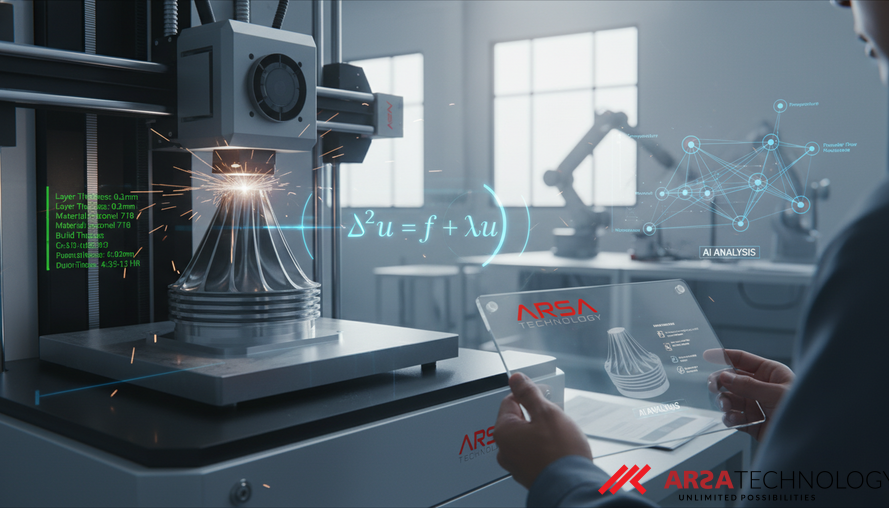
Revolutionizing Additive Manufacturing with AI and Knowledge Graphs
Additive Manufacturing (AM), commonly known as 3D printing, has rapidly transformed various sectors, from creating intricate aerospace components and personalized biomedical implants to advanced energy devices and mechanical metamaterials. This revolutionary process builds objects layer by layer, offering unparalleled design freedom and material efficiency. However, realizing its full potential hinges on a deep understanding of how process parameters—such as laser power, print speed, or material composition—influence the final product's properties, like strength, durability, or density. Traditionally, optimizing these process-property relationships has relied on extensive trial-and-error experiments, expert intuition, or costly numerical simulations. These methods are often slow, expensive, and result in knowledge that is fragmented and difficult to apply across different machines, materials, or operating conditions.
The rise of Artificial Intelligence (AI) and particularly Large Language Models (LLMs) has opened new avenues for advanced manufacturing. LLMs, adept at processing vast amounts of unstructured text, hold promise for tasks like recommending process parameters, detecting defects, guiding design choices, and analyzing experimental data. While exciting, these models present significant limitations in high-reliability engineering applications. A major concern is their tendency to "hallucinate," generating plausible-sounding but factually incorrect information. This happens because LLMs predict word sequences rather than explicitly reasoning with verified physical knowledge. This lack of inherent trustworthiness and interpretability makes their direct application in critical manufacturing processes challenging.
The Strategic Integration of Knowledge Graphs
To overcome the inherent limitations of LLMs, a powerful synergy is emerging through their integration with Knowledge Graphs (KGs). KGs are structured networks of interconnected entities and relationships, providing an explicit, interpretable, and factually accurate way to represent knowledge. Unlike LLMs, KGs store verifiable physical knowledge in a format that machines can easily query and reason over, eliminating the risk of hallucinations. They also offer symbolic reasoning capabilities, making their conclusions transparent and auditable for human users. Furthermore, domain-specific KGs can be built to capture precise, transferable knowledge relevant to particular industries or processes.
While KGs excel at structured knowledge representation, they can be static and struggle with incomplete data, which is common in complex fields like additive manufacturing. The solution lies in a unified approach where LLMs enhance KGs by extracting knowledge from unstructured sources, and KGs, in turn, guide LLMs to ensure physical consistency and reliability in their generated outputs. This combined approach leverages the strengths of both technologies, expanding their applicability across various knowledge-intensive engineering tasks.
ARSA's Advanced Framework for Reliable Additive Manufacturing
A novel, ontology-guided, equation-centric framework aims to tightly integrate LLMs with a specialized Additive Manufacturing Mathematical Knowledge Graph (AM-MKG). This framework is designed to extract reliable, equation-based knowledge from vast amounts of AM literature and use it for robust extrapolative modeling. By explicitly structuring equations, variables, underlying assumptions, and their semantic relationships within a formal ontology (a precise, machine-readable definition of concepts), unstructured scientific papers are transformed into machine-interpretable representations. This allows for systematic querying, conditioning, and extension of knowledge.
The process begins with document preprocessing to segment raw scientific papers into meaningful text units. Next, an ontology-guided knowledge graph is constructed by extracting entities and relationships based on a predefined schema, which is then organized into a hierarchical structure. This multi-level organization enables abstraction-aware access to equation-centered physical mechanisms while maintaining links to fine-grained details. Leveraging this structured foundation, LLM-based equation generation is specifically conditioned on subgraphs derived from the AM-MKG. This conditioning enforces physically meaningful functional forms for the equations and mitigates the non-physical or unstable extrapolation trends commonly observed when LLMs generate outputs without such guidance. This ensures that any predictive model or equation generated by the AI aligns with fundamental physical principles, making the predictions far more reliable for critical engineering applications.
Unlocking Business Value: Practical Applications and Benefits
Implementing such a framework offers significant business advantages, moving beyond theoretical advancements to tangible operational improvements. For businesses in manufacturing, construction, and other heavy industries, the ability to accurately predict material properties and process outcomes in additive manufacturing can drastically reduce costs and accelerate innovation. For instance, predictive maintenance powered by AI and IoT, similar to ARSA’s Industrial IoT & Heavy Equipment Monitoring solutions, can foresee potential equipment failures by analyzing sensor data and AI-derived mathematical models. This proactive approach minimizes expensive downtime and prevents unexpected repair costs, directly impacting the bottom line.
Furthermore, automated product defect detection, another area where AI Vision excels (analogous to capabilities in ARSA’s AI Video Analytics), ensures higher product quality and reduces rejection rates. By leveraging a comprehensive mathematical knowledge graph, manufacturers can optimize production parameters with greater confidence, leading to consistent, high-quality output. This translates to faster research and development cycles, allowing companies to bring new AM products to market more quickly and efficiently. The shift from heuristic rules to data-driven, knowledge-assisted manufacturing workflows provides a measurable Return on Investment (ROI) through increased efficiency, productivity, and enhanced security, aligning with the goals ARSA Technology has pursued since being experienced since 2018.
Ensuring Trust: Confidence in AI's Extrapolative Predictions
A critical innovation within this framework is the introduction of a confidence-aware extrapolation assessment. In engineering, it's not enough to simply make a prediction; understanding the reliability of that prediction is paramount, especially when extrapolating beyond existing data. This framework goes beyond conventional predictive uncertainty measures by integrating several factors into a unified confidence score: extrapolation distance, statistical stability, and knowledge-graph-based physical consistency.
The extrapolation distance quantifies how far a prediction is from the known data points used to train the model, giving an initial indication of potential uncertainty. Statistical stability assesses the consistency of predictions across various model iterations or data subsets. Most importantly, knowledge-graph-based physical consistency evaluates whether the extrapolated predictions align with the fundamental physical laws and semantic relationships encoded in the AM-MKG. This multi-faceted assessment provides a robust measure of reliability, distinguishing truly trustworthy extrapolations from potentially misleading ones. For industries where safety and performance are non-negotiable, like aerospace or medical device manufacturing, this confidence score is invaluable, enabling informed decision-making and mitigating risks associated with uncertain AI outputs. This level of rigorous assessment is crucial for applications that demand high standards of safety and compliance, much like the monitoring capabilities provided by solutions in the AI BOX - Basic Safety Guard for general industrial environments.
The Path Forward for Smart Manufacturing
The integration of Large Language Models with Mathematical Knowledge Graphs represents a significant leap forward for Additive Manufacturing. By transforming fragmented, unstructured literature into machine-interpretable, physically consistent knowledge, this framework establishes a robust foundation for reliable predictive modeling and confident extrapolation. It addresses critical challenges posed by traditional methods and enhances the trustworthiness of AI in high-stakes engineering applications. This holistic approach, combining ontology-driven knowledge representation, subgraph-conditioned equation reasoning, and rigorous confidence assessment, paves the way for a new era of AI-augmented smart manufacturing.
Companies looking to embrace this future can leverage advanced AI solutions to optimize their operations. ARSA Technology specializes in AI and IoT solutions, including the versatile AI Box Series, which transforms existing infrastructure into intelligent monitoring systems, providing similar data-driven insights. To explore how these cutting-edge technologies can drive your business's digital transformation and deliver measurable impact, we invite you to contact ARSA for a free consultation.