Enhancing Brain Network Analysis with LLM-Powered Graph Neural Networks: The BLEG Breakthrough
Explore BLEG, a novel method integrating Large Language Models (LLMs) with Graph Neural Networks (GNNs) to overcome data limitations in fMRI brain network analysis for advanced neurological diagnostics.

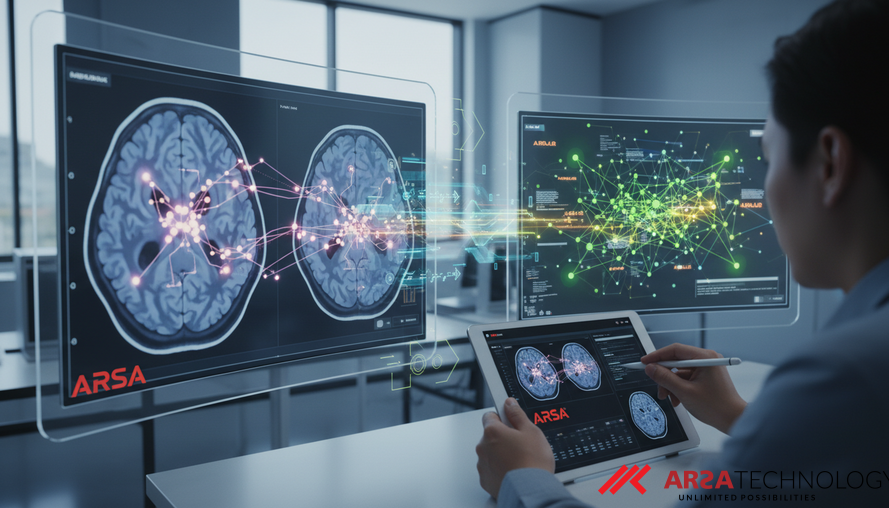
Unlocking Deeper Insights into Brain Networks with Advanced AI
Understanding the human brain's intricate mechanisms and diagnosing neurological diseases are critical challenges in modern medicine. Functional Magnetic Resonance Imaging (fMRI) has emerged as a powerful tool, generating complex data that reflects brain activity and connectivity. Analyzing this data, often represented as "brain networks" or "neurographs," typically relies on deep learning techniques, particularly Graph Neural Networks (GNNs). GNNs excel at processing graph-structured data, making them ideal for uncovering the topological features inherent in brain networks. However, these methods face significant hurdles due to the high feature sparsity of preprocessed fMRI data and an inherent lack of external domain knowledge within these uni-modal neurographs. This often limits their ability to achieve the highest accuracy in diagnostic and analytical tasks.
Meanwhile, Large Language Models (LLMs) have revolutionized the field of Natural Language Processing (NLP) with their remarkable capabilities in understanding, reasoning, and generating human language. The potential of combining LLMs with GNNs for brain network analysis presents a fascinating, yet largely unexplored, frontier. The academic paper "BLEG: LLM Functions as Powerful fMRI Graph-Enhancer for Brain Network Analysis" introduces a groundbreaking method that integrates the representational power of LLMs to significantly boost GNN performance on downstream tasks such, as gender classification, major depressive disorder (MDD) diagnosis, and autism spectrum disorder (ASD) diagnosis Source: Dong et al., 2026. This innovation promises to overcome long-standing data limitations and provide more accurate, insightful brain network analysis.
The Constraints of Traditional GNN Approaches in Brain Analysis
While GNNs have achieved considerable success in various applications, their efficacy in brain network analysis is often hampered by the nature of fMRI data itself. Brain graph data, derived from fMRI scans, often presents with limited sample sizes in research datasets, which restricts the depth of data-driven learning. Furthermore, the preprocessing pipelines applied to neurographs can lead to significant feature sparsity, meaning that much of the rich, nuanced information about brain activity and connectivity might not be explicitly captured or is lost.
Beyond these technical data constraints, brain networks derived solely from neuroimaging data are inherently uni-modal. They lack the broader contextual domain knowledge that is not directly encoded in the images. This missing information, such as clinical history, genetic markers, or cognitive assessments, could provide crucial context for a more comprehensive understanding of brain function and pathology. The combination of data sparsity, limited sample size, and the absence of multi-modal domain knowledge collectively poses significant challenges for developing highly accurate and robust GNN-based brain network analysis systems.
Leveraging Large Language Models: A New Paradigm for Neuroscience
The advent of Large Language Models (LLMs) has marked a new era in AI, demonstrating unprecedented capabilities in processing and generating human-like text. In neuroscience, earlier applications of LLMs primarily focused on text-based modalities, such as training medical language models on vast biomedical literature. More recently, multimodal LLMs (MLLMs) have emerged, integrating information from various sources like medical images, electrophysiological recordings, and structured clinical data to aid diagnosis and research. However, applying LLMs to graph-based brain network data, which comprises both node and structural features, has remained an untapped area.
This research pioneers the integration of LLMs with GNNs for neuroscience tasks, specifically fMRI brain network analysis. Instead of using LLMs as direct decoders, which would be computationally expensive and less efficient for graph data, the BLEG method innovatively functions LLMs as powerful enhancers. This approach aims to leverage the rich, contextual embeddings generated by LLMs to significantly improve the representation learning capabilities of GNNs, offering a more nuanced and informed analysis of complex brain data.
Introducing BLEG: A Cost-Effective Hybrid Framework
The BLEG (Language-Enhanced Graph Neural Network for Brain Network Analysis) framework tackles the challenges of integrating LLMs with GNNs in a practical and cost-effective manner. Recognizing the immense computational resources required to directly tune large LLMs, BLEG adopts a clever three-stage process:
1. LLM-Enhanced fMRI Graph Text Generation: The first step involves prompting a powerful LLM to generate rich, augmented text descriptions for the fMRI graph data. Essentially, each brain graph is translated into a textual format, allowing the LLM to provide high-level contextual analysis, key features, and conclusions about the graph's patterns. This process enriches the sparse numerical graph data with qualitative, human-interpretable insights derived from the LLM's vast knowledge base.
2. Graph-Text Aligned Instruction Tuning: Next, a smaller, more manageable Language Model (LM) is trained using an "LLM-LM" instruction tuning method. This training leverages the augmented textual data generated in the previous stage. Simultaneously, a GNN encoder is also trained, and a coarse alignment is established between the representations learned by the LM and the GNN. This dual training ensures that the smaller LM effectively captures the textual insights, while the GNN begins to align its graph-based understanding with this enhanced textual knowledge. This instruction tuning significantly reduces the computational cost compared to directly fine-tuning a full-scale LLM.
3. LM-Aided Supervised Fine-tuning for Downstream Tasks: In the final stage, the GNN undergoes supervised fine-tuning for specific downstream tasks, such as diagnosing particular neurological conditions. A crucial innovation here is the utilization of "logits" (the raw, unnormalized prediction scores) from the pre-tuned smaller LM. These logits are integrated to further enhance the GNN's representation learning, providing a fine-grained alignment that boosts the GNN's performance. This intelligent alignment process allows the GNN to benefit from the LLM's vast knowledge without the computational burden of a full LLM integration.
By strategically functioning LLMs and smaller LMs as enhancers, BLEG allows GNNs to learn superior representations. This approach provides a significant advantage for various brain network analysis tasks, offering a path to more accurate and robust diagnostics.
Practical Implications for Neurological Diagnostics and Beyond
The BLEG framework offers profound practical implications across various sectors, particularly in healthcare and research. By enhancing the accuracy of GNNs in analyzing fMRI data, BLEG can lead to more reliable diagnosis of neurological conditions like Major Depressive Disorder (MDD) and Autism Spectrum Disorder (ASD). This means earlier and more precise detection, which is crucial for effective intervention and treatment planning. The ability to better classify biological markers, as demonstrated by the improved gender classification, also opens doors for more personalized medicine and understanding subtle group differences in brain function.
For enterprises and healthcare providers, deploying such advanced AI solutions can transform diagnostic workflows. Instead of solely relying on expert interpretation of complex fMRI data, AI-powered systems can provide automated, objective, and highly accurate insights, supporting clinicians in their decision-making. The cost-effective nature of BLEG, by avoiding direct LLM tuning, also makes it a more viable option for real-world deployment. ARSA Technology, with its expertise in AI and IoT solutions, is well-equipped to develop and deploy custom AI solutions that integrate such advanced techniques, providing scalable and privacy-compliant systems for various industries including healthcare, public safety, and smart infrastructure. Our capabilities in AI Video Analytics and AI Box Series for edge AI systems demonstrate our commitment to practical, production-ready AI.
This pioneering integration of LLMs with GNN-based brain network analysis represents a significant step forward in leveraging the full potential of AI for understanding the human brain. It underscores the value of combining different AI paradigms to overcome individual limitations and unlock new levels of insight, ultimately leading to better health outcomes and a deeper scientific understanding.
To explore how advanced AI and IoT solutions can transform your operations and lead to breakthrough insights, do not hesitate to contact ARSA for a free consultation.