Enhancing Surgical Performance: Real-Time AI for Actionable Team Dynamics
Explore how Time-Expanded Interaction Graphs and AI model surgical team dynamics in real-time, providing actionable insights for efficiency and safety. Learn about ARSA's role in delivering such advanced solutions.

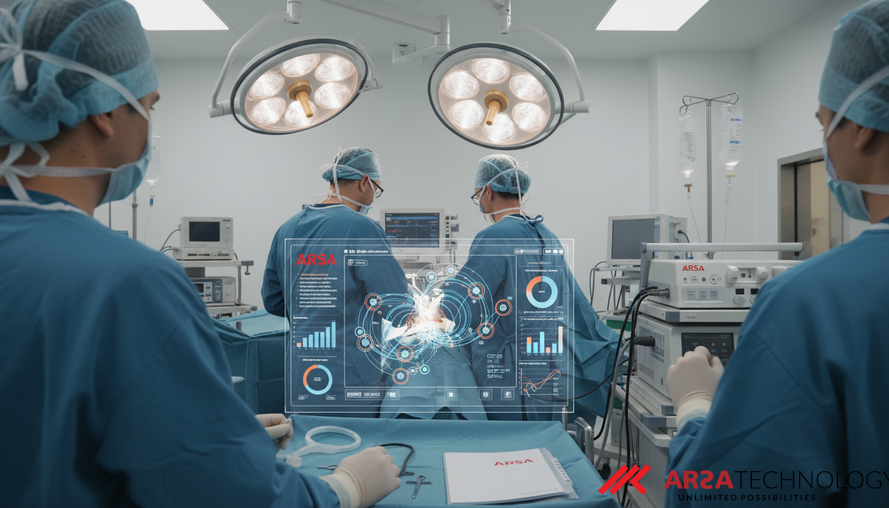
The Unseen Dynamics of Surgical Success
In the high-stakes environment of the operating room (OR), successful outcomes hinge not only on the technical skills of surgeons but also on the intricate dance of communication and coordination among the entire surgical team. While Artificial Intelligence (AI) has made significant strides in healthcare, many current surgical AI systems primarily focus on visual workflow analysis or technical skill assessment. This leaves a critical gap: the real-time dynamics of intraoperative team interactions, which are paramount for safety and efficiency, often remain unaddressed. Understanding and optimizing these complex relationships can transform surgical practice, moving beyond mere prediction to providing actionable guidance.
A recent academic paper, "Actionable Real-Time Modeling of Surgical Team Dynamics via Time-Expanded Interaction Graphs" Source: arXiv:2605.04169v1 [cs.AI], introduces a groundbreaking approach to bridge this gap. It proposes an AI system designed to model surgical team dynamics in real-time, leveraging innovative graph-based techniques. This system goes beyond identifying problems; it suggests concrete behavioral changes to enhance team performance and improve patient outcomes. For enterprises and healthcare institutions, this innovation represents a significant leap towards truly intelligent and supportive OR environments, reducing costs and enhancing security through advanced operational intelligence.
Beyond Visuals: Capturing the Nuances of Team Interaction
Traditional Surgical Data Science (SDS) research, while valuable, has largely overlooked the complex interplay of non-technical skills within surgical teams. Yet, communication breakdowns, misaligned task assignments, and subtle coordination failures can accumulate, leading to delays and increased procedural time. These temporal inefficiencies are not just minor inconveniences; they directly correlate with higher postoperative risks and significantly impact healthcare costs. For instance, a 15% increase in operative time has been linked to a 14% higher risk of complications, and prolonged surgeries can increase costs by up to 160% per procedure, with OR expenses reaching $37 per minute.
The innovation proposed in the paper lies in its ability to model team interactions by jointly capturing both the temporal (over time) and relational (between members) dimensions from multimodal communication data. Instead of relying solely on visual cues, the system processes a rich blend of data to understand how teams truly perform. This comprehensive approach is crucial for high-stakes scenarios where every second and every interaction matters, ensuring that AI provides decision support that is both accurate and genuinely actionable.
Introducing Time-Expanded Interaction Graphs: A Novel Approach
To model the intricate dynamics of surgical teams, the research introduces Time-Expanded Relational Neural Networks (TE-ReNN) and the concept of Time-Expanded Interaction Graphs. Imagine representing each team member at every 15-second interval during a surgery as a distinct "node" in a vast, interconnected network. Communication exchanges between these members during that time, or even a single member speaking to the group, form "directed edges" connecting these nodes. As time progresses, these "snapshot" graphs for each 15-second window are then linked by "identity-preserving temporal edges," creating a single, continuous Time-Expanded Interaction Graph.
This "spatio-temporal expansion" allows the system to analyze how interactions evolve over the entire surgical procedure. Crucially, while the underlying dynamics are temporal, the final expanded graph becomes a static structure that can be efficiently processed by a standard Graph Neural Network (GNN). A GNN is a type of AI designed to process data that is structured as a graph, making it adept at understanding complex relationships and patterns between interconnected entities. This technique addresses challenges in small-data environments, such as limited surgical team interaction data, by transforming dynamic information into a format optimized for robust AI analysis. Platforms that integrate real-time video feeds with advanced analytics, much like ARSA AI Video Analytics, could leverage such graph-based modeling to deliver deeper operational insights from existing infrastructure.
Decoding Behavior: From Vocal Cues to Actionable Insights
The effectiveness of this AI model is rooted in its rich input data and how it interprets subtle cues from the OR environment. For each team member, the system captures a "multimodal feature vector" in every 15-second window, integrating various data points:
Paralinguistic Features: These are vocal characteristics like loudness, alpha-ratio (indicating vocal dominance), and harmonics-to-noise ratio (reflecting vocal control/tension). These features are not about what is said, but how* it is said, offering insights into activation, engagement, and emotional state.
- Motion Features: This includes the position of each team member, their average displacement, and its standard deviation, revealing movement patterns.
- Human-Tool Interaction Features: Data on who is interacting with which object and performing specific actions (e.g., "anesthesiologist-calibrating-instrument").
- Role Features: The functional role of each team member (e.g., head surgeon, nurse), providing essential context.
To make the AI's predictions truly "actionable," the researchers have developed a "Behavioral State Representation." This maps specific combinations of paralinguistic features to interpretable behavioral classes, such as "Calm-Cooperative," "Engaged-Cooperative," or "Agitated/Over-aroused." While the model uses the raw, continuous data for high predictive accuracy during training, these discrete behavioral classes are used for generating clear, human-understandable suggestions. This dual approach ensures that the AI can both maintain fidelity to complex acoustic information and translate its findings into practical, modifiable human behaviors. For organizations seeking to implement such cutting-edge solutions, ARSA Technology, with its expertise since 2018, specializes in custom AI solutions that bridge complex data science with practical, human-centered applications.
Actionable AI: Predicting Efficiency and Guiding Improvement
The ultimate goal of this research is to create "Actionable AI" – systems that not only predict outcomes but also provide recommendations that users can act upon. In this context, the model predicts procedural efficiency by estimating the deviation from an expected surgery duration. Early identification of prolonged interventions is critical, allowing teams to adjust their strategies before minor issues escalate into significant problems.
Beyond mere prediction, the system employs a sophisticated "counterfactual analysis." This means the AI can answer "what if" questions: "What minimal changes in communication structure or team behaviors would have led to a more efficient outcome?" For example, the AI might suggest that if a certain team member had exhibited more "Calm Leader" behavior during a specific phase, the surgery might have proceeded more smoothly. This capability is revolutionary because it provides concrete, interpretable suggestions rather than just flagging a problem. Such targeted feedback empowers surgical teams to improve their non-technical skills proactively, fostering a continuous learning and adaptation cycle within the OR. Implementing such advanced, real-time analytics often requires robust edge computing, a capability offered by solutions like ARSA's AI Box Series, which processes data locally for instant insights without cloud dependency.
Real-World Impact and Future Directions in Surgical AI
The experimental evaluation on simulated surgical procedures has demonstrated the significant potential of this approach. Structured modeling of team interactions substantially improves the early identification of prolonged interventions. Furthermore, the counterfactual analysis provides coherent and actionable explanations, paving the way for targeted training and real-time intervention strategies. This work marks a crucial step in advancing surgical AI towards team-aware, real-time, and actionable decision support systems.
The implications extend beyond the OR, showcasing how advanced AI can bring unprecedented clarity and control to any high-stakes, collaborative environment where human interaction directly impacts critical outcomes. By transforming complex data into understandable behavioral insights, such systems can enhance performance, reduce risks, and optimize operations across various industries. Businesses in various industries, from manufacturing to public safety, can benefit from similar AI-driven operational intelligence.
To explore how AI and IoT solutions can transform your operations with practical, proven, and profitable deployments, we invite you to consult with our experts.
Ready to innovate your operational intelligence? Discover how ARSA Technology can deliver custom AI and IoT solutions tailored to your unique challenges. Schedule a free consultation today.