Enhancing Visual Intelligence: How AI Predicts Human Attention for Smarter Operations
Explore how advanced AI, using Gabor and texture features, predicts human visual attention for critical tasks like medical diagnostics and industrial monitoring. Discover practical applications for businesses.

The Science of Seeing: Unraveling Human Visual Search with AI
In our daily lives, we constantly perform "visual search" – from finding a specific item in a crowded supermarket aisle to spotting a critical detail in a complex report. For professionals, especially in fields like medical diagnostics, manufacturing quality control, or security surveillance, this ability to quickly and accurately find "regions of interest" (ROIs) is paramount. Understanding how humans allocate their attention and where their eyes fixate first is a fundamental challenge that artificial intelligence (AI) is now helping to solve. This understanding can revolutionize how we design AI systems to be more effective, intuitive, and aligned with human perception.
Recent academic research has delved into this complex area, investigating how specific image features influence our visual search behavior. By mimicking human visual processing, AI systems can be trained to predict where an observer is likely to focus, transforming passive data into actionable insights. This predictive capability has profound implications for businesses aiming to optimize operations, enhance safety, and improve decision-making across various industries.
Gabor and Texture Features: Decoding Visual Cues
At the heart of predicting human visual attention are advanced image processing techniques that break down visual information into digestible features. Two prominent categories explored in research are Gabor features and gray-level co-occurrence matrix (GLCM)–based texture features. While they approach image analysis differently, they both capture critical information that influences how our eyes perceive and process a scene.
- Gabor Features: Imagine a sophisticated set of filters in your brain, each tuned to recognize lines, edges, or patterns at specific angles and scales. Gabor functions are mathematical representations of these filters. They are exceptionally good at identifying local orientations and frequencies in an image – essentially, the structural building blocks of what we see. By applying Gabor filters, AI can detect where these structural elements are most prominent, often indicating a potential point of interest.
- GLCM Texture Features: Beyond simple edges, the "texture" of an image – its granularity, smoothness, or randomness – also guides our gaze. GLCM features quantify these textures by analyzing the statistical relationships between neighboring pixels. For instance, a GLCM can tell us how often a certain gray level appears next to another gray level at a specified distance. This helps describe properties like contrast, homogeneity, or correlation within an image region, which are crucial for distinguishing objects from their background.
The synergy between these two types of features is particularly potent. Research has shown a strong correlation between GLCM mean (average brightness patterns) and Gabor feature responses, suggesting that these distinct analytical methods often capture related aspects of image information. This insight is vital for developing robust AI vision systems that can understand visual cues more holistically, much like the human brain does.
Building Predictive AI Pipelines for Visual Search
To translate these feature insights into practical predictions, researchers have designed sophisticated AI "pipelines" – structured sequences of data processing. One approach involves using a Gaussian Mixture Model (GMM), an unsupervised clustering technique, to group pixels based on their GLCM or Gabor features. Think of GMM as an AI tool that automatically sorts similar-looking areas of an image into distinct categories, without needing pre-labeled examples. This clustering helps the AI understand the underlying visual structure of an image.
In one proposed pipeline, GLCM mean and contrast are calculated across an entire image. The GMM then clusters these texture data points into groups, including one representing the image background. Simultaneously, Gabor features are extracted, and initial "fixation candidates" (potential points of human attention) are identified based on areas with high Gabor responses. These candidates are then refined by filtering them through the mask generated from the GLCM clusters. This two-step approach allows the system to combine structural and textural insights to narrow down the most probable regions a human would observe. Such advanced techniques are fundamental to ARSA Technology's approach to AI Video Analytics, enhancing the ability to derive meaningful insights from visual data.
Real-World Applications: From Medical Imaging to Industry
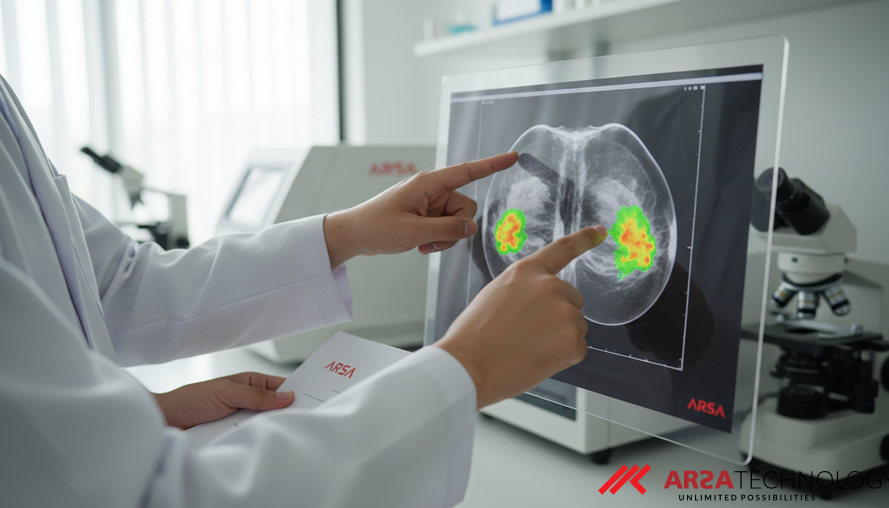
The practical implications of this research extend far beyond the laboratory. While the study utilized simulated digital breast tomosynthesis (DBT) images – a complex medical imaging modality for breast cancer detection – to validate its findings, the core principles apply to a myriad of industrial and commercial settings. In medical imaging, for example, accurately predicting where a radiologist's attention is drawn can help flag subtle abnormalities, reduce diagnostic errors, and improve training for new practitioners.
Beyond healthcare, these AI-driven visual search models hold immense promise for optimizing operations in various industries:
- Manufacturing and Quality Control: In high-speed production lines, an AI system that predicts where human inspectors would spot defects can enhance automated visual inspection. By identifying subtle textural anomalies or structural inconsistencies, the system can reduce rework, prevent faulty products from reaching the market, and free human operators to focus on more complex tasks.
- Retail and Customer Experience: Understanding customer gaze patterns in a store can optimize product placement, store layout, and advertising effectiveness. Solutions like the ARSA AI BOX - Smart Retail Counter leverage similar AI principles to analyze foot traffic, dwell times, and popular areas, helping retailers create more engaging and profitable environments.
- Security and Surveillance: In a crowded public space or a restricted industrial zone, AI that can predict suspicious behavior or potential threats by identifying anomalies in visual patterns can significantly improve real-time monitoring. By pinpointing areas that would typically draw human attention, the system reduces the burden on human operators and accelerates response times. Similarly, in occupational safety, an AI that monitors for missing Personal Protective Equipment (PPE) like the ARSA AI BOX - Basic Safety Guard applies sophisticated visual feature detection to ensure compliance and worker safety.
- Logistics and Transportation: Monitoring large vehicle fleets or managing complex parking facilities benefits from AI that can detect unusual vehicle movements, identify congestion, or track specific vehicle types. This kind of visual intelligence is at the core of solutions like the ARSA AI BOX - Traffic Monitor, which transforms existing CCTV infrastructure into smart vehicle analytics systems.
The Impact of AI-Driven Visual Search Modeling
The research demonstrates that combining structural (Gabor) and texture-based (GLCM) features provides a robust foundation for predicting human visual attention. The strong correlation found between these features highlights their complementary nature and reinforces the idea that diverse visual cues contribute to our perception. This consistency between AI-predicted fixation regions and early-stage human gaze behavior, confirmed through eye-tracking data, validates the approach.
For businesses, integrating such perceptually informed AI models offers tangible benefits:
- Increased Efficiency: Automating the preliminary identification of regions of interest significantly reduces the manual effort and time required for analysis, whether in reviewing medical scans or monitoring factory floors.
- Enhanced Accuracy: By leveraging AI models proven to align with human visual search, organizations can improve the accuracy of anomaly detection, compliance checks, and overall surveillance.
- Cost Reduction: Minimizing human error, preventing accidents (e.g., through PPE detection), and optimizing operational layouts can lead to substantial cost savings.
- Data-Driven Decisions: Transforming passive video feeds into actionable data provides objective metrics for strategic planning, resource allocation, and continuous improvement.
As we move towards increasingly complex environments and larger data volumes, the ability of AI to intelligently process visual information and predict human attention will become an indispensable asset. ARSA Technology, with its expertise in AI and IoT solutions, is at the forefront of implementing these advanced computer vision principles to deliver measurable impact for enterprises across the globe.
Ready to harness the power of AI to transform your visual data into strategic insights and optimize your operations? Explore ARSA's innovative AI and IoT solutions and contact ARSA today for a free consultation.