FreeOrbit4D: Revolutionizing Camera Redirection for Monocular Videos with Geometry-Complete 4D Reconstruction
Explore FreeOrbit4D, a training-free framework that enables arbitrary camera redirection from single videos using geometry-complete 4D reconstruction. Discover its applications in AR/VR, cinema, and digital twins.

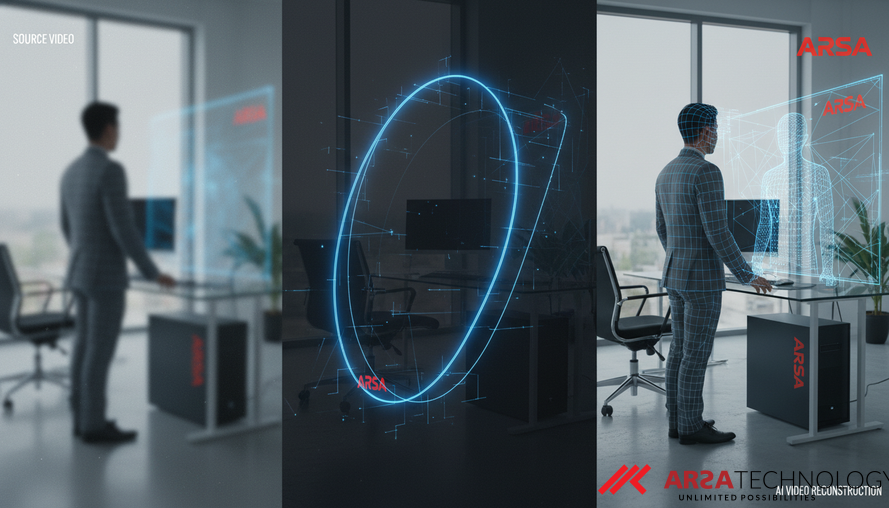
Unlocking New Perspectives: The Promise of Arbitrary Camera Redirection
Imagine watching a video clip, perhaps an interview or a sports highlight, and instantly being able to re-experience that exact moment from any conceivable angle – from the side, a top-down view, or even a slow-motion "bullet-time" orbit. This is the ambitious goal of camera redirection: transforming a standard video, captured from a single viewpoint, into an interactive, free-viewpoint experience. Such capability holds immense potential for various industries, from creating more immersive content for augmented and virtual reality (AR/VR) to enhancing cinematic effects that typically demand expensive multi-camera setups. For example, in autonomous driving, reviewing incidents from multiple angles could provide invaluable data, while in manufacturing, a dynamic 3D view of a process could aid in quality control.
However, achieving this level of arbitrary camera redirection from a single monocular video is a profoundly complex challenge. A traditional video provides only a narrow, two-dimensional "window" into a dynamic three-dimensional world, offering highly partial observations. The information about what lies behind objects, or how an object fully appears when rotating, is simply missing. This inherent lack of data leads to significant geometric ambiguity and temporal inconsistency when trying to generate entirely new viewpoints, especially those far removed from the original camera path. While some existing AI models can generate impressive visual content, they often struggle when faced with these "large-angle" viewpoint changes, resulting in distorted geometry or flickering visuals due to insufficient understanding of the underlying 3D (and dynamic 4D) world.
The Foundational Challenge: Reconstructing the Dynamic 4D World
The core difficulty in camera redirection lies in accurately reconstructing a complete and coherent "plenoptic representation" – essentially, a full visual and geometric understanding of the dynamic scene from all possible angles at every moment in time. Without this comprehensive understanding, any attempt to generate views from drastically different perspectives will inevitably encounter gaps, known as occlusions, where information was never captured by the original camera. This is a problem that traditional computer vision methods have grappled with for decades.
Previous approaches to camera redirection generally fall into two categories, each with its own limitations. "Implicit control" methods attempt to guide video generation by embedding camera trajectories or text descriptions into AI models. While flexible, these often offer only "soft" control, meaning the generated video might not perfectly follow the desired camera path, and require vast amounts of meticulously labeled data for training. The alternative, "explicit warping," tries to project the pixels from the original video onto a new viewpoint using estimated depth information. This method offers more precise control, but it invariably leaves visible "holes" or unfilled regions where parts of the scene were originally hidden from view. These gaps then need to be "hallucinated" or guessed by other generative models, which can lead to visual inconsistencies, especially during large camera movements. Neither of these paradigms has fully achieved both precise camera control and complete visibility of unseen areas, which are critical for truly faithful large-angle camera redirection.
Introducing FreeOrbit4D: A Geometry-Complete Approach
A recent academic paper introduces FreeOrbit4D, an innovative training-free framework that addresses these fundamental limitations. Its breakthrough lies in its ability to explicitly reason about and recover a complete 4D geometry from the partial observations of a single monocular video. This "geometry-complete 4D proxy" then serves as robust structural guidance for generating new video frames from novel viewpoints. By "completing the geometry" – essentially figuring out the full 3D shape of objects, even their hidden sides – FreeOrbit4D resolves the ambiguities that plague prior methods, enabling consistent video synthesis even when the target camera path is drastically different from the original. This is a significant leap forward, as it means the system doesn't need to be retrained for every new scene or object, offering a high degree of flexibility and efficiency.
The method ingeniously separates the complex task of reconstructing a dynamic scene into more manageable sub-tasks. It first "unprojects" the original monocular video into a global 3D space, creating a static background and incomplete 3D representations of moving foreground objects. The key innovation then emerges in how it tackles the missing parts of the foreground objects. It uses an advanced object-centric multi-view diffusion model to synthesize what these objects would look like from multiple angles, effectively "filling in" the unseen portions and building a complete 3D model of each moving entity in its "canonical object space" – a standardized orientation that makes understanding its full shape much easier.
How FreeOrbit4D Reconstructs and Redirects
The real challenge, and brilliance, lies in unifying these separate reconstructions into a coherent whole. FreeOrbit4D achieves this through "dense pixel-synchronized 3D–3D correspondences," a sophisticated process that meticulously matches points on the newly completed 3D object models back to their corresponding pixels in the original video. This allows for the precise alignment of the complete foreground objects back into the global scene, resulting in a truly "geometry-complete 4D proxy." This proxy essentially functions as a digital twin of the entire dynamic scene, offering a comprehensive 3D model that evolves over time.
Once this 4D proxy is established, it's used to generate "geometric scaffolds" – like detailed depth maps and visibility cues – from the desired target camera viewpoints. These scaffolds provide essential structural guidance to a "conditional video diffusion model," which then generates the final redirected video. This two-stage process (first reconstruct geometry, then generate video guided by that geometry) ensures that the output videos maintain faithful appearance and strong temporal coherence, even under extreme camera motions like bullet-time effects. The result is a video that not only looks visually stunning but also maintains geometric accuracy and consistency across different viewpoints and over time. For businesses requiring detailed spatial awareness, such capabilities could be transformative. ARSA Technology specializes in AI Video Analytics, leveraging computer vision and deep learning to derive actionable insights from video footage, which shares fundamental principles with the geometric reasoning at the heart of FreeOrbit4D.
Practical Applications and Business Impact
The capabilities demonstrated by FreeOrbit4D extend beyond impressive visual effects. Its ability to create geometry-complete 4D reconstructions from single videos opens new avenues for practical applications:
- Cinematic Production: Demolishing the need for costly multi-camera rigs for bullet-time effects or complex camera movements, democratizing high-end production for smaller studios or independent creators.
- AR/VR Content Creation: Generating dynamic 3D assets for virtual environments becomes significantly easier and more cost-effective, offering users more realistic and interactive experiences.
- Digital Twins and Simulations: Creating accurate 4D digital twins of real-world events or industrial processes from standard video footage can enable better analysis, predictive maintenance, and operational optimization.
- Surveillance and Forensics: Reconstructing incident scenes from various angles could provide clearer insights for security personnel or investigators.
- Manufacturing and Logistics: Imagine monitoring a production line or warehouse activity from any virtual angle to identify bottlenecks, improve safety, or detect product defects. Solutions such as ARSA’s AI BOX - Basic Safety Guard for PPE detection and AI BOX - Traffic Monitor for vehicle analytics already utilize advanced computer vision to provide critical operational insights, demonstrating the existing real-world application of such visual intelligence.
By producing more faithful and temporally coherent redirected videos under challenging large-angle trajectories, FreeOrbit4D's geometry-complete 4D proxy offers a powerful new tool. It enhances the visual generation quality and opens the door for other applications like "edit propagation" (making changes to an object in one view and having them automatically apply consistently across all views) and comprehensive "4D data generation" for advanced AI training or simulation environments. This innovation represents a significant step towards enabling machines to truly understand and manipulate dynamic 3D scenes from limited 2D input.
Source: Wei Cao et al., "FreeOrbit4D: Training-Free Arbitrary Camera Redirection for Monocular Videos via Geometry-Complete 4D Reconstruction," arXiv preprint arXiv:2601.18993, 2026. https://arxiv.org/abs/2601.18993
Harness the power of advanced AI and IoT solutions to transform your operations. To explore how ARSA Technology can provide tailored computer vision and video analytics systems for your enterprise needs, we invite you to contact ARSA for a free consultation.