Infrared Vision Unleashed: How Trajectory-Aware AI Boosts Small Target Detection
Discover how TAPM-Net, an innovative AI model inspired by physical diffusion, revolutionizes infrared small target detection. Achieve higher accuracy and efficiency for critical surveillance, defense, and industrial monitoring applications.

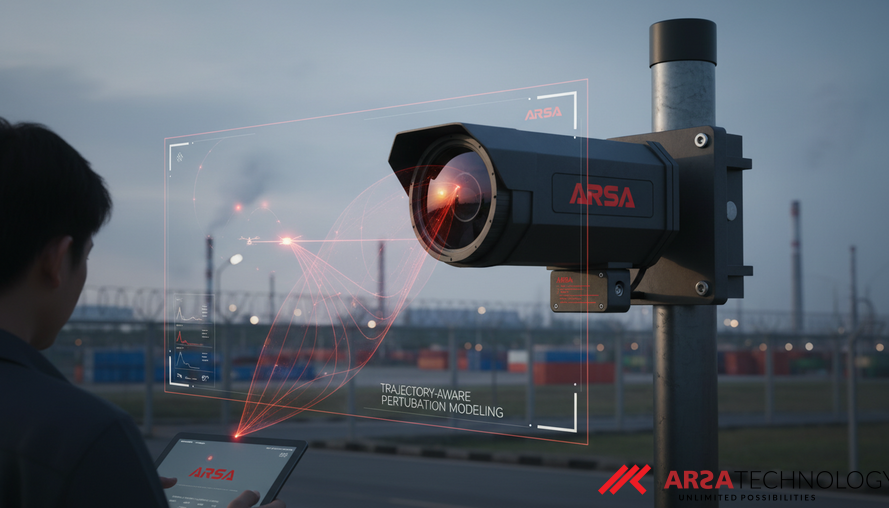
The Critical Challenge of Detecting the Unseen
In an increasingly complex world, the ability to detect small, distant objects in challenging environments is paramount. Infrared Small Target Detection (ISTD) is a critical task for various applications, from national security and defense to industrial monitoring and smart city surveillance. Imagine needing to spot a small drone against a chaotic urban skyline, a faint heat signature of an intruder in dense fog, or a tiny anomaly on a fast-moving production line. These targets are characterized by their weak signal contrast, limited spatial extent (they appear very small), and often cluttered backgrounds, making them incredibly difficult for human operators and traditional vision systems to reliably identify.
Conventional approaches, while useful, often fall short. Early methods focused on isolating targets by suppressing background noise or treating targets as isolated anomalies. However, these techniques frequently suffered from low accuracy, struggled in complex scenes, and were vulnerable to structured noise that could mimic targets. More recently, sophisticated deep learning models like Convolutional Neural Networks (CNNs) and Vision Transformers (ViTs) have significantly improved detection accuracy by learning data-driven features. Yet, even these advanced models face hurdles: they can be computationally intensive, making them impractical for resource-constrained edge devices, and they often lack a nuanced mechanism to understand how a tiny target's presence subtly "perturbs" the visual data, particularly how this disturbance propagates through the system's internal processing layers.
Introducing TAPM-Net: A New Paradigm in AI Vision
To overcome these long-standing limitations, researchers have introduced the Trajectory-Aware Mamba Propagation Network (TAPM-Net), a groundbreaking approach that fundamentally redefines how AI detects small targets in infrared imagery. Instead of merely looking for bright spots or distinct shapes, TAPM-Net draws inspiration from physical diffusion models, treating small targets not as isolated peaks but as subtle sources of "structured perturbation" that spread through the AI's internal feature space. Imagine a tiny pebble dropped into a vast pond: the ripples it creates, though faint, carry information about its origin and characteristics. TAPM-Net aims to trace these digital "ripples."
This innovative network is built upon two core components. First is the Perturbation-guided Path Module (PGM), which intelligently constructs "perturbation energy fields" from multi-level features within an image. From these fields, it extracts "gradient-following feature trajectories." In simpler terms, the PGM identifies areas where a target causes a disturbance and maps out the directional paths along which this disturbance spreads within the AI's data processing. Second is the Trajectory-Aware State Block (TASB). This block utilizes a Mamba-based state-space architecture, which is a highly efficient type of neural network. The TASB dynamically models how the target's influence propagates along these identified trajectories, incorporating "velocity-constrained diffusion" (ensuring the spread is consistent with how such information should logically move) and "semantic-aligned feature fusion" to merge word- and sentence-level embeddings. This sophisticated fusion ensures the system understands both fine-grained details and broader contextual information, enabling a coherent and precise interpretation of the perturbation.
How TAPM-Net Achieves Superior Performance and Efficiency
The key advantage of TAPM-Net lies in its ability to enable anisotropic, context-sensitive state transitions along spatial trajectories. Unlike traditional attention-based methods that process information globally and uniformly, TAPM-Net focuses its computational power on following the specific, directional paths of target-induced disturbances. This means the AI's internal 'thinking' adapts based on the direction and surrounding context of the disturbance, rather than applying a one-size-fits-all approach. This targeted processing allows TAPM-Net to maintain global coherence in its understanding of the scene while significantly reducing computational costs.
The Mamba architecture, upon which the TASB is built, plays a crucial role in this efficiency. Mamba's linear-time recurrence offers substantial advantages over traditional attention mechanisms, especially when dealing with long sequences of data—or, in this case, complex spatial trajectories. By integrating trajectory-guided state propagation, TAPM-Net captures intricate, anisotropic feature flow patterns induced by small targets, without sacrificing real-time processing capabilities or requiring massive computing resources. Experiments on recognized datasets like NUAA-SIRST and IRSTD-1K have demonstrated that TAPM-Net achieves state-of-the-art performance in infrared small target detection, proving its effectiveness under both demanding detection requirements and stringent deployment constraints.
Practical Applications and Business Impact
The breakthroughs demonstrated by TAPM-Net have profound implications for various industries, offering tangible benefits in security, operational efficiency, and data-driven decision-making. By providing highly accurate and efficient detection of subtle, weak infrared targets, this technology can significantly enhance existing systems and unlock new capabilities.
- Enhanced Surveillance and Security: For critical infrastructure, borders, or large public spaces, detecting small, fast-moving threats like drones or unauthorized personnel from a distance is vital. TAPM-Net's ability to discern weak signals from noise means faster, more reliable threat identification. Solution providers like ARSA AI Video Analytics can integrate such advanced computer vision models to provide superior situational awareness, reducing false alarms and accelerating response times.
- Industrial Monitoring and Safety: In manufacturing and heavy industry, detecting small defects on production lines or monitoring subtle changes in equipment operation can prevent costly downtime and ensure safety. By deploying AI vision models on ARSA AI Box Series edge devices, companies can achieve real-time quality control and proactive maintenance, even in challenging industrial environments. For example, ensuring worker safety and compliance through automatic PPE detection, akin to ARSA's AI BOX - Basic Safety Guard, can be made more robust with such advanced detection capabilities.
- Smart City and Transportation Management: Monitoring traffic flow, identifying unusual vehicle behavior, or detecting potential anomalies in smart city infrastructure requires intelligent vision systems. TAPM-Net's efficiency allows for broader deployment and real-time analysis, contributing to smarter mobility and safer public spaces. ARSA's AI BOX - Traffic Monitor already provides intelligent vehicle analytics, and integrating more sophisticated detection models further refines these capabilities.
- Defense and Remote Sensing: For defense applications, reliable detection of stealthy targets is non-negotiable. For remote sensing, identifying subtle environmental changes or monitoring wildlife movements in challenging terrains benefits from advanced infrared analysis. The ability to perform such complex analysis with high accuracy and low computational overhead makes this technology suitable for deployment in various platforms, from ground stations to aerial vehicles.
ARSA Technology, being experienced since 2018 in AI and IoT solutions, understands the practical realities of deploying such advanced models. The focus on edge computing and privacy-by-design ensures that while sophisticated analysis is performed, data remains secure and processing happens locally, providing both efficiency and compliance.
The Future of AI-Powered Surveillance and Monitoring
The development of TAPM-Net marks a significant step forward in artificial intelligence's ability to perceive and interpret the world around us. By shifting the focus from simple detection to understanding the dynamic "perturbations" caused by small targets, this research paves the way for a new generation of AI vision systems that are not only more accurate but also vastly more efficient. This efficiency is critical for accelerating the adoption of AI and IoT in resource-constrained environments, making advanced capabilities accessible for a wider range of applications.
As industries continue their digital transformation journey, leveraging such sophisticated AI models will be key to unlocking new levels of security, operational excellence, and data-driven intelligence. The ability to derive actionable insights from what was once an incomprehensible stream of data empowers businesses and governments to make faster, more informed decisions, ultimately leading to safer and smarter operations.
Ready to explore how advanced AI Vision solutions can transform your operations? Learn more about ARSA Technology's innovative products and services, and contact ARSA today for a consultation tailored to your specific industry needs.