MedExpMem: Revolutionizing Medical Diagnosis with AI Experience Memory
Discover MedExpMem, an innovative AI framework that equips medical Vision-Language Models with crucial differential diagnosis expertise by learning from past errors in a privacy-preserving manner.

The Nuance of Medical Diagnosis and AI's Challenge
Medical expertise extends far beyond simply memorizing textbook definitions; it's a dynamic skill refined through countless clinical encounters. While aspiring medical professionals can master the theoretical knowledge of various diseases – their typical imaging patterns, diagnostic criteria, and management protocols – matching the diagnostic acumen of seasoned clinicians remains a significant challenge. The crucial differentiator often lies in clinical experience: the refined, case-specific insights accumulated through repeated exposure to subtle diagnostic ambiguities and differentiating conditions. This experience isn't just a record of past cases, but an abstract distillation of comparative judgments, understanding why two conditions might be confused, which subtle features truly distinguish them, and when to favor one diagnosis over another.
In the realm of Artificial Intelligence, Vision-Language Models (VLMs) have shown remarkable promise in interpreting medical images. However, these models typically operate in a stateless manner, treating each diagnostic session as an isolated event without retaining any persistent "experience" from prior encounters. While theoretically, fine-tuning could embed this experiential knowledge into a VLM's parameters, this approach is often impractical in clinical environments. Challenges include stringent privacy regulations, substantial computational costs, and the risk of catastrophic forgetting, where new learning overwrites previously acquired knowledge. These limitations highlight a critical gap: how can AI models continuously learn and adapt their diagnostic capabilities in a way that mirrors human clinical progression, especially in a field as complex and sensitive as medicine?
MedExpMem: An AI Framework for Differential Diagnosis Expertise
To bridge this crucial gap, a novel framework called MedExpMem has been proposed. It empowers VLM-based diagnostic agents to accumulate differential diagnosis expertise without requiring constant parameter updates, a key advantage for real-world medical deployment. Traditional approaches, such as Retrieval-Augmented Generation (RAG), typically supplement models with external knowledge by retrieving encyclopedic disease descriptions. However, this often falls short in differential diagnosis, which demands highly specific, comparative knowledge to distinguish between confusable conditions. Existing memory mechanisms for AI agents usually store factual summaries or conversational histories, rather than abstracting complex comparative reasoning patterns. MedExpMem takes a fundamentally different approach.
Unlike systems that organize memory around individual diseases, MedExpMem structures its knowledge around diagnosis pairs – the foundational unit of differential reasoning. This innovative approach allows the AI to learn specifically why conditions are often confused and how to effectively distinguish them. Each "experience note" within MedExpMem is derived from the diagnostic agent's own past failures, creating a personalized learning mechanism that targets its specific blind spots. This ensures the accumulated knowledge is directly relevant to improving the model's performance where it struggles most, offering a pragmatic path to continuous improvement in complex diagnostic tasks. The framework’s ability to adapt without altering core model parameters aligns well with the stringent requirements of clinical settings, where data privacy and model stability are paramount. ARSA Technology, with its expertise in AI Video Analytics and custom AI solutions, recognizes the immense value of such adaptive and privacy-preserving AI systems in healthcare.
The Power of Pairwise Differential Experience Notes
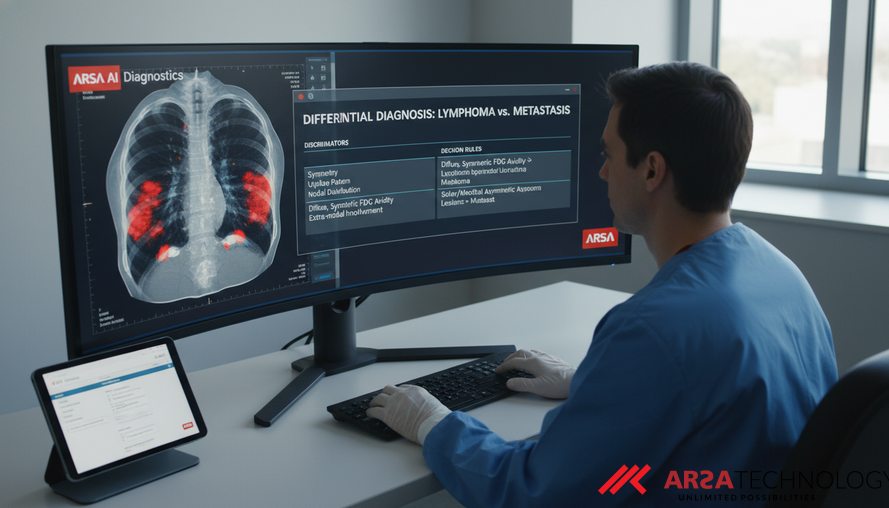
The core innovation of MedExpMem lies in its meticulously designed structured experience notes, which are organized around diagnosis pairs. This "A vs. B" organization offers significant advantages over merely retrieving descriptions of isolated conditions. When a clinician faces two similar conditions, they don't just recall what each disease is; they actively compare and contrast them, looking for subtle distinguishing factors. MedExpMem replicates this by providing targeted discriminative knowledge that explicitly highlights the differences between commonly confused diagnoses. For instance, a note on "Lymphoma vs. Metastasis" would contain specific details that separate these two conditions, which would not be found by simply reviewing individual descriptions of Lymphoma and Metastasis.
Each pairwise experience note in MedExpMem is rich with actionable insights. It includes a comprehensive set of "key discriminators" – features that specifically favor one diagnosis over the other in a given pair. Beyond just identifying these features, the notes also encode "actionable decision rules," guiding the AI on how to interpret these discriminators in specific contexts. Crucially, the notes capture "reasoning error patterns" that previously led the agent to misdiagnosis, allowing it to proactively avoid these pitfalls in the future. This structure reflects the bidirectional nature of clinical reasoning, where understanding what makes two conditions similar is just as important as knowing what makes them different. This granular, comparative knowledge is what elevates MedExpMem beyond standard knowledge retrieval, providing true differential reasoning support.
Mirroring Human Learning: MedExpMem's Two-Phase Memory Construction
The construction of MedExpMem’s experience memory is designed to closely mimic the iterative learning process of a human physician. It involves a two-phase process, both guided by expert-verified diagnostic knowledge, ensuring that the accumulated experience is both accurate and robust. This method allows for continuous and robust accumulation of expertise without the need for cumbersome parameter updates, making it highly adaptable for clinical deployment.
In Phase I: Zero-Shot Blind-Spot Discovery, the AI agent performs an initial round of diagnoses on cases without any prior experience memory. This "zero-shot" diagnosis stage is crucial for exposing the model's inherent reasoning blind spots and identifying cases where it struggles or makes errors. These diagnostic failures become the raw material for learning. Subsequently, in Phase II: Reflective Refinement, the agent revisits these erroneous cases, but this time, it has access to the experience accumulated from Phase I. This simulated "iterative practice" allows the agent to consolidate reliable diagnostic patterns, correct inconsistencies in its reasoning, and filter out spurious errors. By learning from its own mistakes in a structured, reflective manner, MedExpMem builds a personalized and effective knowledge base that continually improves its differential diagnostic capabilities. This approach aligns with ARSA Technology's commitment to practical, deployable AI solutions proven in demanding environments, which is a hallmark of our experienced since 2018 journey.
Real-World Impact and Deployment Advantages
The analytical experiments conducted with MedExpMem on a radiology benchmark, spanning 11 subspecialties, demonstrated consistent accuracy improvements across diverse models and scales, with a maximum gain of 7.0%. This significant improvement highlights the practical value of integrating an experience memory into VLM-based diagnostic systems. By enabling continuous adaptation without modifying core parameters, MedExpMem offers substantial advantages for real-world clinical environments where privacy and data governance are non-negotiable.
The framework's privacy-by-design approach means that sensitive patient data can remain localized, as the learning occurs from the agent’s own processing failures rather than requiring external data transfer or extensive retraining. This makes it an ideal solution for hospitals and healthcare providers operating under strict regulations like GDPR or HIPAA. Furthermore, the decoupling of experience from model parameters mitigates the risks of catastrophic forgetting often associated with traditional fine-tuning. For healthcare facilities and enterprises seeking to deploy advanced AI with robust data governance, solutions like ARSA's on-premise AI systems or the Self-Check Health Kiosk exemplify similar principles of privacy-preserving, adaptive technology designed for critical operations. MedExpMem represents a forward step in medical AI, allowing models to learn and evolve dynamically, much like human experts, ultimately leading to more accurate and reliable diagnostic assistance.
Conclusion
The development of MedExpMem represents a significant leap forward in empowering AI for medical diagnosis. By moving beyond static knowledge and embracing a dynamic, experience-driven learning paradigm, AI diagnostic agents can now acquire and refine critical differential diagnosis expertise. This framework, through its structured pairwise experience notes and human-mimicking two-phase construction process, ensures that AI models learn effectively from their own diagnostic journeys, leading to enhanced accuracy and robust performance. This innovation not only improves diagnostic capabilities but also aligns with the practical and privacy-sensitive realities of healthcare deployment.
At ARSA Technology, we are dedicated to engineering intelligent solutions that deliver measurable impact in critical sectors like healthcare. Our expertise in AI and IoT, combined with a focus on practical deployment and data integrity, positions us to help enterprises integrate such advanced capabilities. To learn more about how intelligent technology can transform your operations and to explore our solutions, we invite you to contact ARSA team for a free consultation.
Source: MedExpMem: Adapting Experience Memory for Differential Diagnosis