Navigating Autonomous Systems: A Business Guide to PID vs. Fuzzy Logic Control
Explore the strategic choice between PID and Fuzzy Logic control for industrial automation and autonomous systems. Understand their applications, benefits, and how AI drives optimal performance.

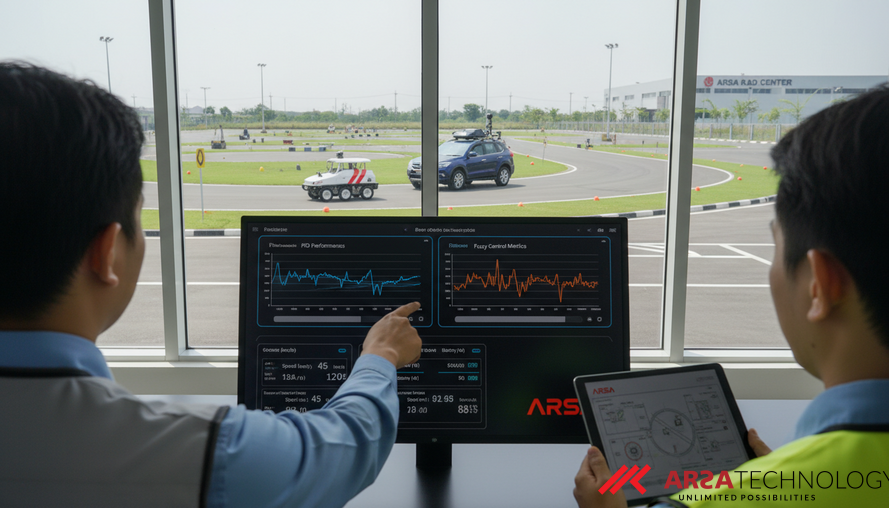
The Strategic Importance of Advanced Control Systems in Industry
Modern industry is rapidly embracing autonomous systems, from self-driving vehicles in logistics to automated production lines in manufacturing. The intelligence driving these systems relies heavily on sophisticated control methodologies that dictate how machines respond to their environment. For businesses aiming for digital transformation, understanding these core control systems is not just a technicality but a strategic imperative. The choice between different control paradigms, such as Proportional-Integral-Derivative (PID) control and Fuzzy Logic, significantly impacts operational efficiency, safety, and ultimately, a company's bottom line.
Just as engineers in training learn to critically evaluate design alternatives, businesses must undertake a similar process when deploying AI and IoT solutions. It's not enough for a system to simply "function"; it must perform optimally, adapt to dynamic conditions, and deliver measurable return on investment (ROI). This requires a deep dive into how various control systems operate and their suitability for specific, often complex, real-world challenges. ARSA Technology, with its deep expertise, helps enterprises navigate these decisions, transforming existing infrastructure into intelligent, high-performing assets.
Understanding Core Control Methodologies: PID and Fuzzy Logic
At the heart of many automated systems are control algorithms that manage and regulate processes. Two prominent examples are PID control and Fuzzy Logic control. A PID controller is a widely used, robust feedback control loop mechanism that continuously calculates an "error value" as the difference between a desired setpoint and a measured process variable. It then applies a correction based on proportional, integral, and derivative terms to minimize this error. PID controllers are well-suited for systems with predictable, linear behavior and are prized for their simplicity and reliability when properly tuned.
In contrast, Fuzzy Logic control offers a more human-like approach to decision-making. Instead of precise mathematical models, it uses "fuzzy" sets and linguistic rules (e.g., "if temperature is hot and speed is fast, then reduce power slightly") to handle systems that are complex, non-linear, or have inherent uncertainties. This makes Fuzzy Logic particularly effective in scenarios where a clear mathematical model is difficult to derive, such as controlling autonomous robots operating in unpredictable environments. For example, ARSA's AI BOX - Traffic Monitor utilizes advanced analytics to adapt to dynamic traffic conditions, a scenario where a flexible control approach is invaluable.
Real-World Applications and the Challenge of Optimization
The application of these control systems spans across various industries. In manufacturing, PID controllers might regulate temperature in an oven or pressure in a chemical reactor, ensuring consistent product quality. Fuzzy Logic, on the other hand, could manage robotic arms performing delicate assembly tasks, adapting to slight variations in part placement or material properties. In logistics, PID might govern the speed of a conveyor belt, while Fuzzy Logic could control the navigation of an autonomous forklift in a crowded warehouse, interpreting sensory data to avoid obstacles and optimize routes.
One compelling example is in leader-follower robotics, where an autonomous vehicle maintains a specific distance and orientation behind a lead vehicle. This requires precise control over speed and steering, often in dynamic conditions. While a PID controller can be tuned for stable following behavior, a Fuzzy Logic controller might offer more adaptable and smoother responses, especially when the lead vehicle's movements are erratic or environmental factors change. The challenge for engineers and businesses lies in determining which method delivers superior performance against specific, quantifiable criteria. ARSA's expertise in AI Video Analytics provides the visual intelligence needed to monitor and assess such complex interactions in real time.
The Necessity of Comparative Analysis and Data-Driven Decisions
In real-world engineering, problems rarely come with clear-cut solutions or explicit performance criteria. Businesses must define their own metrics for success, develop experimental procedures to test alternatives, and make informed design decisions based on comprehensive analysis. This process demands a high level of critical thinking, moving beyond mere implementation to evaluating, synthesizing, and optimizing solutions. For instance, when implementing an automated safety system like ARSA's AI BOX - Basic Safety Guard, it's crucial to compare different detection algorithms or response protocols to ensure maximum effectiveness and compliance.
The complexity of comparing control methods like PID and Fuzzy Logic stems from the multitude of factors that influence performance: environmental conditions, sensor accuracy, actuator response, and the specific performance goals (e.g., stability, response time, energy efficiency, adaptability). A solution that performs well in a controlled lab setting might fail in a real-world industrial environment with dust, vibrations, or inconsistent lighting. This underscores the need for thorough, data-driven comparative studies, rather than relying on assumed optimal solutions. ARSA Technology is committed to building solutions that are not only innovative but also proven and scalable, ready for practical deployment.
ARSA Technology: Your Partner in AI-Powered Automation
ARSA Technology brings deep experience in developing and deploying advanced AI and IoT solutions that tackle these complex industrial challenges. Our approach is rooted in providing measurable ROI, enhancing security, and boosting operational efficiency across various sectors. Whether it’s optimizing heavy equipment monitoring with predictive maintenance, transforming existing CCTV into intelligent surveillance systems, or enabling sophisticated traffic management, our solutions are designed for real-world impact. We offer specialized hardware like the ARSA AI Box Series, which integrates edge computing power to deliver real-time analytics with maximum privacy.
We understand that adopting cutting-edge technology requires more than just off-the-shelf products; it demands a partner capable of conducting detailed analysis, customising solutions, and providing continuous support. Our team, with its expertise in computer vision, industrial IoT, and data analysis, works closely with clients to define clear objectives, develop tailored AI models, and ensure seamless integration with existing business systems. This collaborative approach ensures that the chosen control methodologies and AI applications are perfectly aligned with your operational needs and strategic goals.
Ready to explore how advanced control systems can transform your operations and drive measurable results? We invite you to explore ARSA's comprehensive AI and IoT solutions and contact ARSA for a free consultation.