Optimizing Energy Storage: Mapping High-Performance Battery Scheduling with AI
Explore how AI optimizes battery scheduling by analyzing data uncertainty, battery design, and planning horizons, ensuring efficiency and cost savings for industrial energy storage.

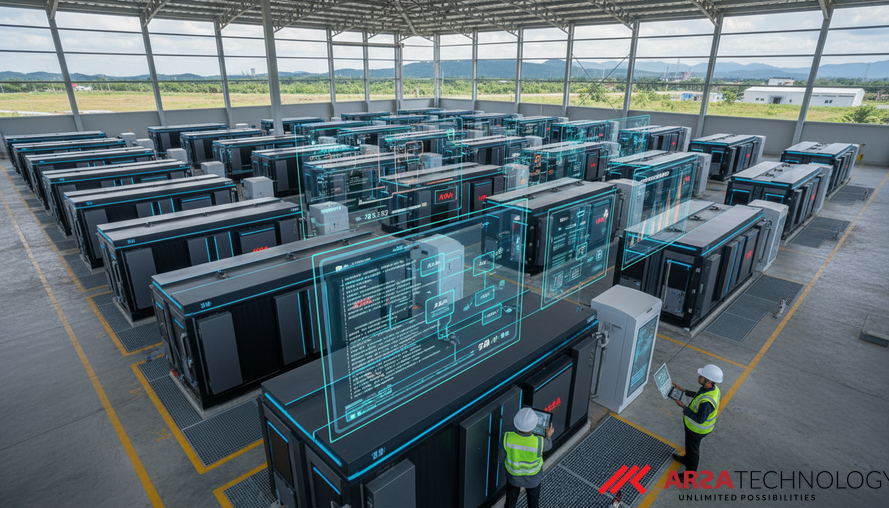
Battery energy storage systems (BESS) are rapidly becoming indispensable components of modern energy infrastructure. They are crucial for integrating intermittent renewable energy sources, stabilizing grids, and enabling profitable participation in electricity markets through energy arbitrage. However, effectively managing these complex systems requires sophisticated scheduling strategies, especially when faced with the inherent uncertainties of future energy prices, load demands, and renewable generation. A recent academic paper, "Mapping High-Performance Regions in Battery Scheduling across Data Uncertainty, Battery Design, and Planning Horizons" by Jaime de-Miguel-Rodriguez et al., delves into the intricate relationship between various factors influencing optimal battery operation, offering critical insights for industrial applications.
The Foundational Role of Battery Scheduling
At its core, battery scheduling involves optimizing when to charge and discharge an energy storage system to meet specific objectives, such as minimizing operational costs or maximizing economic profit. This optimization must adhere to various physical and operational constraints, including energy capacity, power limits, and state-of-charge boundaries. While often simplified to linear programs, more detailed formulations may employ advanced nonlinear optimization techniques to capture complex battery behaviors. The challenge intensifies when considering the predictive nature of these schedules; they are inherently reliant on forecasts of future values, which are always subject to error and uncertainty.
Forecast uncertainty is a well-established challenge, particularly in energy systems increasingly dependent on variable renewable sources like solar and wind. Traditional methods for optimizing under uncertainty, such as stochastic optimization or Model Predictive Control (MPC), have gained renewed importance. MPC operates on a receding-horizon framework, where an optimization problem is repeatedly solved over a rolling window as new information becomes available. This adaptive approach helps systems make informed decisions in dynamic environments, but the choice of the "optimization window" or planning horizon length is paramount.
Navigating Uncertainty: The Crucial Planning Horizon
The length of the planning horizon in MPC is a critical design decision. A horizon that is too short can lead to myopic decisions, missing out on significant future opportunities or failing to anticipate critical constraints. Conversely, an overly long horizon introduces more uncertain forecasts, potentially degrading performance and increasing computational burden unnecessarily. For time-sensitive operations like energy trading, where delayed decisions can lead to substantial financial losses, an optimally chosen horizon is vital for faster and more effective decision-making.
Despite its significance, the planning horizon is often treated as a fixed or secondary parameter in many industrial applications. Studies frequently observe limited sensitivity to horizon length, leading to the adoption of intuitive values like 24 hours without thorough justification. This apparent insensitivity is often attributed to the characteristics of fast-cycling batteries, like lithium-ion systems, which can complete charge-discharge cycles rapidly. For these batteries, near-term information predominantly influences scheduling decisions, rendering far-future data less impactful. This phenomenon is further reinforced by the relatively reliable short-term forecasts for weather-dependent energy variables.
Unveiling the "Effective Horizon" for Efficiency
The paper introduces the concept of an "effective planning horizon." This refers to the portion of the overall optimization horizon where future information genuinely influences scheduling decisions, given the battery's physical limits and the temporal structure of the input data. This effective horizon emerges organically from the interaction between battery dynamics and data, persisting even under conditions of perfect foresight. Essentially, fast-cycling batteries exhibit a self-limiting effect on the useful optimization window, naturally reducing their exposure to long-term forecast uncertainty. The research highlights that accounting for this effective horizon can significantly reduce computational costs while maintaining optimal operational performance.
To systematically explore these dynamics, the researchers generated synthetic datasets, allowing for the precise parametrization of data profiles and uncertainty levels. This enabled them to construct clear relationships between these characteristics and the optimal horizon length. The findings provide practical guidance by detailing optimal horizon lengths across a wide range of battery types, uncertainty levels, and data profiles. For enterprises managing diverse energy storage assets, understanding these relationships is key to deploying custom AI solutions that deliver measurable financial outcomes.
Tailoring Solutions: How Battery Design and Data Impact Operations
While fast-cycling lithium-ion batteries may naturally mitigate the impact of longer horizons, this isn't universally true. The choice of optimization horizon becomes critical in several key scenarios:
- Rapid Uncertainty Growth: In certain electricity markets, such as balancing or reserve markets, forecast uncertainty can escalate quickly, making predictions unreliable even over short periods.
- Computational Complexity: Advanced optimization methods, particularly stochastic optimization, face computational demands that grow rapidly with horizon length. Identifying a shorter, effective horizon can enable the practical deployment of these sophisticated techniques, which might otherwise be dismissed due to computational constraints.
- Alternative Battery Technologies: Growing concerns about resource availability and sustainability have spurred interest in alternative storage solutions like flow batteries and hydrogen-based systems. These technologies typically operate at significantly lower C-rates (power-to-capacity ratios), meaning they charge and discharge much slower, often over several hours. Consequently, their effective planning horizons are substantially longer, making them far more susceptible to the detrimental effects of forecast uncertainty over extended periods. For such systems, accurately selecting an appropriate optimization horizon is paramount to balance the value of long-term information against the risks posed by uncertainty.
The study also quantifies revenue losses directly attributable to forecast uncertainty, demonstrating that even for fast batteries, prediction errors can significantly impact profitability. This emphasizes the need for robust AI-driven analytics that can anticipate and mitigate these losses. For instance, edge AI systems can be deployed to process data locally, minimizing latency and maximizing the accuracy of real-time operational adjustments.
The Future of Intelligent Battery Management
The framework presented in this paper lays vital groundwork for future machine learning approaches. By systematically mapping dataset parametrization to optimal planning horizons, continuous optimization can be achieved in industrial settings without requiring heavy computational resources for exhaustive horizon searches. This represents a significant step towards more autonomous and efficient energy storage management, enabling systems to dynamically adapt their operational strategies based on real-time data and changing conditions.
Such advancements in intelligent energy management align perfectly with the capabilities of modern AI and IoT solutions. Companies like ARSA Technology, experienced since 2018 in developing AI and IoT systems, focus on engineering solutions that work in the real world, prioritizing accuracy, scalability, privacy, and operational reliability across various industries. This blend of technical depth and practical application is crucial for transforming theoretical insights into tangible business benefits.
The paper’s findings underscore that understanding the interplay between battery design, data characteristics, and planning horizons is fundamental for informed system design and operation, ultimately enhancing profitability and operational resilience in the rapidly evolving energy sector.
Source: "Mapping High-Performance Regions in Battery Scheduling across Data Uncertainty, Battery Design, and Planning Horizons" by Jaime de-Miguel-Rodriguez et al., March 2026. Available at https://arxiv.org/abs/2604.15360.
Ready to enhance your energy storage operations with intelligent AI and IoT solutions? Explore ARSA Technology’s offerings and contact ARSA for a free consultation to discuss your specific needs.