Orthogonal Art: Redefining Human Creativity in the Age of AI
Explore Orthogonal Art, a new discipline using technical schematics to challenge AI's creative limits, and how it redefines human expression beyond machine capabilities.

The Emergence of Orthogonal Art: A Humanistic Response to AI
The intersection of art and artificial intelligence (AI) has sparked a profound re-evaluation of human creativity. While many artists now leverage AI as a powerful tool, a new philosophical and artistic discipline called "Orthogonal Art" proposes a fundamentally different approach. Instead of using AI, Orthogonal Art deliberately explores the generative and conceptual spaces that current AI systems cannot access, thereby redefining what remains uniquely human in the creative process. This framework challenges artists to confront the boundaries of machine capability, transforming technology from a mere instrument into a mirror reflecting human self-knowledge.
At its core, Orthogonal Art posits that art must embody two irreducible qualities: genuine novelty and profound personal expression. Novelty refers to the capacity to introduce something truly unprecedented, transcending existing cultural or perceptual horizons. Personal expression, on the other hand, represents the indelible imprint of an individual's subjectivity, shaped by lived experience, embodiment, and intention. Without these elements, while an output might be aesthetically pleasing, it falls short of being philosophically defensible as art. This perspective becomes particularly vital as generative AI systems, trained on vast datasets of human creation, produce outputs that can be statistically indistinguishable from human work, yet lack experience, a physical body, a self, or genuine intention.
The Historical Pattern of Artistic Disruption
The idea that technology could render human creative practices obsolete is not new. Throughout history, art has consistently evolved in response to technological advancements. For centuries, the pinnacle of artistic achievement was often linked to mimetic realism – the ability to faithfully represent reality. From ancient cave paintings to Renaissance portraits, artists strived to close the gap between representation and reality, reflecting a deep human desire to capture and share lived experience.
This long-standing assumption was dramatically challenged by the invention of photography in 1839. Photography could achieve in minutes what painters spent years mastering, offering a cheaper, faster, and more accurate reproduction of visual reality. This crisis forced painters to ask a fundamental question: if the camera can do this, what is our purpose? The answer was not retreat, but radical reinvention. Impressionism shifted focus to subjective perception, Expressionism embraced emotional truth through distortion, Cubism fractured single viewpoints, and Abstract Art abandoned representation entirely, prioritizing color, form, and human gesture. This historical pattern reveals a consistent logic: technological disruption clarifies and relocates human creative agency, compelling artists to explore what only human consciousness can contribute. Just as photography liberated painting, generative AI might now liberate art into new, previously unexplored dimensions.
Augmented Machines: Challenging AI's Limits
The "Augmented Machines" framework, introduced in the paper "Advances in Art: Orthogonal Disruption and the Beauty in Schematics" (Source: arxiv.org/abs/2604.20865), distinguishes itself from conventional human-AI collaboration. While collaboration implies a stable division of labor, Augmented Machines proposes a more dynamic and challenging relationship. Rather than merely asking how AI can be used to create art, it asks: what are the frontiers of AI’s incapacities, and what do these limitations reveal about human creative potential that was previously hidden or impossible to articulate?
This reorientation transforms AI from a creative partner into an "instrument of self-knowledge." By continuously pushing against the evolving boundary of what machines cannot do, human artists engage in an ongoing inquiry into the nature of consciousness, intentionality, and meaning-making. This framework positions the machine not as a collaborator, but as a catalyst for understanding the distinctiveness of human creative capacity. For instance, while AI can generate countless patterns, the human ability to imbue a simple schematic with emotional resonance or a complex narrative intent remains a deeply human act.
Technical Schematics as the Medium of Orthogonal Art
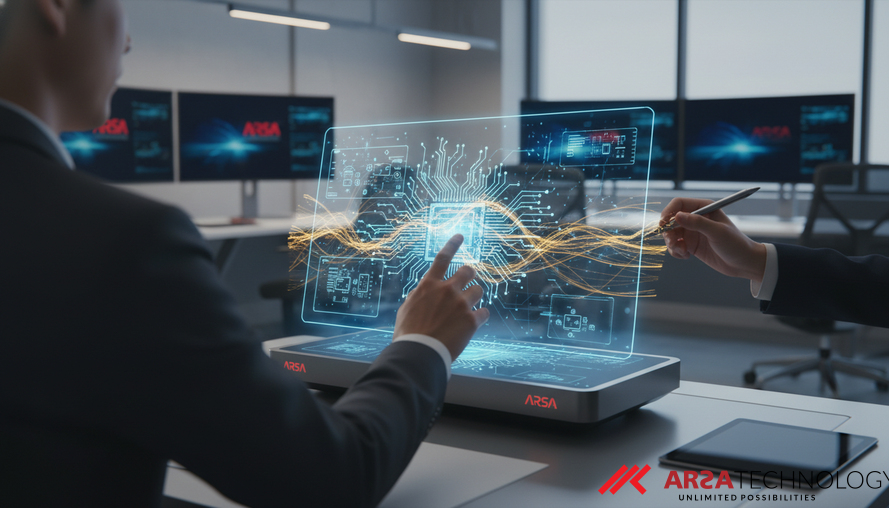
A foundational example of Orthogonal Art presented by the paper involves using technical schematics as the primary artistic medium. These schematics, typically precise diagrams detailing electronic circuits or logical structures, are usually seen as purely functional. However, within the Orthogonal Art framework, they are transformed into a canvas for creative expression. Artists working in this domain would not simply generate schematics using AI; instead, they might intentionally craft schematics that possess inherent beauty, intricate logic, or narrative depth that challenges AI's current capabilities to truly "understand" or originate in a meaningful context.
This approach grounds artistic practice in algorithmic structure and logical precision, offering an accessible entry point into complex technical fields for those in the humanities, bridging art, engineering, and philosophy. It demonstrates how the precision and logical flow inherent in engineering design can be appreciated not just for utility, but for intrinsic aesthetic and conceptual value. Companies like ARSA Technology, which specialize in delivering AI and IoT solutions, fundamentally work with sophisticated "technical schematics" – albeit ones designed for real-world functionality rather than artistic expression. ARSA’s work in developing and deploying complex systems, such as AI Video Analytics or the AI Box Series, involves bringing these intricate designs to life, transforming raw data into actionable intelligence for diverse applications across various industries.
The Future of Creativity in an AI-Driven World
The rise of generative AI demands a fundamental rethinking of what art is and what it means to create. Orthogonal Art and the Augmented Machines framework offer a path forward by intentionally moving away from AI-augmented creative practices towards exploring the unique capabilities of human consciousness. This doesn't diminish AI's role but rather clarifies the distinctive value of human creativity. It forces a deeper engagement with human intentionality, subjective experience, and the pursuit of genuine novelty.
By defining art in dialectical response to AI, this new discipline opens up avenues for humanistic inquiry, pushing artists to uncover new forms of expression that emphasize the irreducibly human. This ongoing, self-revising inquiry into human potential is vital for navigating a future where the lines between human and machine capabilities continue to blur. It reinforces that while AI can generate outputs, the human imperative to create, driven by unique experience and intent, remains a powerful and irreplaceable force.
To explore how advanced AI and IoT solutions can transform your operations and to discuss your unique technical challenges, contact ARSA for a free consultation.