Revolutionizing Edge AI: Gaze-Led Attention for Ultra-Efficient Object Detection in AR/VR
Discover GLANCE, an innovative edge AI system using gaze-led attention and memory-centric networks for real-time object detection in AR/VR. Learn how it cuts latency, power, and costs for enterprise applications.

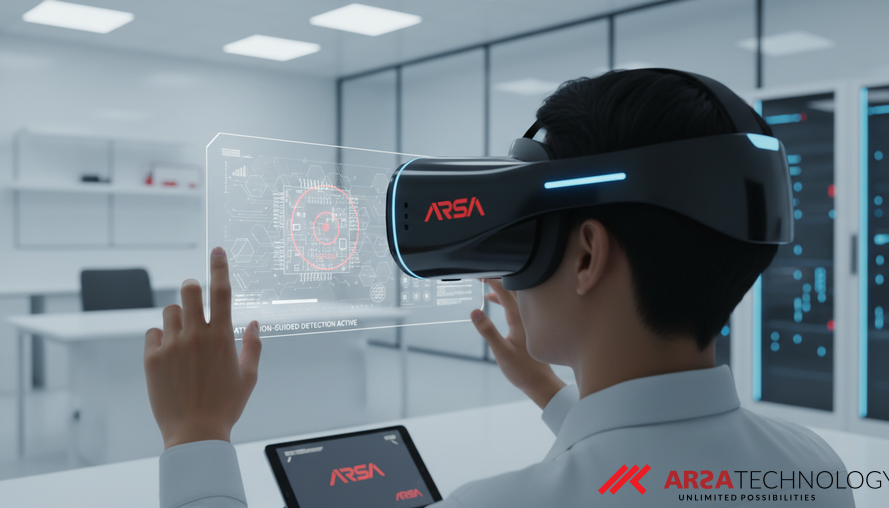
Augmented and virtual reality (AR/VR) technologies are rapidly advancing, promising immersive experiences and powerful new applications across various industries. However, a significant hurdle remains: achieving real-time object detection with minimal latency and power consumption, especially on compact, battery-powered devices like headsets and wearables. Traditional AI models, while powerful, often fall short of these stringent demands, leading to performance bottlenecks and a compromised user experience. This challenge is precisely what new innovations in edge AI are addressing, drawing inspiration from the efficiencies of human vision.
The Computational Bottleneck in Modern AR/VR
Modern AR/VR systems are expected to handle a complex array of tasks simultaneously: understanding the scene, detecting objects, tracking user gaze, and rendering high-fidelity graphics. For a truly immersive experience, these operations must occur with a "motion-to-photon" latency below 10 milliseconds (ms) – delays beyond this threshold can cause "cybersickness" and break immersion. Furthermore, these devices operate under tight power budgets, typically consuming no more than a few tens of watts, to enable continuous operation at 60-120 frames per second. Current state-of-the-art object detectors, such as advanced YOLO models, achieve impressive accuracy, yet often demand over 100 billion floating-point operations (FLOPs) per frame. This extensive computation translates into substantial energy consumption, making continuous, high-performance operation on battery-powered platforms challenging. The fundamental inefficiency stems from these detectors processing an entire field of view uniformly, regardless of where the user's attention is focused.
Mimicking Human Vision for Smarter AI
Human vision offers a profound blueprint for efficiency. Our eyes don't process everything equally; instead, the fovea, a small central area covering only about 2 degrees of visual angle, receives the majority of neural resources for detailed processing. Peripheral vision, in contrast, is handled at a much lower resolution. This highly selective approach results in a 100 to 1000 times disparity in effective resource allocation between central and peripheral vision. Emulating this "foveation" in computational models can lead to significant speedups, often by a factor of 10, with only minimal loss in accuracy. However, explicit attention signals, such as precise gaze tracking, have historically been underutilized in practical, energy-constrained object detection pipelines. The innovative GLANCE system (Gaze-Led Attention Network for Compressed Edge-inference) addresses this by integrating real-time gaze estimation to guide a more selective and efficient object detection process, as detailed in the academic paper GLANCE: Gaze-Led Attention Network for Compressed Edge-inference.
Introducing GLANCE: A Two-Stage, Attention-Guided Pipeline
GLANCE is a groundbreaking two-stage, attention-guided detection pipeline designed for resource-limited edge devices. Its core innovation lies in combining ultra-efficient gaze estimation with selective, region-of-interest (ROI) based object detection. The system leverages Differentiable Weightless Neural Networks (DWNs) for gaze tracking. Unlike conventional deep neural networks (DNNs) that rely on arithmetic-intensive Multiply-Accumulate (MAC) operations, DWNs perform inference through memory lookups using lookup tables (LUTs). This memory-centric approach drastically reduces the computational load and energy consumption associated with gaze estimation. For example, the system achieves an impressive angular error of 8.32 degrees with only 393 MACs and 2.2 KiB of memory per frame for gaze tracking.
Once gaze is estimated, GLANCE guides selective object detection to focus solely on the user’s attended regions. This intelligent resource allocation significantly reduces the computational burden by 40-50% and energy consumption by a remarkable 65%. On an Arduino Nano 33 BLE, a microcontroller-class platform, the GLANCE system achieves 48.1% mAP (mean Average Precision, a standard metric for object detection accuracy) on the COCO dataset, with accuracy rising to 51.8% for objects within the attended regions. Critically, it maintains sub-10 ms latency, meeting the stringent requirements of AR/VR systems and improving communication time by an impressive 177 times. When compared to global object detection baselines like YOLOv12n, GLANCE’s ROI-based method shows superior accuracy for objects of all sizes, particularly for small objects, achieving 51.3% vs. 39.2% for small objects, 72.1% vs. 63.4% for medium objects, and 88.1% vs. 83.1% for large objects under the same settings.
Key Innovations Driving GLANCE's Efficiency
GLANCE's enhanced efficiency and accuracy are built upon several novel contributions:
- Memory-Based Gaze Estimation: This pioneering application of weightless neural networks for real-time gaze estimation on edge devices demonstrates that LUT-based inference is a highly viable, low-energy alternative to traditional MAC-centric models. This is particularly crucial for devices where every millijoule of power and every millisecond of latency counts.
- Attention-Guided Detection via Union-of-ROIs Mosaic: The system seamlessly integrates explicit gaze cues with a memory-light ROI fusion mechanism. This mechanism creates a single "mosaic" from all attended regions, which is then fed to the object detector. This approach offers a clear efficiency-accuracy trade-off, outperforming methods based solely on learned attention or saliency.
- Temporal ROI Integration Policy: To maintain spatial coherence and stable recall (the ability to correctly identify objects) with modest computational cost, GLANCE incorporates a temporal policy. It maintains a scanpath-aware union of ROIs over the last several frames, ensuring that objects recently looked at remain within the detection scope even if gaze momentarily shifts.
- Rotation and Motion-Aware ROI Stabilization: Recognizing the dynamic nature of AR/VR environments, GLANCE also reprojects ROIs into a persistent 360-degree map. It further enhances bounding box sizes using Inertial Measurement Unit (IMU) data, ensuring objects are not missed during head movements between detector runs.
These innovations collectively prove that memory-centric architectures with explicit attention modeling offer superior efficiency and accuracy for resource-constrained wearable platforms compared to traditional uniform processing methods.
Impact and Practical Applications for Enterprises
The implications of GLANCE's approach extend far beyond AR/VR, offering significant potential for various enterprise applications requiring robust edge AI solutions. Industries can leverage this technology to:
- Enhance Industrial Safety: Deploying edge AI with gaze-led attention can improve the accuracy of Personal Protective Equipment (PPE) compliance monitoring and restricted area intrusion detection, as offered by solutions like ARSA AI BOX - Basic Safety Guard. By focusing computation where human attention is, critical safety violations can be detected faster and more reliably in demanding industrial environments.
- Optimize Retail & Customer Experience: In retail settings, gaze-led analytics could refine customer behavior analysis, optimizing store layouts and staffing. Systems like ARSA AI BOX - Smart Retail Counter could be further enhanced by understanding which displays or products truly capture shopper attention, leading to better conversion rates.
- Improve Smart City & Traffic Management: For smart city initiatives, efficient object detection can lead to more responsive traffic flow analysis, vehicle counting, and congestion detection, without the massive computational overhead of processing every single camera frame in full detail.
- Power Next-Generation Wearables and Mobile Vision: The energy and latency benefits of GLANCE pave the way for more capable and longer-lasting smart glasses, mobile devices, and IoT sensors that can perform complex computer vision tasks directly on the device, without relying heavily on cloud processing. This reduces network latency and enhances data privacy.
ARSA Technology, with its expertise in deploying practical AI & IoT solutions across various industries, recognizes the critical need for efficient, edge-ready AI. Solutions that provide high accuracy under strict power and latency budgets are paramount for the next wave of digital transformation. The GLANCE system exemplifies how targeted innovation in AI architecture can overcome real-world constraints, making advanced intelligence accessible on even the most compact devices.
To explore how these cutting-edge AI innovations can be tailored to your specific operational needs and drive measurable outcomes for your enterprise, we invite you to contact ARSA for a free consultation. Our team is ready to discuss robust, custom AI solutions that bring intelligence to the edge.
Source: Neeraj Solanki et al., "GLANCE: Gaze-Led Attention Network for Compressed Edge-inference," IEEE TRANSACTIONS ON VERY LARGE SCALE INTEGRATION (VLSI) SYSTEMS, March 2026.