Revolutionizing Human Movement Analysis: 3D Kinematics and Dynamics from a Single Smartphone Video
Discover how OpenCap Monocular is transforming biomechanical assessment, enabling 3D human kinematics and musculoskeletal dynamics from a single smartphone for healthcare, sports, and research.

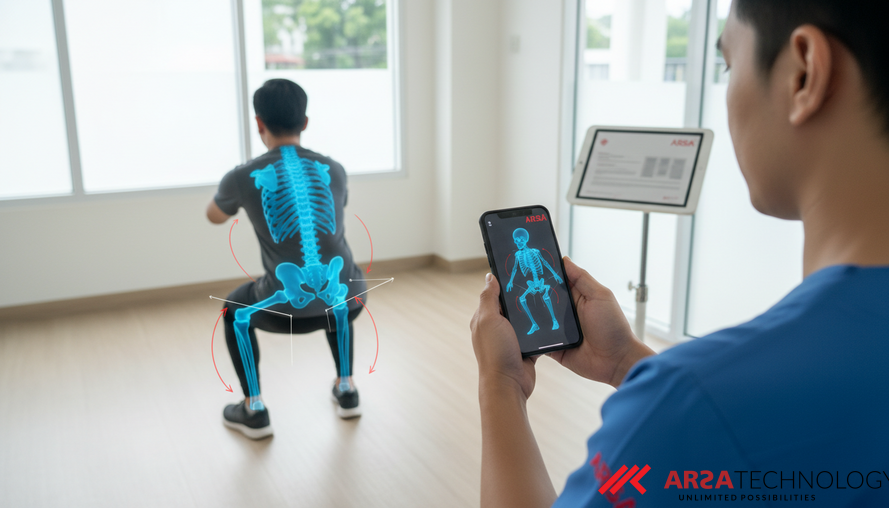
Quantitative analysis of human movement is a cornerstone for fields ranging from rehabilitation and sports science to ergonomics and the treatment of musculoskeletal disorders. Understanding how our bodies move (kinematics) and the forces generated within them (kinetics) can offer crucial insights into injury risk, disease progression, recovery tracking, and the effectiveness of various interventions. However, the traditional "gold standard" for this analysis has long been confined to specialized laboratories, demanding expensive equipment, significant time, and expert personnel. This has severely limited its widespread clinical adoption and the ability to conduct large-scale, real-world studies.
The prohibitive cost (often exceeding $150,000), dedicated space, and labor-intensive nature of lab-based motion capture, which relies on reflective markers and force plates, make it impractical for routine assessments. Most biomechanics research, therefore, remains small-scale and confined, failing to capture the vast, diverse movement patterns occurring in everyday life. While mobile sensing techniques like Inertial Measurement Units (IMUs) offer some portability, they still necessitate multiple sensors and can be cumbersome for rapid, whole-body evaluations. This enduring gap between high-fidelity lab analysis and scalable, accessible solutions has spurred innovation in video-based approaches, leveraging the ubiquity and power of modern smartphones.
The Rise of Smartphone-Based Biomechanical Assessment
The widespread availability of smartphones presents a transformative opportunity for democratizing biomechanical analysis. Building on advancements in computer vision and deep learning for human pose estimation, researchers have been developing systems that can quantify complex human movement without specialized lab equipment. One significant development in this area is OpenCap Monocular, an advanced algorithm that now enables the estimation of 3D skeletal kinematics and musculoskeletal dynamics directly from a single, static smartphone video. This innovation removes the need for multiple cameras, tripods, or external sensors, making sophisticated movement analysis accessible to billions of smartphone users worldwide. This enhanced accessibility paves the way for large-scale remote studies and routine functional evaluations in clinical settings or even at home. The research behind this groundbreaking method is detailed in "OpenCap Monocular: 3D Human Kinematics and Musculoskeletal Dynamics from a Single Smartphone Video" by Gilon et al.
The ability to analyze 3D human motion and forces with such simplicity represents a significant leap forward. Previously, multi-camera systems, like the original OpenCap platform, brought assessment time down to around 10 minutes with equipment costing less than $1,000. While a notable improvement, even that setup could be a barrier for frequent in-home or clinical use due to the requirement for multiple calibrated phones and a laptop. By distilling this capability into a single-smartphone solution, OpenCap Monocular drastically reduces infrastructure requirements, broadening the potential for its application in diverse environments.
How OpenCap Monocular Translates Video into Insights
At its core, OpenCap Monocular leverages a sophisticated pipeline combining computer vision, biomechanical modeling, and machine learning. The process begins by taking a standard video recorded with a single smartphone. A monocular pose estimation model, often from the field of computer vision (such as WHAM, as mentioned in the original paper), first estimates the 3D human pose from the 2D video frames. However, these initial estimates can sometimes contain physically implausible artifacts, like unnatural joint movements or "foot sliding" that isn't biologically accurate.
To overcome these limitations, OpenCap Monocular refines these raw 3D pose estimates through an optimization process. This process integrates a biomechanically constrained skeletal model, ensuring that the estimated movements adhere to the natural limits and mechanics of the human body. Once the kinematics (joint angles, velocities, and positions) are accurately computed, the system then estimates kinetics (forces and moments, such as ground reaction forces or muscle forces) through a combination of physics-based simulation and machine learning algorithms. This multi-layered approach ensures that the output is not only accurate but also physically and biomechanically consistent, providing reliable data for analysis. ARSA Technology specializes in developing and deploying practical AI solutions, including AI Video Analytics, that transform raw visual data into actionable intelligence for various enterprise needs.
Validation and Clinical Accuracy
The effectiveness of OpenCap Monocular has been rigorously validated against traditional, gold-standard laboratory methods, including marker-based motion capture and force plate data. The system was tested across common functional tasks such as walking, squatting, and sit-to-stand movements. The results demonstrated remarkably low kinematic error, with a mean absolute error (MAE) of 4.8° for rotational movements (like joint angles) and 3.4 cm MAE for pelvis translations (body position shifts). These figures represent a significant improvement, outperforming a regression-only computer vision baseline by 48% in rotational accuracy and 69% in translational accuracy.
Furthermore, OpenCap Monocular proved capable of estimating ground reaction forces during walking with accuracy comparable to, or even surpassing, that of previous two-camera OpenCap systems. This level of precision is particularly important for clinical applications, where subtle changes in movement or force can indicate significant health conditions. For organizations requiring robust, on-premise processing for video analytics or similar edge AI applications, ARSA offers the AI Box Series, providing pre-configured systems for fast, reliable deployment.
Transforming Healthcare and Wellness Applications
The ability to accurately quantify human movement and forces with such ease has profound implications for various clinical and wellness applications:
- Frailty Assessment: One crucial application involves analyzing sit-to-stand transitions, a movement highly indicative of age-related declines in quadriceps strength. OpenCap Monocular can accurately estimate the knee extension moment, a key kinetic outcome. Errors in these estimates fell below a clinically meaningful threshold of 11 Nm—a difference observed between individuals with and without early signs of frailty. This capability allows for early detection and targeted interventions, improving quality of life for an aging population.
Knee Osteoarthritis Management: The algorithm also excels in estimating the knee adduction moment during walking. This metric is a critical indicator of knee loading and is closely associated with the progression of medial compartment knee osteoarthritis. OpenCap Monocular's errors in this estimation were below a clinically meaningful threshold of 0.5% bodyweight height, making it a valuable tool for predicting disease progression and evaluating the effectiveness of joint-offloading interventions.
- Beyond Clinical: Sports and Rehabilitation: Beyond these specific clinical examples, the technology holds immense potential for sports performance analysis, injury prevention, and personalized rehabilitation programs. Athletes could gain real-time insights into their biomechanics, optimizing training and preventing over-exertion. Individuals recovering from injuries could monitor their progress accurately from home, allowing therapists to adjust protocols remotely.
The Future of Accessible Biomechanics
OpenCap Monocular is not just an academic achievement; it's a practical, deployable solution. It is made available through a smartphone app, a web app, and secure cloud computing, making it freely accessible and easy to use. This level of accessibility is critical for enabling large-scale remote studies, which can gather data from diverse populations in their natural environments, leading to more robust research findings and a deeper understanding of human movement.
Ultimately, the availability of such an accurate, scalable tool for biomechanical assessment means that quantitative evaluations of mobility and function could become a routine part of clinical practice or personal health management. This empowers clinicians with objective data beyond subjective observations and provides individuals with tools to proactively monitor their own health. The privacy-by-design approach, often involving on-device processing where video streams are analyzed locally and do not leave the network unless explicitly configured, is a critical feature that aligns with ARSA Technology's commitment to secure and compliant AI deployments, reflecting our own experienced since 2018 with enterprise-grade solutions.
To learn more about how advanced AI and IoT solutions can transform your operations and to explore customizable applications for your industry, we invite you to contact ARSA for a free consultation.