Revolutionizing Medical Imaging: Deep Learning's Answer to Domain Shift in 4D Flow MRI
Explore how distributional deep learning enhances 4D Flow MRI super-resolution, overcoming domain shift for more accurate cerebral aneurysm diagnosis and improved patient outcomes.

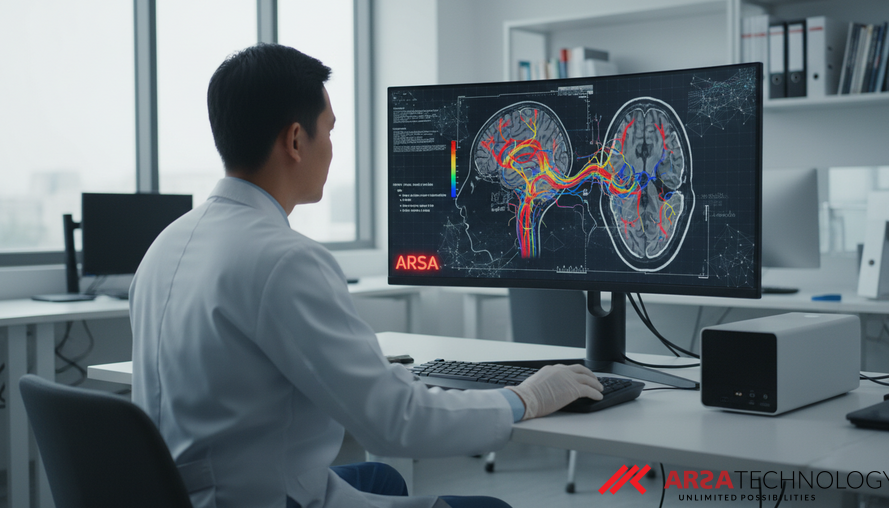
The Promise of Super-Resolution in Medical Diagnostics
Medical imaging is continuously evolving, and technologies like super-resolution are at the forefront of this transformation. Super-resolution techniques aim to enhance low-quality diagnostic data, effectively "upscaling" it to reveal finer details that might otherwise be missed. In clinical practice, this capability is invaluable, as it can significantly reduce the time patients spend in scanners while simultaneously improving the detection of subtle abnormalities. For modalities such as 4D Flow MRI (4DF), which captures complex blood flow dynamics in 3D over time, achieving high resolution is particularly crucial for accurate diagnosis and treatment planning.
However, conventional super-resolution methods often face a critical hurdle. They typically rely on training AI models with perfectly matched datasets: artificially degraded low-resolution images paired with their pristine high-resolution counterparts. While effective in controlled environments, this approach falters when confronted with real-world clinical data. Low-resolution images acquired in hospitals often differ substantially from these idealized training examples due to inherent measurement noise, imaging artifacts, and variations in patient physiology. This discrepancy creates a "domain shift," where the real clinical data falls outside the expected range of the training data, leading to poor model generalization and unreliable results.
Navigating the Complexities of 4D Flow MRI for Aneurysm Risk
Cerebral aneurysms, abnormal bulges in brain blood vessels, affect a significant portion of the population and carry a severe risk of rupture, leading to life-threatening conditions. Identifying which unruptured aneurysms are prone to rupture is a major clinical challenge. Recent advances in 4D Flow MRI have shown immense promise in this area, offering direct, in-vivo measurements of blood flow within these vessels. This modality provides critical hemodynamic variables, such as vessel wall stress and shear concentration index, which are vital for assessing aneurysm rupture risk.
Despite its potential, 4D Flow MRI data is inherently limited by compromises made during scanning to ensure patient comfort, leading to restricted spatial resolution. This often means that small but critical flow characteristics, especially near vessel walls, are overlooked, impacting the accuracy of risk assessments. In contrast, Computational Fluid Dynamics (CFD) simulations can generate high-resolution, noise-free velocity fields by modeling blood flow based on patient-specific vascular geometry. However, CFD relies heavily on modeling assumptions and requires specialized expertise, making its direct application in routine clinical practice less feasible and its outcomes highly sensitive to initial conditions. This disparity underscores the need for robust methods to bridge the gap between idealized simulations and real patient data.
Introducing Distributional Deep Learning: A Robust Solution
To overcome the pervasive challenge of domain shift in medical imaging, researchers have developed a novel approach: distributional deep learning. This framework significantly improves the robustness and generalization capabilities of super-resolution models. Instead of simply learning a direct mapping between low and high-resolution images, distributional deep learning acknowledges and models the uncertainty and variability inherent in real-world data. By incorporating a noise component into the training process, the model effectively expands its understanding of the training data's distribution, making it more adaptable to unexpected variations in new, unseen clinical inputs.
Specifically, this innovative model, dubbed Distributional Super-Resolution (DSR), uses a pre-additive framework to capture the complex relationship between low-resolution and high-resolution data. It's initially trained on large datasets of high-resolution CFD simulations and their synthetically downsampled versions, then refined using a smaller, harmonized dataset of paired 4D Flow MRI and CFD samples. This hybrid training strategy ensures that the model learns from abundant, high-quality simulated data while fine-tuning its performance on the nuances of real clinical cases. The framework demonstrates robust domain extrapolation, meaning it performs exceptionally well even when the real 4D Flow MRI data significantly deviates from the simulated training examples. This is crucial given that real 4DF data often deviates from physical principles like mass conservation, which are strictly followed in CFD simulations.
Architecting Practical AI for Clinical Deployment
The DSR model is part of a comprehensive framework designed to advance 4D Flow MRI super-resolution, particularly for real intracranial data. A key innovation is a local, patch-based super-resolution strategy. This method enhances resolution on complex, irregular three-dimensional vascular geometries by processing smaller, manageable sections (patches) of the image. This ensures broad applicability across diverse patient anatomies and aneurysm structures.
Furthermore, the framework employs a strategic pre-training and fine-tuning paradigm. The model first learns general principles from extensive CFD simulations (pre-training) and then adapts to the specific characteristics of real 4DF data using a limited set of harmonized samples (fine-tuning). This methodology achieves superior performance even with constrained real-world data availability, a common challenge in medical research. Such meticulous engineering ensures that the AI solutions are not just theoretically sound but also practically deployable and impactful in demanding clinical environments. Organizations like ARSA Technology leverage this kind of deep technical expertise to develop custom AI solutions that meet specific industry needs.
Real-World Impact and Future Directions
The effectiveness of distributional deep learning has been rigorously demonstrated through real data applications, showing significant outperformance compared to traditional deep learning approaches. This highlights its potential to address a critical limitation in medical imaging AI: the generalization gap caused by domain shift. By improving super-resolution performance in clinically realistic scenarios, this framework directly contributes to more accurate assessments of cerebral aneurysm rupture risk, enabling clinicians to make more informed decisions and ultimately improving patient outcomes. The ability to obtain higher resolution images from quicker, less invasive scans also offers substantial benefits in terms of patient comfort and healthcare resource efficiency.
This research distinguishes itself by explicitly tackling domain shift, a problem often overlooked in conventional super-resolution techniques. By employing an energy-based loss function, the model is equipped with enhanced extrapolability, allowing it to perform reliably on data outside its immediate training distribution. While the academic paper outlines the development of this specific framework, the underlying principles of robust AI for challenging data environments are broadly applicable. For instance, ARSA Technology is committed to building AI-powered healthcare solutions, from advanced analytics to systems like the Self-Check Health Kiosk, that prioritize accuracy, scalability, and practical deployment, understanding the critical importance of reliable data in improving health outcomes.
The full details of the framework, including theoretical properties, empirical evaluations, and a ready-to-use software package, are available in the original research paper. It underscores the vital role of advanced AI methodologies in bridging the gap between research and real-world clinical application, paving the way for more precise and reliable medical diagnostics (Source: Wen, X., & Jiang, F. (2026). Distributional Deep Learning for Super-Resolution of 4D Flow MRI under Domain Shift. https://arxiv.org/abs/2602.15167).
To explore how advanced AI and IoT solutions can transform your operations and drive measurable impact in healthcare or other critical industries, contact ARSA Technology for a free consultation.