Revolutionizing Video Editing: How AI Achieves Global Coherence with Local Precision
Explore GLANCE, a multi-agent AI framework for music-grounded non-linear video editing. Learn how it uses global-local coordination to create high-quality, adaptive content, reducing costs and enhancing creative output for enterprises.

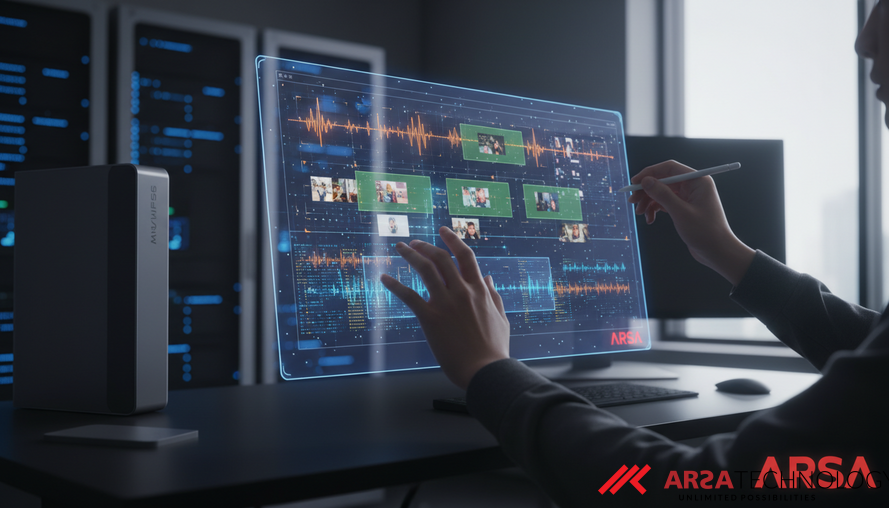
Video content creation is at the heart of modern communication, from marketing campaigns to corporate training and entertainment. Among its most intricate forms is non-linear video editing (NLE), a process of selecting, arranging, and refining visual materials to craft new narratives or evoke specific emotions. When this process is "music-grounded," it adds another layer of complexity, requiring precise synchronization with musical rhythm and emotional cues. While human editors leverage sophisticated tools like Adobe Premiere Pro and DaVinci Resolve, the sheer volume of source footage and the iterative nature of editing make high-quality mashup creation a labor-intensive endeavor. This challenge has driven a push towards leveraging Artificial Intelligence, specifically Multimodal Large Language Models (MLLMs), to automate and enhance video editing workflows.
The Evolution of Automated Video Editing Challenges
Early attempts at AI-powered video editing often relied on fixed pipelines or simple retrieval-and-concatenation methods. These approaches, while promising, struggled with the nuances of creative editing. They lacked the adaptability to handle diverse user prompts, varying music structures, or heterogeneous source materials effectively. A major limitation has been the difficulty in maintaining overall narrative coherence while simultaneously performing granular, segment-level refinements. Imagine crafting a lengthy video mashup; even perfectly edited individual shots can become redundant or inconsistent when assembled into a larger sequence. Furthermore, evaluating the quality of open-ended creative tasks like video mashups poses a unique challenge. Unlike simple accuracy metrics, subjective elements such as story completeness, emotional alignment, and instruction following require a more sophisticated assessment framework.
Introducing GLANCE: A Multi-Agent Framework for Intelligent Editing
To address these critical gaps, researchers have developed GLANCE (Global–Local Coordination Multi-Agent Framework for Music-Grounded Non-Linear Video Editing), detailed in a recent academic paper found at https://arxiv.org/abs/2604.05076. This innovative framework mimics expert human editing practices through a sophisticated bi-loop architecture. The "outer loop" focuses on long-horizon planning, analyzing the entire music structure and user intent to construct a comprehensive task-graph for the video. This global foresight ensures the final video maintains a cohesive flow and narrative arc. Simultaneously, an "inner loop" meticulously handles segment-wise editing tasks, adopting an "Observe-Think-Act-Verify" flow. This iterative process allows the system to make local refinements, ensuring each segment is polished and aligned with its specific requirements, dynamically adapting its workflow and tool usage based on the immediate context.
Mastering Coherence: Global-Local Coordination
One of GLANCE's most significant contributions is its dedicated global-local coordination mechanism, designed to prevent and correct conflicts that arise when combining individually edited segments. On the preventive side, a "context controller" plays a crucial role. This controller carefully regulates the information available to each local editing agent, including global control signals and the states of previously completed subtasks. This proactive approach ensures that every segment is optimized with an overarching timeline-level context in mind, mitigating potential clashes before they occur. For instance, when creating an AI Video Analytics solution for a smart city, ensuring consistent visual language across different camera feeds is vital for clear reporting and actionable insights.
Even with preventive measures, cross-segment inconsistencies can emerge. GLANCE tackles this with corrective components, including a novel "conflict region decomposition module" and a "bottom-up dynamic negotiation mechanism." When inconsistencies are detected, GLANCE can pinpoint the problematic areas and initiate a negotiation process among its agents. This dynamic negotiation ensures that conflicts are resolved harmoniously, leading to a globally coherent and high-quality final product. Such meticulous coordination is crucial for enterprises where consistent messaging and professional output are non-negotiable, aligning with ARSA Technology’s focus on practical, production-ready AI solutions. For example, a system like the ARSA AI Box Series, when deployed at the edge, could leverage such coordination principles to process video streams locally, ensuring privacy and low latency while still contributing to a globally coherent media output.
MVEBench: A Benchmark for Creative AI Evaluation
To rigorously test and validate such an advanced editing framework, a new benchmark called MVEBench was developed. This benchmark breaks down editing difficulty across three key axes:
- Task Type: Differentiating between "On-Beat" mashups (emphasizing rhythmic and emotional alignment with music) and "Story-Driven" mashups (focusing on narrative coherence, with less strict beat synchronization). This allows for evaluating both technical precision and creative storytelling.
- Prompt Controllability: Ranging from high-level "Goal-only" prompts (e.g., "Create a high-energy mashup of Harry Potter synced to music to show happy magical life") to detailed "Outline" prompts that specify each editing segment. This tests the AI's ability to interpret and execute various levels of user instruction.
- Music Length: Categorizing tasks by short (0-30s), medium (30-120s), and long (>120s) music tracks. This axis is particularly important for assessing the AI's "long-horizon reasoning" capabilities, a common challenge in automated content generation.
MVEBench comprises 319 evaluation samples, drawing from over 645 minutes of music and nearly 1,200 hours of source video footage. To tackle the inherently open-ended nature of creative editing, the researchers also introduced an "agent-as-a-judge" evaluation framework, enabling scalable and interpretable multi-dimensional assessment of video quality, story completeness, emotion alignment, and instruction following.
Practical Implications and the Future of Content Creation
The experimental results from MVEBench are compelling. GLANCE consistently outperforms both prior research methods and open-source product baselines, even when using the same backbone MLLMs. Notably, with GPT-4o-mini as the underlying model, GLANCE showed relative improvements of 33.2% and 15.6% on two different task settings, with particularly strong gains observed in more challenging, long-horizon editing tasks. Human evaluation further confirmed the high quality of the generated videos and validated the effectiveness of the proposed evaluation framework.
For enterprises, these advancements translate into significant benefits. Automated, high-quality video editing means faster content creation cycles, reduced production costs, and the ability to scale personalized or niche content more efficiently. Industries requiring frequent video updates—such as marketing, e-learning, news media, and internal communications—can leverage such AI frameworks to maintain brand consistency, deliver engaging narratives, and free up human editors for more strategic, high-level creative direction. Imagine leveraging these capabilities to instantly generate marketing videos tailored to specific demographics or to compile training modules dynamically from existing footage. These applications are highly relevant to ARSA Technology’s mission to deliver practical AI solutions that enhance security, optimize operations, and unlock new business value. With capabilities like the ARSA AI API, developers and enterprises can integrate powerful AI functionalities into their own applications, potentially transforming how video content is produced and consumed. ARSA, experienced since 2018, is committed to engineering systems that work at scale under real industrial constraints.
The GLANCE framework represents a significant leap forward in AI-powered non-linear video editing. By combining adaptive architectural design with robust global-local coordination and a comprehensive evaluation benchmark, it addresses longstanding challenges in automated content creation. As AI continues to evolve, frameworks like GLANCE will empower businesses to unlock unprecedented levels of efficiency, creativity, and quality in their video production workflows.
To explore how advanced AI and IoT solutions can transform your enterprise operations and content strategies, we invite you to contact ARSA for a free consultation.
Source: Lin, Z., Wang, H., Xu, Z., Dai, S., Dong, H., Wang, X., Tang, Y. Y., Wang, Y., Wang, Q., & Huang, L. (2026). GLANCE: A Global–Local Coordination Multi-Agent Framework for Music-Grounded Non-Linear Video Editing. arXiv preprint arXiv:2604.05076. https://arxiv.org/abs/2604.05076