S-AI-Recursive: The Future of Energy-Efficient AI with Bio-Inspired Iterative Reasoning
Discover S-AI-Recursive, a bio-inspired AI architecture that uses iterative, "hormonal" reasoning for energy-frugal performance. Learn how it offers self-correction and efficiency for enterprise applications.

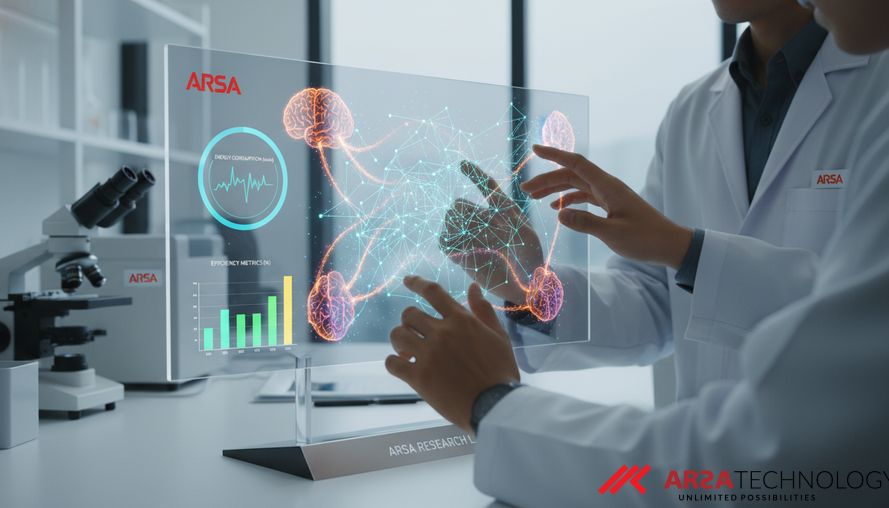
Beyond Gigantic AI Models: A New Paradigm for Intelligence
The current landscape of artificial intelligence is dominated by large models, often with billions of parameters, that process information in a single, unidirectional "feed-forward pass." This means an input goes into the system, travels through its layers once, and an output is generated. While this approach has led to impressive advancements, particularly in areas like natural language processing, it comes with significant limitations. These systems lack an intrinsic ability to self-correct or reconsider their initial outputs. Any refinement or deeper thought must be orchestrated externally through complex prompting strategies. This structural rigidity results in a direct coupling between reasoning capacity and model size, leading to exorbitant computational and energy costs for training and operation.
This "size-first" approach presents three critical challenges for enterprises: scaling capacity often demands ever-larger models, errors propagate unchecked without internal correction mechanisms, and the environmental and financial costs become unsustainable. Addressing these challenges requires a fundamental shift in how we conceive and build AI.
The Brain's Blueprint: Iteration and Feedback in Cognition
Human intelligence rarely operates in a single pass. Whether solving a puzzle, constructing an argument, or making a diagnosis, our minds engage in iterative processes: forming hypotheses, evaluating them, detecting errors, and refining solutions until a stable understanding is reached. This is often described in cognitive science as a dual-process model, where rapid, associative thinking (System 1) is complemented by slow, deliberate, iterative reasoning (System 2). Most contemporary AI models primarily implement only System 1.
Nature offers a powerful blueprint for iterative control: biological hormonal feedback loops. Systems like the human endocrine network don't issue one-off commands; they continuously emit signals, observe responses, inhibit or reinforce actions, and re-emit, gradually converging toward a state of balance or "homeostasis." This bio-inspired feedback mechanism holds immense potential for AI, allowing systems to self-regulate their reasoning process over time. A recent academic paper, "S-AI-Recursive: A Bio-Inspired and Temporal Sparse AI Architecture for Iterative, Introspective, and Energy-Frugal Reasoning," delves into this very concept, proposing a revolutionary architecture (Source: https://arxiv.org/abs/2605.13872).
Introducing S-AI-Recursive: An Iterative and Sparse Architecture
S-AI-Recursive builds upon the concept of Sparse Artificial Intelligence (S-AI), where only a minimal, specialized subset of computational "agents" is activated for any given task, drastically reducing processing overhead. This new architecture extends this parsimony into the temporal dimension, formalizing reasoning as a "hormonal closed-loop iteration" rather than a single, all-encompassing computation. It introduces a Recursive Reasoning Cycle (RRC), where an AI system can dynamically update and refine its cognitive state over successive iterations.
The core idea is "temporal parsimony": instead of building a massively wide and deep network, S-AI-Recursive achieves comparable or superior performance by iterating a smaller, more efficient network. This approach essentially trades "architectural width" for "cognitive depth" over time, leading to significant reductions in parameter count and computational footprint. This aligns with ARSA's philosophy of delivering practical AI that is both powerful and efficient, enabling effective on-premise deployments and edge computing.
How Hormones Drive Intelligent Convergence
Central to S-AI-Recursive's iterative process are two novel "hormones" that govern its reasoning cycle:
- Clarifine (Convergence Signal): This hormone increases as the AI system approaches a stable, correct solution. It signals that residual errors are decreasing and the system's "cognitive entropy" (a measure of uncertainty) is collapsing.
- Confusionin (Uncertainty Detector): This hormone rises in proportion to the remaining error and uncertainty in the AI's output. It acts as a trigger, keeping the iterative cycle active as long as the current cognitive state is not sufficiently resolved.
These two hormones are designed to be "antagonistically coupled," meaning they regulate each other. High Confusionin will suppress Clarifine, driving the system to continue iterating. As convergence is achieved, Clarifine will rise and suppress Confusionin, signaling that the reasoning process can terminate. This hormonal stopping criterion, mathematically proven to lead to finite-time termination through a concept known as Lyapunov stability, ensures the AI knows when it has reached a satisfactory solution without external intervention. The theoretical foundation, known as the Entropic Contraction Theorem, demonstrates that the convergence of these hormonal signals directly corresponds to a monotonic reduction of the AI’s internal reasoning uncertainty.
Practical Implications for Enterprise AI
The S-AI-Recursive architecture offers compelling advantages for businesses and governments seeking to deploy intelligent systems:
- Energy Efficiency and Cost Reduction: By substituting architectural width with iterative temporal depth, S-AI-Recursive can achieve high performance with significantly fewer parameters and lower computational demands. This translates directly into reduced energy consumption, lower operational costs, and a smaller carbon footprint for AI deployments.
- Intrinsic Self-Correction: Unlike traditional feed-forward models, S-AI-Recursive's iterative nature allows it to detect and correct internal inconsistencies. This self-correction mechanism enhances reliability and reduces the need for constant external oversight or complex error-handling strategies.
- Robustness and Reliability: The system's ability to refine its output until a "cognitive equilibrium" is reached means it can handle complex, ambiguous tasks with greater confidence and accuracy, providing more dependable insights for mission-critical operations.
- Adaptability and Warm-Start Acceleration: S-AI-Recursive includes a memory mechanism that allows it to learn from past reasoning trajectories. This "warm-start acceleration" enables the system to solve analogous problems more quickly by leveraging prior experiences, making it more efficient for repetitive or similar tasks.
- Privacy-by-Design and Edge Deployment: Architectures that are inherently more efficient and can process data locally without constant cloud dependency are ideal for environments where data sovereignty, low latency, and regulatory compliance are paramount. For example, ARSA's AI Box Series embodies the principles of edge processing, allowing organizations to deploy powerful AI directly on-site, ensuring data remains within their control and minimizing network reliance. This is crucial for sectors like defense, public safety, and industrial operations.
Key Innovations and Future Directions
S-AI-Recursive represents a significant leap forward in bio-inspired AI. Its eight principal contributions, detailed in the academic paper, formalize a novel approach to iterative reasoning, introduce innovative regulatory mechanisms (Clarifine and Confusionin), and provide mathematical proofs for its stability and efficiency. The architecture offers a compelling alternative to the current paradigm of ever-larger, energy-hungry AI models by demonstrating that "iterative cognitive depth substitutes for architectural width."
This shift enables the development of smarter, smaller, and more self-aware AI systems. For organizations looking to leverage advanced AI in practical, real-world scenarios, solutions based on these principles can offer powerful capabilities in AI video analytics for various industries. ARSA, with its expertise since 2018 in delivering robust AI and IoT solutions, can partner with enterprises to develop custom AI solutions that harness such architectural efficiencies to address unique operational challenges.
This innovative approach to AI promises not just intelligent systems, but introspective and energy-frugal ones, paving the way for more sustainable and effective AI deployment across diverse applications.
Ready to explore how advanced, efficient AI architectures can transform your operations? Let's discuss tailored solutions that meet your specific needs. contact ARSA today.