Seeing Beyond Obstacles: How AI Reconstructs Hidden 3D Worlds from Subtle Shadows
Explore Soft Shadow Diffusion (SSD), a breakthrough AI that reconstructs detailed 3D scenes from ordinary photographs of faint shadows, revolutionizing non-line-of-sight imaging for enterprise.

Unveiling the Unseen: The Promise of Non-Line-of-Sight (NLOS) Imaging
In many critical scenarios, direct visual access to a scene is impractical, dangerous, or simply impossible. Imagine the need to detect hidden obstacles in an autonomous vehicle's path, assess risks in a collapsed building during search-and-rescue, or even identify adversaries concealed from view in a security operation. This is where Non-Line-of-Sight (NLOS) imaging emerges as a transformative technology. NLOS imaging aims to reconstruct a scene or infer information about objects that are beyond an observer's direct line of sight by analyzing indirect measurements, such as light, sound, or heat, that have interacted with the hidden environment.
While the concept of seeing around corners sounds futuristic, NLOS imaging has seen rapid growth due to its vast potential. Early methods, particularly active techniques, have achieved impressive high-resolution 3D reconstructions. However, these often rely on complex and costly equipment, such as ultrafast pulsed lasers and sophisticated photon detectors, limiting their widespread adoption in commercial and industrial applications. Simpler, passive methods, which leverage existing ambient light without needing specialized illumination, have been constrained by low resolution or the requirement to know the approximate shape of the hidden object in advance.
The Breakthrough: 3D Reconstruction from Subtle Shadows
A recent academic paper introduces a groundbreaking advancement called Soft Shadow Diffusion (SSD). This novel approach significantly pushes the boundaries of passive NLOS imaging by enabling the 3D reconstruction of entire hidden scenes from nothing more than an ordinary photograph of a subtle shadow. Unlike previous methods that might only provide 1D or low-resolution 2D information, or require prior knowledge of the hidden object's shape, SSD can accurately reconstruct complex 3D structures, including both the light-occluding (shadow-casting) and non-light-occluding elements of a hidden scene.
The innovation lies in a sophisticated reformulation of how light travels and interacts with objects. This new model conveniently breaks down the hidden scene into components that block light and those that reflect it, transforming a seemingly impossible task into a solvable mathematical challenge known as a separable non-linear least squares inverse problem. This approach allows researchers to work backward from the observed shadow patterns to infer the detailed 3D geometry of the hidden environment with remarkable precision.
How Soft Shadow Diffusion (SSD) Works: AI-Powered Insights
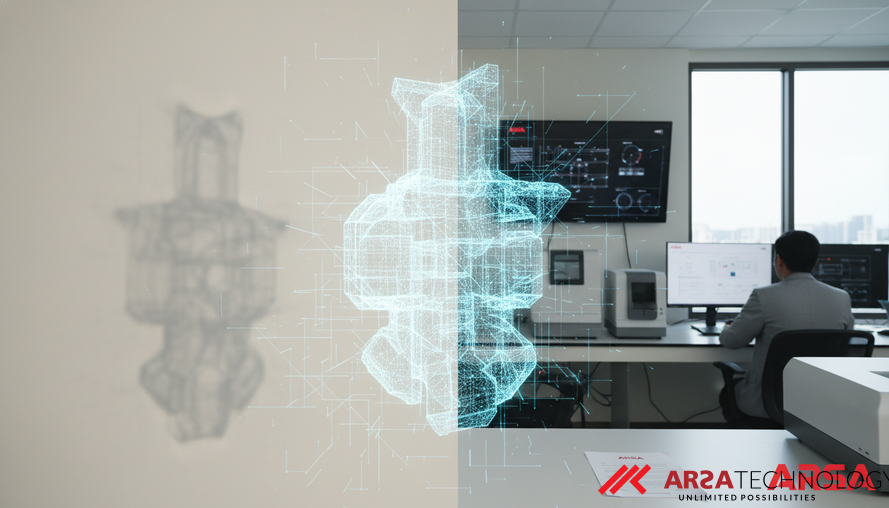
To tackle this complex challenge, two main solutions were developed: a gradient-based optimization method, which systematically refines its guesses to find the best possible reconstruction, and the more advanced Soft Shadow Diffusion (SSD). SSD is a physics-inspired neural network, an artificial intelligence system that learns the intricate physics of how light forms shadows. It then uses a "diffusion" process—similar to gradually adding noise to an image and then learning to reverse that process—to generate a detailed 3D model from a single 2D soft shadow photograph.
The power of SSD is evident in its robust performance. It has been shown to be effective across numerous 3D scenes in real experimental scenarios. Crucially, SSD can be trained in simulated environments but still generalize exceptionally well to entirely new classes of objects and real-world NLOS scenes it has never encountered before. This adaptability, combined with its surprising resilience to ambient illumination changes and noise, makes it a highly practical solution for real-world deployment. The output of SSD is a high-resolution 3D point cloud, a collection of points that precisely represent the object's shape, which can then be converted into a 3D mesh for further analysis or visualization.
Revolutionary Applications for Various Industries
The ability to accurately reconstruct hidden 3D environments from subtle shadow information has profound implications across various industries:
- Autonomous Navigation: Enhancing the safety and reliability of self-driving vehicles by detecting unseen obstacles around blind corners, preventing collisions, and saving lives.
- Security and Surveillance: Identifying hidden threats or unauthorized individuals in restricted areas, providing critical situational awareness for military operations and perimeter security.
- Search and Rescue: Locating individuals or assessing structural damage in hazardous environments (e.g., collapsed buildings, disaster zones) without exposing rescue personnel to direct risks.
- Industrial Monitoring: Detecting anomalies or monitoring equipment in complex industrial layouts where direct camera views are obstructed. While SSD is an emerging technology, for immediate, robust industrial safety monitoring, solutions like ARSA's AI BOX - Basic Safety Guard already provide real-time PPE detection and intrusion alerts to ensure workplace compliance and security.
- Smart City Planning: Gaining insights into urban dynamics by tracking unseen pedestrian flows or vehicle movements, optimizing city infrastructure. For comprehensive traffic and vehicle management, advanced solutions such as ARSA's AI BOX - Traffic Monitor offer intelligent vehicle analytics.
The Future of Visual Intelligence
Soft Shadow Diffusion represents a significant leap forward in computational imaging, moving beyond the limitations of conventional line-of-sight visual analysis. By leveraging the subtle cues in soft shadows and powerful AI models, this technology offers a more affordable and less complex alternative to existing active NLOS systems. It transforms ordinary visual data into rich 3D insights, promising to unlock new levels of awareness and safety in environments previously deemed impenetrable. The ability of such a system to provide detailed 3D information from a single, passive image fundamentally changes how we might approach surveillance, safety, and operational intelligence.
While this research highlights the cutting edge of AI, companies like ARSA Technology are already providing businesses with actionable visual intelligence. Our AI Video Analytics solutions can transform existing CCTV infrastructure into strategic data assets, offering capabilities such as face recognition, crowd analytics, and anomaly detection. To explore how ARSA’s proven AI and IoT solutions can address your business's unique challenges and enhance your operational capabilities, we invite you to contact ARSA for a free consultation.