SpaceX's Terafab Project: A $55 Billion Bet on AI Chip Manufacturing
Explore SpaceX's ambitious "Terafab" plant in Texas, a $55 billion investment to revolutionize AI chip production for Earth and space, backed by Tesla and Intel.

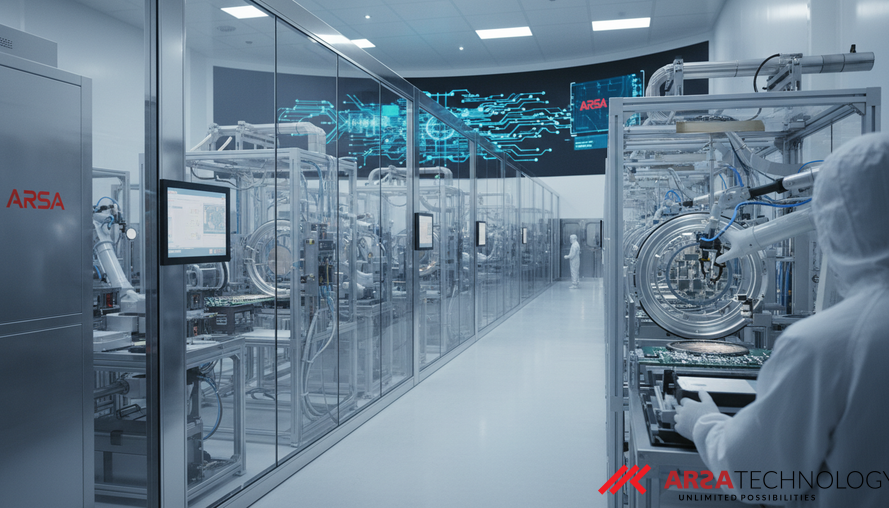
SpaceX, led by Elon Musk, is embarking on an ambitious and capital-intensive venture into the realm of artificial intelligence chip manufacturing. This strategic move, detailed in recent reports, centers around a colossal facility named "Terafab," projected to be built in Texas. This initiative underscores a growing trend among technology giants to secure and customize their essential hardware supply chains, especially for high-demand AI components. The sheer scale of the investment—initially estimated at $55 billion and potentially reaching $119 billion—signals a profound commitment to shaping the future of AI infrastructure, both on Earth and in space, as reported by The New York Times and CNBC, with further details from a court filing in Grimes County, Texas (Source: The Verge).
The Unprecedented Scale of Terafab's Investment and Vision
The "Terafab" plant represents an extraordinary investment in next-generation manufacturing, with an initial commitment of at least $55 billion. This figure could potentially balloon to an astonishing $119 billion if all planned expansion phases come to fruition. Such a monumental financial outlay highlights the critical importance that SpaceX and Tesla place on achieving self-sufficiency and control over the production of high-performance AI semiconductors. This level of investment is not merely about production capacity; it signifies a strategic pivot towards vertical integration in an era where specialized AI hardware is becoming a significant bottleneck for innovation and deployment across various industries.
The ambitious vision for Terafab extends beyond Earth-bound applications. Elon Musk has articulated a goal for the plant to produce chips capable of supporting up to 200 gigawatts per year of computing power on our planet, with an even more audacious target of one terawatt in space. This suggests a future where AI processing capabilities are not confined to terrestrial data centers but are integral to orbital operations, satellite networks, and potentially interplanetary missions. The implications for industries like aerospace, telecommunications, and even defense are immense, as on-demand, high-performance computing becomes available in previously unserved environments.
Strategic Imperative: Vertical Integration in AI Hardware
The decision by SpaceX and Tesla to invest so heavily in proprietary AI chip manufacturing is a clear response to several strategic imperatives. Firstly, it addresses the critical global demand for AI-optimized silicon, a market currently dominated by a few key players. By bringing chip production in-house, these companies aim to mitigate supply chain risks, reduce reliance on external suppliers, and gain a competitive edge through custom hardware tailored to their unique requirements. This vertical integration allows for tighter integration between hardware and software, potentially unlocking unprecedented performance and efficiency gains for their AI models and robotics platforms.
Secondly, developing specialized chips enables optimization for specific workloads inherent to AI, robotics, and complex space applications. Standard off-the-shelf processors may not meet the stringent power, size, or processing requirements for these advanced systems. Custom silicon can offer significant advantages in terms of energy efficiency, processing speed for neural network inference, and resilience in extreme operating conditions, such as those found in space. This level of control over the core computing components is vital for companies operating at the forefront of technological innovation.
Powering AI: From Earth-Bound Data Centers to Space
The chips produced at Terafab are slated for use across both SpaceX and Tesla's ecosystems, powering AI applications, advanced robotics, and critical space-based data centers. On Earth, this directly fuels Tesla's advancements in autonomous driving, manufacturing automation, and energy solutions. For SpaceX, the chips will be pivotal for everything from satellite internet constellations like Starlink to future lunar and Martian missions, where on-board intelligence and data processing are paramount. This holistic approach to hardware development ensures that their ambitious projects are supported by bespoke, high-performance computing.
SpaceX is simultaneously expanding its terrestrial data center footprint. The company operates a significant "Colossus" data center in Memphis, Tennessee, which recently secured an agreement to power AI models for Anthropic, a prominent AI research company. This collaboration highlights the crucial role large-scale data centers play in training and deploying sophisticated AI algorithms. Just as these centralized computing hubs are vital for processing vast datasets and running complex AI models on Earth, the vision of space-based data centers could revolutionize data collection, analysis, and real-time decision-making for orbital assets and deep-space probes. For enterprises looking to build robust AI capabilities, flexible deployment models are essential. Solutions like ARSA's AI Video Analytics Software offer on-premise deployment, enabling organizations to retain full data ownership and operate without cloud dependency, which is critical for sensitive data and mission-critical applications.
Key Partnerships and Deployment Realities
Bringing a project of Terafab's magnitude to fruition requires not only massive capital but also deep expertise in semiconductor manufacturing. Intel, a global leader in chip design and fabrication, has announced its involvement, committing to help design and build Terafab. This partnership is expected to accelerate Terafab’s goal of producing one terawatt per year of compute, underpinning future advances in AI and robotics. Intel’s capabilities in designing, fabricating, and packaging ultra-high-performance chips at scale are indispensable for realizing SpaceX’s vision.
The deployment of such advanced AI systems requires careful consideration of infrastructure and operational realities. While large central facilities like Terafab will produce the chips, their application will span a spectrum from centralized data centers to distributed edge computing. Edge AI systems, where processing occurs closer to the data source (e.g., in a robot or a satellite), are crucial for applications demanding low latency, high privacy, and offline operation. The ARSA AI Box Series, for example, exemplifies this with its pre-configured edge AI systems that offer plug-and-play deployment and on-premise processing for rapid rollout projects across various industries. This combination of powerful centralized manufacturing and flexible edge deployment is key to truly scalable AI.
Future Implications for Global AI Infrastructure
SpaceX's Terafab project is more than just a new factory; it represents a significant step in the evolution of global AI infrastructure. By demonstrating an unparalleled commitment to in-house chip manufacturing, SpaceX and Tesla are pushing the boundaries of what's possible in AI hardware. This venture could inspire other major tech players to explore similar vertical integration strategies, leading to a more diverse and resilient global supply chain for advanced semiconductors. The ability to customize chips from the ground up will undoubtedly accelerate innovation in AI, robotics, and potentially catalyze the expansion of computing capabilities into new, challenging environments. Moreover, the emphasis on data sovereignty and secure operations, especially for sensitive data in regulated environments, is a critical consideration. Companies like ARSA, with their Face Recognition & Liveness SDK, offer on-premise solutions that provide full control over biometric data, security, and operations, aligning with the highest standards of privacy and compliance for enterprise clients.
This monumental undertaking highlights that the future of AI is deeply intertwined with advancements in specialized hardware and the strategic control over its production. As AI continues to permeate every aspect of industry and daily life, the foundational infrastructure supporting it will become increasingly vital.
To learn more about how advanced AI and IoT solutions can transform your enterprise operations, we invite you to explore ARSA Technology's offerings and request a free consultation.
Source: The Verge, "SpaceX has a $55 billion plan to build AI chips in Texas" by Stevie Bonifield, May 7, 2026.