Sustainable Document Automation: How Multi-Agent AI and Human Oversight Transform Enterprise Workflows
Explore MADP, a multi-agent AI pipeline combining deep learning and LLMs with Human-in-the-Loop for accurate, sustainable enterprise document processing, reducing costs and carbon footprint.

The Unending Challenge of Enterprise Documents
For businesses globally, processing vast quantities of documents remains a significant bottleneck. Traditional manual approaches are not only labor-intensive and prone to human error but also costly. While Optical Character Recognition (OCR) systems have improved, they often struggle with complex layouts, multi-page structures, and specialized terminology, demanding extensive manual verification to maintain accuracy. This often leads to inefficiencies and delays in critical business processes such as invoice handling, contract management, and data entry.
The advent of Large Language Models (LLMs) promised a leap forward, demonstrating impressive capabilities in understanding and extracting structured information from unstructured documents. However, their deployment in real-world enterprise environments faces substantial hurdles. These include concerns about "hallucinations" or non-deterministic inaccuracies in mission-critical applications, the considerable computational and environmental costs associated with large-scale inference, and the lack of interpretability and auditability crucial for regulated industries.
Introducing MADP: A Collaborative AI Ecosystem
To overcome these challenges, researchers have developed MADP (Multi-Agent Pipeline for Sustainable Document Processing with Human-in-the-Loop), an innovative multi-agent architecture designed for end-to-end document processing. This framework orchestrates a team of specialized AI agents under intelligent human oversight, combining the strengths of deep learning and large language models within a modular pipeline. MADP introduces a key innovation: the Prompt Fine Tuning with Feedback Inheritance (PFTFI) mechanism, which allows the system to continuously refine its extraction behavior over time using human corrections, all without the need to retrain the underlying AI models.
MADP's design focuses on delivering superior accuracy, operational efficiency, and a remarkably low environmental impact, presenting a compelling alternative to both fully manual and entirely automated legacy systems. It represents a significant step towards practical, sustainable AI deployments in complex enterprise settings, demonstrating how sophisticated AI can be both powerful and responsible. This groundbreaking work highlights how intelligently designed AI can solve real-world problems. You can explore more about this research in the original paper: Source: Gosmar, D., & Zenezini, G. (2026). MADP: A Multi-Agent Pipeline for Sustainable Document Processing with Human-in-the-Loop. arXiv preprint arXiv:2605.17159.
The Power of Five: MADP's Specialized AI Agents
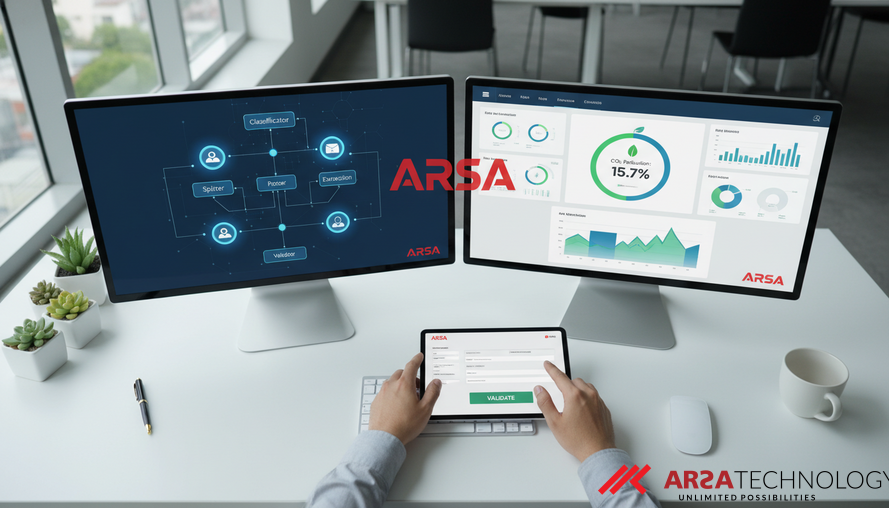
The MADP architecture functions like a highly efficient assembly line, where five specialized AI agents work in concert, passing intermediate results from one stage to the next. This modular approach provides inherent security benefits by allowing validation at each stage and supports both fully automated processing and human-in-the-loop (HITL) validation at critical decision points.
- Classificator Agent: This agent utilizes a Convolutional Neural Network (CNN)—a type of deep learning model adept at recognizing visual patterns—to swiftly identify document types and supplier categories. For instance, in invoice processing, it can classify documents by supplier, enabling the system to apply specific extraction templates tailored to each vendor. The design choice of a more compact CNN (ResNet-18) prioritizes minimal latency and computational footprint while maintaining high classification accuracy (95.3% on tests). This is akin to the precision required in AI Video Analytics, where visual data is processed to categorize and extract information for real-time insights.
- Splitter Agent: Many enterprise documents are multi-page, making consistent processing a challenge. The Splitter Agent is responsible for intelligently segmenting multi-page documents, ensuring that each logical unit is processed correctly before information extraction begins.
- Parser Agent: After classification and splitting, the Parser Agent extracts key information fields from the documents. This stage often contends with complex document layouts. Tools like Docling are pragmatic choices, acknowledging that no single parsing method can perfectly handle the diverse array of document types encountered in real-world enterprise scenarios.
- Extraction Agent: This agent leverages the advanced capabilities of Large Language Models (LLMs) to perform sophisticated information extraction. While parsers might identify basic fields, LLMs can understand context and extract nuanced data points, even from unstructured text. This is crucial for capturing the detailed information often found in complex documents like invoices or contracts.
- Validator Agent: The final agent in the sequence, the Validator, is critical for maintaining accuracy. It cross-references extracted data, checks for consistency, and flags potential errors. This stage is where the Human-in-the-Loop mechanism plays a vital role, ensuring that critical data is correct before being committed to downstream systems.
Human-in-the-Loop and Adaptive Learning
One of MADP's most significant innovations is its sophisticated Human-in-the-Loop (HITL) mechanism, coupled with the novel Prompt Fine Tuning with Feedback Inheritance (PFTFI) approach. HITL is not merely a fallback system; it's a strategic component designed to enhance both accuracy and compliance. Instead of humans laboriously reviewing every document, the Validator Agent selectively flags uncertain predictions or critical data points for human review. This targeted intervention ensures that human expertise is applied where it matters most, maximizing efficiency and minimizing errors in mission-critical applications.
The PFTFI mechanism takes this a step further. When a human expert corrects an AI's extraction, this feedback isn't just used to fix that specific instance. Instead, it’s inherited and used to subtly "fine-tune" the prompts or instructions given to the underlying LLM for future tasks. This iterative correction refines the AI's behavior over time without requiring a complete and costly retraining of the entire model. This continuous learning from human feedback ensures that the system becomes progressively more accurate and adaptable, especially as new document formats or data variations emerge. This type of iterative refinement and custom adaptation is a core part of what custom AI solutions aim to achieve for enterprises seeking evolving intelligence.
Transformative Results: Efficiency and Environmental Impact
The real-world operational analysis of MADP reveals compelling benefits for enterprises. In a production use-case scenario involving 100,000 invoices per year, the system demonstrated a potential reduction of Full-Time Equivalent (FTE) requirements by approximately 70%. This dramatic efficiency gain translates directly into significant cost savings and allows human resources to be reallocated to higher-value tasks.
Beyond the simulated scenario, actual production deployment showed remarkable reliability. Processing 955 real-world documents, MADP achieved a 97.0% full-pipeline automation rate, with only a small 3% requiring non-AI fallback. A more granular evaluation on a stratified subset of 100 documents, covering 20 diverse supplier and document-type categories, confirmed the system's robustness, attaining 98.5% document-level accuracy with Human-in-the-Loop supervision.
Perhaps most impressively, MADP pioneers a comprehensive sustainability analysis for AI-assisted document processing. Compared to traditional manual processing, this hybrid AI+HITL approach significantly reduces environmental impact:
- CO2 emissions: Reduced by 69%
- Energy consumption: Reduced by 69%
- Water usage: Reduced by 63%
This makes MADP not just an economically sound choice but also an environmentally responsible one, addressing the growing concern about the carbon footprint of AI systems. This commitment to practical, impactful, and responsible technology aligns with the vision of companies like ARSA Technology (PT Trisaka Arsa Caraka), which aims to build the future with AI and IoT.
Strategic LLM Selection for Production
A practical aspect of MADP's development involved benchmarking multiple Large Language Model (LLM) backends, including Granite-Docling, Mistral-Small, and DeepSeek-OCR. This comparison provides crucial insights for businesses looking to deploy similar solutions, highlighting the trade-offs between critical factors such as accuracy, processing latency, and the computational resources required (resource footprint) in real-world production environments. Such benchmarks are vital for selecting the optimal AI components that meet specific operational demands and budget constraints. This methodical approach ensures that the chosen AI models are not only powerful but also practical and sustainable for large-scale enterprise use.
The Future of Document Automation
The MADP multi-agent pipeline offers a clear vision for the future of enterprise document processing. By combining the precision of deep learning with the contextual understanding of LLMs, and critically, integrating intelligent human oversight through a Human-in-the-Loop mechanism and adaptive learning, it delivers unparalleled accuracy and efficiency. The compelling operational and sustainability metrics underscore that this hybrid approach significantly reduces both costs and environmental impact, making it a powerful solution for organizations navigating digital transformation. This intelligent orchestration of AI agents, coupled with strategic human intervention, is not just about automation; it's about building smarter, more resilient, and more sustainable business operations.
To explore how advanced AI and IoT solutions can transform your enterprise operations and unlock new efficiencies, we invite you to contact ARSA for a free consultation.