TaFall: Revolutionizing Fall Detection with Privacy-Preserving Thermal AI
Discover TaFall, an AI-powered thermal sensing system that offers highly accurate, privacy-preserving fall detection for older adults. Learn how balance-informed AI reduces false alarms and enhances safety in sensitive indoor environments.

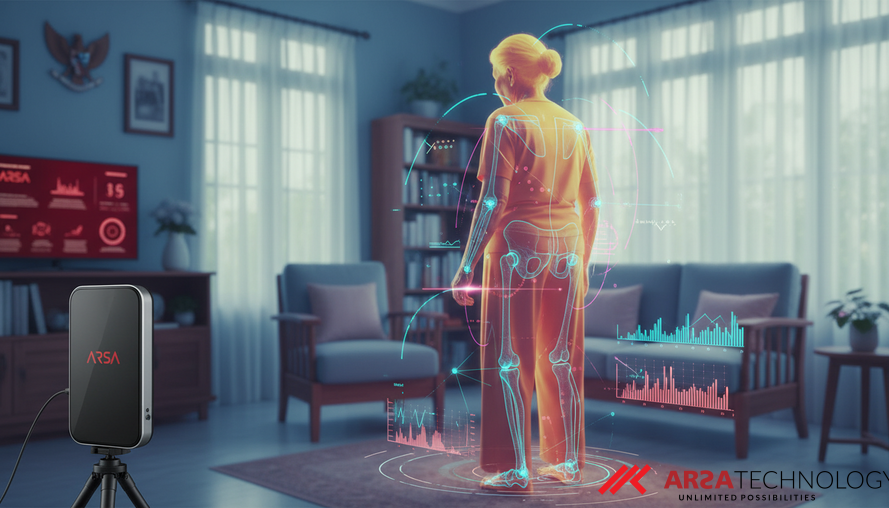
Falls are a significant global health concern, particularly for older adults, often leading to serious injuries, reduced independence, and a persistent fear that restricts daily activities. The challenge in preventing and responding to falls lies in effective, yet privacy-preserving, monitoring within private indoor environments. Traditional monitoring solutions—from wearable devices with adherence issues to camera-based systems raising significant privacy concerns—have struggled to find universal acceptance. Even radio frequency (RF) sensing, while more privacy-friendly, often relies on coarse motion cues that lead to unacceptable false alarm rates, overwhelming caregivers and eroding trust.
The Innovation: Balance-Informed Thermal Sensing
A groundbreaking approach called TaFall introduces a new paradigm in fall detection, leveraging low-cost, privacy-preserving thermal array sensing. The core innovation of TaFall is its ability to model a fall not merely as an abrupt movement but as a gradual process of balance degradation. By estimating pose-driven biomechanical balance dynamics from low-resolution thermal maps, TaFall can distinguish between a genuine fall and common daily activities that might otherwise trigger false alarms, such as quickly sitting down or bending over to pick up an object. This balance-centric approach ensures a higher level of reliability critical for real-world deployments.
Thermal array sensors work by passively measuring the infrared radiation (heat) emitted by objects in their field of view. This creates a low-resolution temperature map, as demonstrated in the academic paper TaFall: Balance-Informed Fall Detection via Passive Thermal Sensing (Li et al., 2026). Crucially, these maps do not capture visual details that could identify individuals, thus inherently preserving privacy—a vital consideration for sensitive areas like bedrooms and bathrooms where many falls occur. Moreover, thermal arrays operate effectively in total darkness or low-light conditions, maintaining robust performance regardless of ambient lighting. Compared to RF modalities like mmWave radar, thermal arrays offer finer spatial resolution and better human-background contrast due to consistent body temperatures, enabling more accurate reconstruction of body pose dynamics essential for balance estimation.
Overcoming Technical Challenges for Robust Pose Estimation
Translating this innovative concept into a practical system required overcoming several technical hurdles. Low-resolution, textureless thermal maps, combined with motion blur during rapid movements, make precise pose reconstruction—identifying the body's skeletal structure and posture—extremely challenging. To address this, TaFall incorporates three novel techniques:
- Appearance–Motion Fusion for Pose Estimation: Instead of seeing motion blur as a problem, TaFall reinterprets it as a valuable cue. The system fuses "appearance" (stable temperature distributions, e.g., hotter head/limbs, cooler torso) with "motion" (the smearing of thermal energy due to rapid movement, indicating velocity and direction). This dual-pronged approach enables robust pose reconstruction even under difficult conditions like rapid motion or self-occlusion.
- Physically Grounded Balance-Aware Learning: Traditional discrete balance-state annotations (stable balance, loss of balance, ground impact stage) can be ambiguous, especially during the critical "loss of balance" phase. TaFall introduces a continuous, physically grounded balance representation called the Signed Margin of Balance (SMoB). Inspired by biomechanical models of postural control, SMoB provides a more precise and objective measure of balance degradation, improving the accuracy of fall detection.
- Pose-Bridged Pretraining: To enhance robustness against diverse daily activities and variations among individuals and environments, TaFall uses pose-bridged pretraining. This technique allows the AI model to learn from a wider range of pose data, improving its ability to accurately classify balance states and minimize false alarms, especially for previously unseen situations.
Real-World Performance and Impact
The efficacy of TaFall has been rigorously tested, demonstrating exceptional performance in both controlled and real-world scenarios. On a dataset comprising over 3,000 fall instances from 35 participants across various indoor environments, TaFall achieved an impressive detection rate of 98.26% with a remarkably low false alarm rate of 0.65%.
Even more critically for long-term reliability, a 27-day deployment across four homes saw TaFall achieve an ultra-low false alarm rate of just 0.00126%. A pilot study in a bathroom setting further confirmed its robustness, even when faced with challenging environmental interferences like moisture and fluctuating temperatures—conditions where many other sensors might fail. This proven reliability in sensitive and high-risk environments significantly reduces the burden on caregivers, making it a viable and trustworthy solution for promoting independent living. These results, detailed in the research paper (Li et al., 2026), highlight TaFall's potential to provide reliable and privacy-preserving fall detection in everyday living environments.
Advanced AI for Enhanced Safety and Operational Intelligence
The principles behind TaFall—using advanced AI for precise, real-time analysis in sensitive environments while preserving privacy—align closely with the innovative solutions offered by companies like ARSA Technology. Our expertise in AI Video Analytics and Edge AI Systems enables enterprises to transform passive data streams into actionable intelligence. For instance, our AI Box Series provides pre-configured edge AI systems that can process video streams locally, similar to how TaFall handles thermal data, ensuring low latency and data privacy.
Solutions like the AI BOX - Basic Safety Guard are designed for safety and compliance monitoring in industrial environments, detecting issues like PPE non-compliance or restricted area intrusions. While focused on different contexts, the underlying commitment to real-time, on-premise AI processing and robust, accurate detection is shared. This emphasis on local processing and privacy-by-design ensures that sensitive data remains within your control, addressing concerns prevalent in both elder care and industrial settings.
Conclusion
TaFall represents a significant leap forward in fall detection technology, offering a robust, highly accurate, and privacy-centric solution that addresses critical limitations of previous systems. By moving beyond coarse motion cues to balance-informed biomechanical dynamics and leveraging the unique advantages of thermal sensing, it promises to enhance the safety and independence of older adults without compromising their privacy. This technology underscores the power of practical AI solutions that deliver real impact in the everyday world.
To explore how advanced AI and IoT solutions can enhance safety, optimize operations, and create new revenue streams in your industry, we invite you to contact ARSA for a free consultation.
Source: Li, C., Zhang, X., Zhu, W., Jiang, Y., & Wu, C. (2026). TaFall: Balance-Informed Fall Detection via Passive Thermal Sensing. arXiv preprint arXiv:2604.09693.