The 2026 AI & Machine Learning Roadmap for Smart Manufacturing: Driving Efficiency and Innovation
Explore the future of smart manufacturing with ARSA Technology's insights into the 2026 AI and ML roadmap. Understand foundational trends, key applications, and emerging techniques like generative AI and digital twins for industrial transformation.

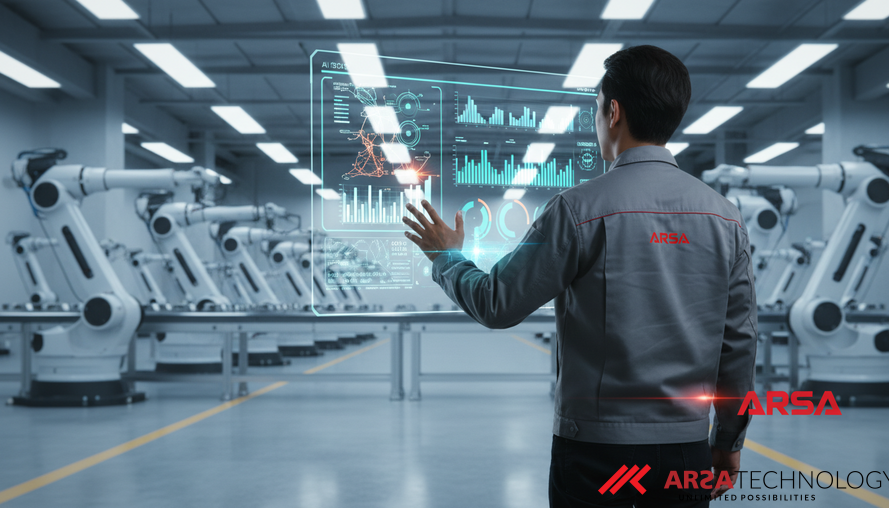
The Revolution of AI and Machine Learning in Manufacturing
The landscape of smart manufacturing is undergoing a profound transformation, driven by the rapid evolution of Artificial Intelligence (AI) and Machine Learning (ML). These technologies are not just enhancing existing processes but are fundamentally reshaping industrial operations, offering unprecedented capabilities in efficiency, adaptability, and autonomy across entire value chains. From optimizing production lines to predicting equipment failures and streamlining supply chains, AI and ML are becoming indispensable tools for enterprises aiming to stay competitive in a globalized market. This shift signifies a move beyond traditional automation, ushering in an era where systems can learn, adapt, and make intelligent decisions independently.
However, integrating AI and ML into complex industrial environments comes with its unique set of challenges. Manufacturers must contend with the sheer volume and complexity of industrial big data, the need for robust data management strategies, and seamless integration with diverse sensing and control systems. Furthermore, there's a critical demand for AI solutions that are trustworthy, explainable, and reliable, especially in high-stakes industrial scenarios where errors can have significant consequences. Addressing these hurdles is paramount for realizing the full potential of AI-driven smart manufacturing, as highlighted in the "2026 Roadmap on Artificial Intelligence and Machine Learning for Smart Manufacturing" published by IOP Publishing. (Source)
Tracing the Evolution of Smart Manufacturing
The journey towards smart manufacturing is a culmination of decades of technological advancements. It began in the mid-1960s with Flexible Manufacturing Systems (FMS), which introduced automated machining capable of adapting to various products. The 1970s and 1980s saw the emergence of Computer-Integrated Manufacturing Systems (CIMS), integrating CAD, CAM, robotics, and enterprise systems for holistic production management. By the early 1990s, Agile Manufacturing Systems (AMS) prioritized responsiveness to rapid market changes, while the Intelligent Manufacturing Systems (IMS) Program fostered global collaboration for developing intelligent, distributed, and adaptive manufacturing systems. These foundational phases laid the groundwork for modern automation and integration.
The digital infrastructure boom of the 2000s and 2010s marked a new foundational phase, characterized by data-driven connectivity and advanced sensing technologies. This period paved the way for the current era of AI/ML-enabled smart manufacturing (2014-2025), where intelligent algorithms are deployed to analyze vast datasets, automate complex tasks, and generate actionable insights. Looking ahead to 2025-2035, the industry is poised for the next generation of AI, promising even greater levels of autonomy, predictive capabilities, and intelligent decision-making, transforming manufacturing into a highly interconnected and adaptive ecosystem.
AI's Foundational Role in Modern Manufacturing
Today, AI and ML are central to enhancing almost every aspect of manufacturing. Industrial big data analytics, for instance, allows companies to derive meaningful insights from massive datasets, enabling predictive maintenance, quality control, and process optimization. Advanced sensing and perception systems, often powered by computer vision and deep learning, provide real-time monitoring and anomaly detection, crucial for safety and efficiency. For example, ARSA Technology's AI Video Analytics can transform standard CCTV footage into intelligent sensors, identifying PPE compliance, restricted area intrusions, and traffic patterns with high accuracy.
Autonomous systems are rapidly gaining traction, from self-optimizing production lines to intelligent robotics that collaborate seamlessly with human workers. In specialized fields like additive manufacturing and laser-based processes, machine learning optimizes material usage, print quality, and energy consumption. Digital twins, virtual replicas of physical assets or processes, are becoming increasingly sophisticated with AI, allowing for real-time simulation, performance monitoring, and predictive modeling. Solutions like the ARSA AI Box Series bring edge AI capabilities directly to the factory floor, processing data locally for immediate insights and enhanced data privacy, without heavy reliance on cloud infrastructure. This distributed processing is vital for scenarios demanding low latency and continuous operation.
Unlocking New Frontiers with Advanced AI
Beyond established applications, non-traditional machine learning techniques are opening exciting new avenues for smart manufacturing. Physics-informed AI integrates physical laws and engineering principles directly into AI models, leading to more accurate predictions and robust control systems, especially critical in complex industrial processes. Generative AI is transforming design and engineering, enabling the rapid creation of novel product designs, optimizing component geometries, and simulating manufacturing processes with unprecedented speed. This reduces development cycles and fosters innovation.
Semantic AI, which focuses on understanding the meaning and context of data, is crucial for building more intelligent and interoperable manufacturing systems. It allows disparate data sources to communicate effectively, creating a unified operational picture. The concept of advanced digital twins, powered by physics-based predictive control, allows for real-time decision-making, enabling autonomous manufacturing operations that can self-correct and adapt dynamically. Furthermore, the push for Trustworthy AI, Explainable AI (XAI), and Reliability, Availability, Maintainability, and Safety (RAMS) integration with AI/ML ensures that these advanced systems operate securely, transparently, and dependably in mission-critical environments. Large Language Models (LLMs) and foundation models are also emerging as powerful tools for processing and synthesizing vast amounts of unstructured industrial data, leading to more intelligent decision support and automation in highly connected and complex manufacturing ecosystems. Custom AI solutions, such as those offered by ARSA Technology, are key to developing these specialized, impactful applications.
Overcoming Challenges for Effective AI Deployment
While the potential of AI in smart manufacturing is immense, practical deployment requires addressing several core challenges. The sheer volume and variety of industrial data necessitate robust data collection, storage, and processing infrastructure. Ensuring data quality and relevance is crucial for training effective AI models. Integration with existing, often legacy, sensing and control systems can be complex, requiring flexible and hardware-agnostic solutions. The demand for trustworthiness means AI models must not only be accurate but also transparent in their decision-making, particularly in safety-critical applications.
Furthermore, issues of privacy and data sovereignty are paramount, especially in highly regulated industries. Edge AI systems play a vital role here by processing data locally, minimizing external data transfer, and reducing latency. The roadmap emphasizes the need for continuous innovation in methods, integration strategies, and fostering wider industrial adoption through collaborative efforts between academia and industry. Companies like ARSA, leveraging their expertise gained since 2018, understand these deployment realities and build practical, production-ready solutions.
The Future Outlook: Towards Reliable, Sustainable, and Scalable Manufacturing
The 2026 roadmap paints a picture of a manufacturing future where AI and ML are not merely tools but integral components of intelligent, adaptive, and sustainable operations. By guiding researchers, engineers, and practitioners, it aims to accelerate innovation and align academic advancements with industrial priorities. The ultimate goal is to ensure that AI-driven smart manufacturing delivers tangible benefits: reliable processes, sustainable resource utilization, and scalable impact across diverse manufacturing ecosystems globally. From enhancing public safety and defense to optimizing smart cities, retail, and industrial operations, AI's role will only grow.
Ready to explore how advanced AI and IoT solutions can transform your manufacturing operations, reduce costs, and create new value streams? Discover ARSA Technology's range of solutions and begin your journey towards a smarter, more efficient future.
Contact ARSA today for a free consultation.
Source: IOP Publishing Journal XX (XXXX) XXXXXX, "2026 Roadmap on Artificial Intelligence and Machine Learning for Smart Manufacturing" (https://arxiv.org/abs/2605.00839)