Unleashing Edge AI: Browser-Based Vision Training for Microcontrollers
Discover webmcu-vision-web, a zero-install browser application revolutionizing TinyML vision model training on microcontrollers, offering speed, privacy, and accessibility for edge AI.

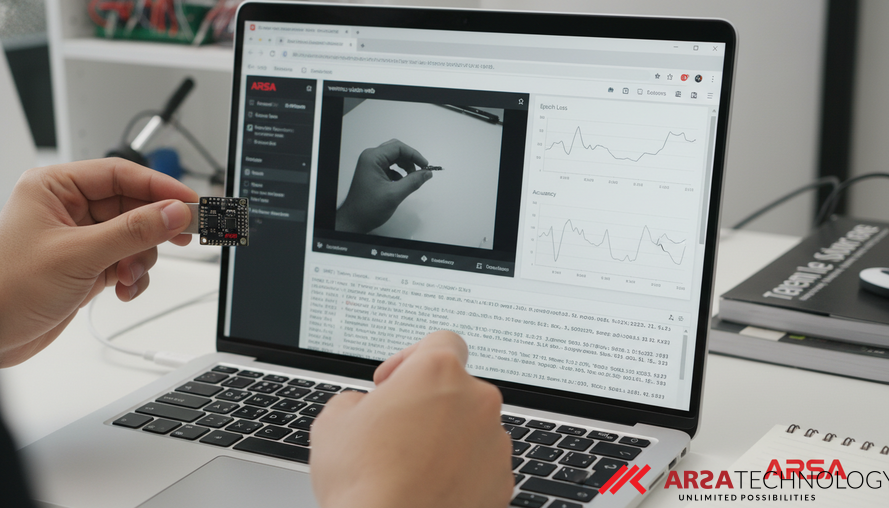
In the rapidly expanding world of Artificial Intelligence, a significant frontier is "TinyML" – machine learning optimized to run on low-power, cost-effective microcontrollers. This innovation promises to bring intelligent capabilities to the very edge of networks, where data is generated. However, developing and deploying TinyML solutions, especially for computer vision, often comes with a steep learning curve and practical complexities. A recent academic paper, "WebSerial Vision Training for Microcontrollers: A Browser-Based Companion to On-Device CNN Training," introduces `webmcu-vision-web`, a groundbreaking browser-based application that significantly simplifies this process, making sophisticated edge AI accessible to a broader audience.
The Foundational Philosophy of TinyML Datasets
Unlike traditional large-scale computer vision models that thrive on massive, diverse datasets for maximum generality, TinyML operates on an inverse principle. Devices constrained by power, memory, and processing capabilities are designed to solve one specific task with extreme efficiency. This could mean detecting a particular component on a factory assembly line under specific lighting conditions or identifying a single plant disease in a controlled greenhouse environment. For such tasks, the most effective dataset is not a vast, general corpus but a small, meticulously collected set of images captured precisely under the intended deployment conditions.
This tailored approach allows for models that are smaller, train faster, consume less energy during inference, and achieve higher accuracy for their target problem than any general-purpose model could. This is particularly impactful for organizations and individuals in regions with limited access to expensive cloud GPU infrastructure or for small businesses needing bespoke, on-premise solutions. With tools that embrace this philosophy, a factory worker, a researcher, or an educator can collect their own images, train on local hardware, and deploy a robust classifier without any data leaving their premises. This commitment to practical, real-world AI aligns with ARSA Technology's mission to deliver production-ready systems that solve specific operational problems across various industries.
Overcoming Traditional Barriers in Embedded ML Development
Historically, working with on-device machine learning has presented several practical challenges. Initial firmware installation often requires specialized Integrated Development Environments (IDEs) and board packages. Managing collected images or fine-tuning training parameters typically involves physically ejecting an SD card, transferring it to a PC, and manually editing files. Each adjustment to hyperparameters – the settings that control the learning process – usually necessitates modifying source code and recompiling the entire firmware. Even capturing training images directly on the device, often via a small, low-resolution screen, can be cumbersome. These friction points, as highlighted in the source paper [1], can consume valuable time, especially in educational settings or during rapid prototyping.
The `webmcu-vision-web` system directly addresses these limitations. It offers a browser-native companion interface that requires no software installation beyond a Chromium-based browser like Chrome or Edge. This zero-install, fully local machine learning pipeline empowers users to manage their entire development workflow securely and efficiently, transforming what was once a complex, multi-step process into a streamlined, integrated experience.
A Seamless, Browser-Based AI Workflow
The `webmcu-vision-web` application provides an end-to-end TinyML vision model training and deployment solution, all within a browser window. It's designed to work specifically with microcontrollers such as the Seeed Studio XIAO ESP32-S3 Sense. Key capabilities include:
- In-Browser Firmware Flashing: Utilizing `esptool-js`, users can flash firmware directly to their microcontroller from within the browser, eliminating the need for external tools or IDEs.
- Bidirectional Serial Monitor and SD Card Browser: The application includes a serial monitor for communication and a full file browser for the device's SD card, complete with image preview and inline editing. This feature dramatically simplifies data management and configuration.
- Live `config.json` Sync: Hyperparameter adjustments can be made live in the browser via `config.json` synchronization, removing the need for recompiling firmware after every change.
- Flexible Image Capture: Images for training can be captured using either a standard webcam or directly from the ESP32's OV2640 camera, ensuring relevance to the deployment environment.
- Rapid Browser-Side CNN Training: The application supports TensorFlow.js for Convolutional Neural Network (CNN) training that matches the on-device architecture. This is a significant speed improvement, with a representative three-class training run (e.g., distinguishing a blank surface, a cup, or a pen, with around 30 images per class over 20 epochs) completing in approximately 1 minute browser-side, compared to 9 minutes on-device. This efficiency enables a complete collect-train-deploy cycle in under 10 minutes.
- Weight Export and Deployment: Trained model weights are exported as `myWeights.bin` and `myWeights.h` files, ready for seamless deployment to the microcontroller's SD card.
- Advanced Analytics and Visualization: A confusion matrix provides clear insights into model performance, while a live Conv2 activation heatmap streamed from the ESP32 during inference offers real-time visualization of how the AI "sees" and interprets inputs.
Crucially, throughout this entire process, no data ever leaves the local machine, ensuring paramount privacy and security. For enterprises seeking similar streamlined, secure, and rapid deployment of AI at the edge, solutions like ARSA AI Box Series offer pre-configured edge AI systems built for fast on-site deployment without cloud dependency.
Empowering Innovation Through Accessibility
This system represents a new pedagogical model for TinyML iteration, making advanced concepts accessible to a wider audience, including educators, small businesses, and researchers who need to train highly specific visual classifiers. The design philosophy behind `webmcu-vision-web` extends to making the codebase easily adaptable. Its single-file structure, consistent naming, and extensive inline documentation are specifically chosen to facilitate adaptation with Large Language Models (LLMs) like Claude or ChatGPT. This allows users, regardless of their location or technical background, to describe new hardware, sensor modalities, or classification problems to an LLM and receive targeted modifications, lowering the barrier to entry for innovation. ARSA Technology, an organization with experienced since 2018 in developing AI and IoT solutions, understands the value of such adaptable and practical technology.
Robust Performance and Real-World Reliability
The experimental evaluation of `webmcu-vision-web` demonstrates its stability and effectiveness. A consistency evaluation involving five independent runs on a three-class reference problem, each with independently collected datasets, showed stable convergence and provided consistent mean accuracy with low standard deviation. The rapid browser-side training speed, completing a significant training task in about a minute, highlights the efficiency gain compared to purely on-device training. This performance is vital for iterative development and fine-tuning, allowing developers to quickly test and refine models.
Furthermore, the focus on training accuracy versus real-world inference, coupled with insights into dataset size and sufficiency, underscores the practical design of the system. It reinforces the TinyML philosophy that small, clean, and contextually relevant datasets lead to robust performance in the target environment.
The `webmcu-vision-web` project, with its focus on browser-based, zero-install, and privacy-preserving TinyML development, offers a significant leap forward in democratizing edge AI. By removing many of the traditional technical hurdles, it empowers a new generation of innovators to deploy intelligent solutions directly where they are needed most.
To learn more about how cutting-edge AI and IoT solutions can transform your operations, feel free to contact ARSA for a free consultation.
Source:
Ellis, Jeremy. "WebSerial Vision Training for Microcontrollers: A Browser-Based Companion to On-Device CNN Training." arXiv preprint arXiv:2604.22834 (2026). https://arxiv.org/abs/2604.22834.