Unleashing Intelligent Agents: Reinforcement Learning with the Unity Game Engine for Enterprise AI
Explore how Reinforcement Learning (RL) with Unity ML-Agents empowers the creation of intelligent AI agents for simulations, robotics, and complex decision-making, driving real-world enterprise innovation.

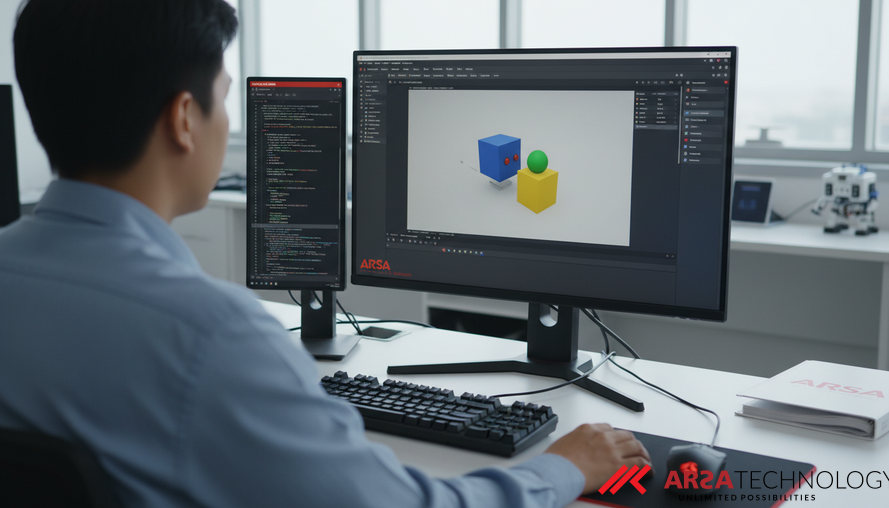
Reinforcement Learning (RL) stands as a pivotal paradigm within artificial intelligence, driving the development of agents capable of learning optimal behaviors through trial and error within dynamic environments. This approach, which mirrors how humans and animals learn from interaction and feedback, has transcended academic research to find profound applications in various industries. From optimizing industrial processes to creating sophisticated simulation models, RL offers a powerful toolkit for developing truly intelligent systems.
The Unity Game Engine, traditionally a cornerstone of interactive entertainment, has emerged as an unexpectedly robust platform for applied Reinforcement Learning. Its capabilities extend far beyond game development, providing a high-fidelity, physics-driven simulation environment that is ideal for training, testing, and deploying RL agents. This unique combination allows developers and engineers to build complex virtual worlds where AI can learn, adapt, and refine its strategies for real-world challenges, as explored in Adam Streck's insightful article, "Introduction to Reinforcement Learning Agents with the Unity Game Engine" (Source: https://towardsdatascience.com/introduction-to-reinforcement-learning-agents-with-the-unity-game-engine/).
Understanding the Core Concepts of Reinforcement Learning
At its heart, Reinforcement Learning involves an "agent" interacting with an "environment" to achieve a specific goal. The agent performs "actions" within this environment, observes the "state" or outcome of these actions, and receives "rewards" or "penalties" based on their effectiveness. Over time, through repeated interactions, the agent learns a "policy"—a mapping from observed states to actions—that maximizes its cumulative reward. This iterative process of exploration and exploitation is what drives the agent's learning.
Key components in any RL setup include:
- Agent: The entity that learns and makes decisions.
- Environment: The world in which the agent operates and interacts.
- Observations (State): Information the agent perceives about the environment at any given time.
- Actions: The choices or moves the agent can make within the environment.
- Reward: A scalar feedback signal from the environment indicating the desirability of an agent's action.
The power of RL lies in its ability to solve problems where explicit programming of optimal behavior is impractical or impossible. Instead of being told what to do, an RL agent discovers the best strategies itself, making it highly adaptable to complex and uncertain scenarios.
Unity as a Premier Platform for AI Agent Development
Unity's strength as an RL platform stems from its advanced 3D rendering, realistic physics engine, and extensive asset store, which together enable the creation of highly detailed and controllable simulation environments. The Unity ML-Agents Toolkit, specifically, bridges the gap between Unity's virtual worlds and popular machine learning frameworks like TensorFlow and PyTorch. This toolkit empowers developers to create diverse environments where agents can learn complex behaviors.
By leveraging Unity, developers can rapidly prototype, iterate, and visualize the learning process of their AI agents. This provides critical insights into how agents interpret their environment and respond to various stimuli. The ability to simulate real-world conditions, from intricate mechanical systems to dynamic crowd behaviors, makes Unity an invaluable tool for both research and practical application of RL.
Building a Reinforcement Learning Environment with Unity
Creating an RL environment in Unity involves several structured steps, primarily managed through C# scripting. First, a virtual scene must be designed to represent the target environment, complete with relevant objects and boundaries. Once the environment is set, the central piece is the "Agent" script, which inherits from Unity's ML-Agents `Agent` class. This script defines the agent's unique behaviors and how it interacts with the learning process.
Within the Agent script, developers must:
- Initialize the Agent: Set up its starting position and any initial parameters.
- Define Observations: Specify what information the agent collects from its surroundings (e.g., its position, velocity, distances to objects, sensor readings).
- Implement Actions: Define the possible actions the agent can take (e.g., move forward, turn, jump, interact with objects).
- Assign Rewards: Crucially, design a reward function that provides positive feedback for desired behaviors and negative feedback for undesirable ones. This guides the agent towards the optimal policy.
- Handle Episode Completion: Determine when an episode (a single learning trial) ends, either by achieving a goal or failing, and reset the environment for the next trial.
This structured approach allows for precise control over the learning problem, ensuring that the agent receives clear signals to learn effectively.
Training and Deploying Intelligent Agents
Once the Unity environment and agent behaviors are defined, the training process begins outside the engine. The Unity ML-Agents Toolkit facilitates this by communicating with an external Python-based machine learning framework. During training, the Unity environment runs numerous simulations, sending observations to the ML framework, receiving actions in return, and providing rewards. This cycle, repeated millions of times, allows the RL algorithm to converge on an optimal policy.
The trained policy, essentially the "brain" of the agent, can then be embedded back into the Unity environment. This allows the AI agent to operate autonomously, applying its learned intelligence within the simulation. For real-world deployments, these trained models can be exported and integrated into actual robotic systems or other operational infrastructures. ARSA Technology, for instance, provides custom AI solutions that bridge such simulation-to-reality gaps, ensuring robust performance in production environments.
Beyond Gaming: Real-World Applications in Enterprise
While Unity's origins are in gaming, the combination of its powerful simulation capabilities with Reinforcement Learning opens doors to significant enterprise applications across various industries:
- Robotics and Automation: Training industrial robots for complex assembly tasks, navigation in dynamic warehouses, or fine motor control in hazardous environments. RL in Unity can simulate these scenarios safely and efficiently before deployment.
- Autonomous Systems: Developing and testing AI for self-driving vehicles, drones, and other unmanned systems. Unity provides realistic simulations of diverse traffic conditions, weather patterns, and urban landscapes.
- Logistics and Supply Chain Optimization: Creating agents that can learn optimal routes for delivery fleets, manage inventory, or streamline warehouse operations, leading to significant cost reductions and efficiency gains.
- Smart City Management: Simulating traffic flow, public transport optimization, and resource allocation to improve urban infrastructure and citizen services. For edge deployment in smart city contexts, solutions like the ARSA AI Box Series can process real-time data efficiently.
- Healthcare Simulation: Training medical professionals for intricate surgical procedures or emergency response scenarios in a risk-free virtual environment. RL agents can also assist in drug discovery by simulating molecular interactions.
These applications highlight the immense potential of using Unity-based RL simulations to tackle intricate real-world problems, offering solutions that are both scalable and profitable. ARSA's expertise in AI video analytics, for example, can contribute to these applications by providing advanced observational capabilities within these simulated and real environments.
Reinforcement Learning agents, built and refined within the Unity Game Engine, represent a frontier in AI development. This powerful combination enables enterprises to move beyond theoretical models, creating and deploying intelligent systems that learn and adapt in dynamic, complex environments. The ability to simulate, train, and validate AI agents in a controlled yet realistic setting offers unparalleled advantages for innovation and operational excellence.
Ready to explore how Reinforcement Learning can transform your operations with intelligent, adaptive AI solutions? We invite you to explore ARSA's range of AI and IoT solutions and request a free consultation to discuss your specific needs.