Unlocking Arabic Sign Language: The Power of Multimodal AI for Greater Accessibility
Explore how a multimodal AI approach, combining Leap Motion and RGB cameras, revolutionizes Arabic Sign Language (ArSL) recognition. Discover its impact on education, healthcare, and social inclusion.

Bridging Communication Gaps with Advanced AI
Human communication is a fundamental pillar of society, enabling interaction, learning, and social engagement. For the deaf and hard-of-hearing (D/HoH) communities worldwide, sign language serves as an indispensable form of communication. It is a rich, complex visual language, distinct from spoken languages, with its own grammar, vocabulary, and cultural nuances. Recognizing this complexity and the critical need for inclusive communication, researchers are continually exploring advanced technologies to bridge the gap between signing and non-signing communities. Arabic Sign Language (ArSL), the primary mode of communication for deaf communities across Arab countries, presents unique challenges due as some signs incorporate specific body parts in addition to hand gestures.
Historically, automated sign language recognition (SLR) systems have struggled with the inherent variability of signing styles, intricate hand shapes, dynamic movements, and contextual facial expressions. While early computer vision techniques laid the groundwork, the advent of deep learning has propelled significant progress, opening doors to new applications. A recent academic paper, "Arabic Sign Language Recognition using Multimodal Approach," delves into an innovative multimodal AI strategy to enhance the accuracy and robustness of ArSL recognition. This research, initially published on arXiv, offers crucial insights into how combining different data inputs can lead to more effective and inclusive communication technologies.
The Limitations of Traditional Single-Sensor Approaches
Many existing sign language recognition systems primarily rely on single data sources, such as a standalone RGB camera or a specialized hand-tracking device like Leap Motion. While these technologies offer specific advantages, they also come with notable limitations that hinder precise and comprehensive sign interpretation. RGB cameras, for instance, excel at capturing visual context and facial expressions but often struggle with the precise 3D tracking of complex hand orientations and subtle movements. Conversely, devices like Leap Motion provide highly accurate 3D hand and finger movement data but lack the broader visual context that can be crucial for interpreting signs that reference specific body parts or require understanding the signer's full posture.
The paper highlights these precise limitations: "inadequate tracking of complex hand orientations and imprecise recognition of 3D hand movements" when relying on single sensors. This makes it particularly challenging for languages like ArSL, where a sign's meaning can change based on whether the hand interacts with, for example, the head, shoulder, or chest. Such nuances are often missed when the system only sees hand motion or only a flat image. The absence of comprehensive data can lead to misinterpretations, reducing the reliability and practical applicability of these systems in real-world communication scenarios.
A Multimodal Breakthrough: Combining Vision and Motion
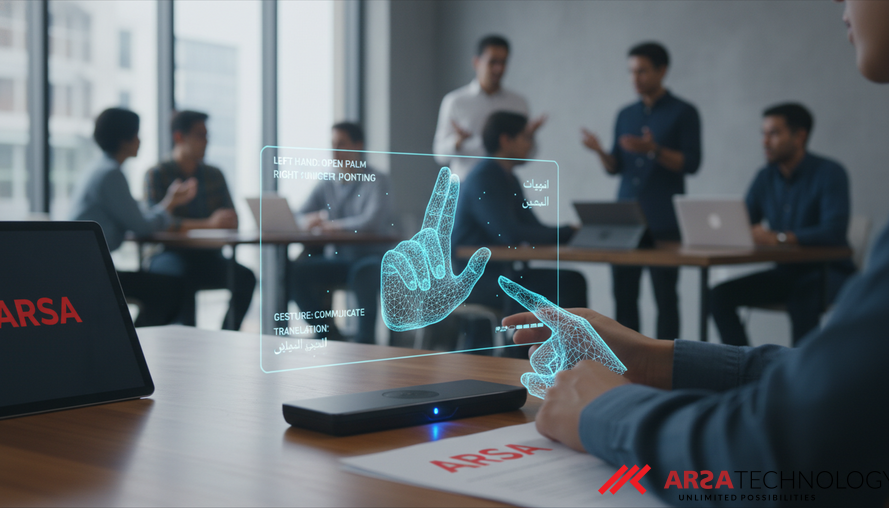
To overcome the inherent weaknesses of single-sensor systems, the research explores a multimodal approach, integrating data from both a Leap Motion controller and an RGB camera. This synergistic combination allows the system to capture both the intricate 3D kinematics of hand gestures (via Leap Motion) and the crucial visual context provided by the body's interaction with the hands (via RGB camera). By fusing these two distinct data streams, the system aims for a more complete and accurate understanding of ArSL signs.
The proposed system architecture is designed with two parallel processing pathways, or "subnetworks." One subnetwork, a custom dense neural network, is dedicated to processing the numerical data from the Leap Motion device. This network incorporates techniques like dropout and L2 regularization to ensure the AI model learns general patterns effectively and avoids simply memorizing the training data. The second subnetwork is an image-based system built upon a fine-tuned VGG16 model, a robust pre-trained deep learning architecture for image recognition. This image subnetwork is further enhanced with data augmentation techniques, which effectively multiply the training data by introducing slight variations to existing images, making the model more robust to different visual conditions.
How the Multimodal System Works (Simplified)
At its core, the multimodal system functions by intelligently processing and combining different types of information. Imagine having two expert interpreters: one who meticulously tracks every tiny movement of your hands in 3D, and another who observes your entire body, noting which body parts your hands touch.
First, the Leap Motion data, which includes precise coordinates and orientations of hands and fingers, goes through a specialized AI component (a dense neural network). This component learns to recognize specific hand shapes and movements. Simultaneously, video frames from the RGB camera feed into another AI component (a fine-tuned VGG16 model), which is adept at understanding visual information. This component identifies the overall context, such as the position of the hands relative to the signer's head or chest, crucial for ArSL.
Once both AI components have extracted their respective "features" – the key pieces of information from their data streams – these features are brought together, or "concatenated," in a central "fusion model." This fusion model then processes the combined information through additional layers, essentially allowing the system to consider all relevant data points simultaneously. Finally, a SoftMax activation layer determines the most probable ArSL word, analyzing both the 'spatial' aspects (hand shape at a given moment) and 'temporal' aspects (the sequence of movements over time) of the gestures. This integrated process allows the AI to make a much more informed and accurate decision than either sensor could alone.
Transforming Lives and Industries: Real-World Impact
The successful implementation of such an AI-powered sign language recognition system has profound implications that extend far beyond technical innovation. It promises to significantly enhance accessibility and foster greater social inclusion for deaf and hard-of-hearing individuals across numerous sectors.
- Education: Real-time ArSL recognition can transform classrooms into truly inclusive environments. By providing instantaneous translations of lectures and educational materials, D/HoH students can participate fully, improving their learning outcomes and expanding their educational opportunities.
- Healthcare: In medical settings, clear communication is paramount. ArSL recognition can facilitate seamless interaction between deaf patients and healthcare professionals, leading to more accurate diagnoses, personalized treatment plans, and an overall better patient experience. This also addresses compliance and patient safety.
- Workplace Accessibility: For businesses, implementing ArSL recognition technology can break down communication barriers, creating more inclusive employment opportunities and diverse workforces. This not only enhances corporate social responsibility but also taps into a broader talent pool, potentially leading to increased productivity and innovation. For instance, such AI capabilities align with solutions that improve overall operational efficiency, similar to how ARSA's AI Box - Basic Safety Guard enhances workplace compliance.
- Social Inclusion: Beyond these specific domains, the technology promotes broader social inclusion by enabling effortless communication in daily interactions, public services, and online platforms. Imagine public announcements being automatically translated, or customer service interactions becoming more accessible. This fosters a sense of belonging and equal participation in society.
The preliminary evaluation, which achieved an overall accuracy of 78% on a custom dataset of 18 ArSL words (correctly recognizing 13), provides promising evidence of the viability of this multimodal fusion approach. While this is an initial step, it underscores the potential for significant improvements with further optimization and larger, more diverse datasets.
ARSA Technology's Role in Advanced AI/IoT Solutions
ARSA Technology has been at the forefront of leveraging AI and IoT to drive digital transformation across various industries, experienced since 2018. While the academic paper focuses on the research of ArSL recognition, the underlying principles of integrating complex data streams and deploying robust AI models for real-time analysis are core to ARSA's expertise. Our AI Video Analytics solutions are designed to convert passive video footage into actionable intelligence, a capability directly relevant to the visual processing needs of a sign language recognition system.
For instance, our AI Video Analytics platform can be customized to detect and classify complex human behaviors and interactions, drawing parallels to the gesture and body part recognition required for ArSL. Furthermore, ARSA's modular AI Box series, which transforms existing CCTV cameras into intelligent monitoring systems with edge computing, offers a robust framework for deploying such advanced computer vision solutions directly on-premise, ensuring privacy and low-latency processing.
The Path Forward: Optimizing for a More Inclusive Future
The "Arabic Sign Language Recognition using Multimodal Approach" paper provides a foundational step towards highly accurate ArSL interpretation. Future work will likely involve expanding the dataset to cover a wider vocabulary and more variations in signing styles, optimizing the neural network architectures, and exploring real-time deployment challenges. Addressing the complexities of natural sign language, including subtle facial expressions and head movements, will be crucial for creating truly intuitive and comprehensive systems.
Ultimately, the goal is to develop highly accurate, intuitive, and efficient sign language recognition technology that serves as a practical tool, fostering accessibility and promoting social inclusion for D/HoH communities globally. Such advancements underscore the immense potential of AI and IoT to create a more connected and equitable world.
To explore how ARSA Technology’s AI and IoT solutions can address your specific operational challenges and drive digital transformation, we invite you to contact ARSA for a free consultation.
**Source:** Alanazi, G., & Benabid, A. (2024). Arabic Sign Language Recognition using Multimodal Approach. arXiv preprint arXiv:2601.17041.