Unlocking Hidden Insights: AI Soft Sensors for Interpretable N2O Emissions in Wastewater Treatment
Explore how AI-powered soft sensors enhance understanding of spatially variable N2O emissions in wastewater treatment, offering clearer insights for environmental compliance and operational efficiency.

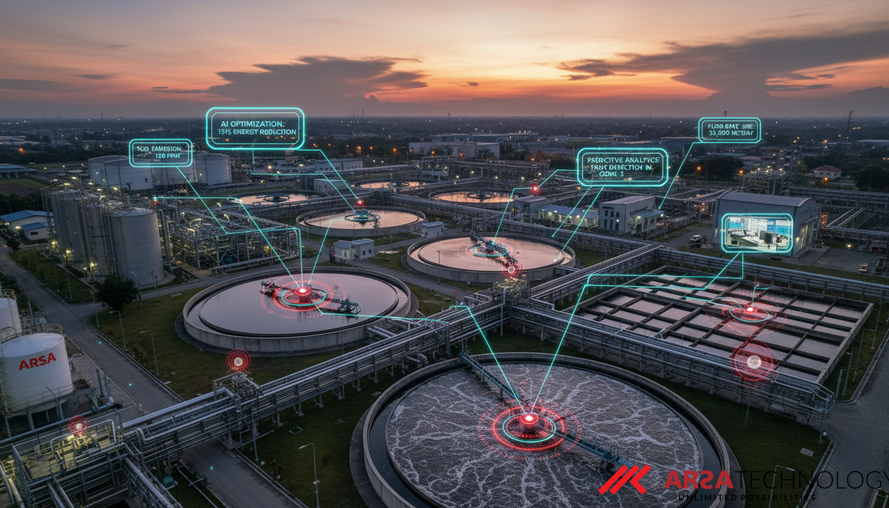
Nitrous oxide (N2O) is a potent greenhouse gas, far more impactful than carbon dioxide over a 100-year period. Its emissions from wastewater treatment plants (WWTPs) are a significant environmental concern, yet accurately monitoring and managing them presents a complex challenge. Unlike liquid waste parameters, N2O emissions are spatially and temporally variable, making traditional point-measurement sensors insufficient for a complete picture. This variability makes it difficult for plant operators to understand where and why N2O is being produced, hindering effective mitigation strategies.
The Invisible Challenge: Spatially Variable N2O Emissions
Wastewater treatment is a complex biological process designed to remove pollutants, primarily nitrogen and phosphorus. N2O is an unintended by-product of two crucial microbial processes: nitrification (converting ammonia to nitrite and then nitrate) and denitrification (converting nitrate back to nitrogen gas). The rate of N2O production is influenced by numerous factors, including the specific treatment technology, operational strategies, the composition of the microbial community, and even climate conditions like temperature and diurnal wastewater loading. These factors change constantly, causing N2O emissions to fluctuate dramatically over time and vary across different sections of a large WWTP.
Current monitoring techniques often fall short. They typically involve short-term measurements from a limited number of point locations, such as gas hoods covering small areas or individual liquid sensors. Extrapolating these localized measurements to represent the entire plant's emissions can lead to significant inaccuracies, as they don't capture the vast spatial variability. Consequently, emission factors (the amount of gas emitted per unit of nitrogen load) derived from such limited data may not truly reflect the long-term, site-scale emissions. This highlights a critical need for solutions that can generate a more comprehensive, higher-resolution dataset of N2O emissions across the entire treatment facility.
Leveraging AI and Soft Sensors for Enhanced Monitoring
Given the limitations of physical sensors, "soft sensors" offer a promising alternative. These are virtual sensors powered by machine learning (ML) models that predict N2O emissions by analyzing readily available operational data (like nutrient levels, dissolved oxygen, and flow rates) from existing sensors. Instead of directly measuring N2O, soft sensors infer it, providing a cost-effective way to generate spatially and temporally richer data. This approach allows WWTPs to gain insights into areas where physical N2O sensors are impractical or too expensive to deploy, effectively turning passive infrastructure into intelligent decision engines.
Recent research, such as the study published on arXiv.org, "Enhancing the interpretability of spatially variable N2O model predictions with soft sensors during wastewater treatment," investigates the robustness and reliability of these AI models (Mohammad Raeisi Gahrouei et al., 2024, https://arxiv.org/abs/2605.04082). By analyzing a real dataset from the Kralingseveer WWTP, researchers found that ML models could predict N2O emissions with high accuracy, achieving R² values between 0.79 and 0.89. When validated against comprehensive synthetic datasets simulating various disturbances and additional sensor locations, these models demonstrated even higher accuracy (0.97 ± 0.02). This performance indicates the strong potential for AI to transform how WWTPs monitor and manage N2O emissions, allowing for real-time alerts and operational metrics. Companies like ARSA Technology, with their expertise in AI Video Analytics and custom AI solutions, can help integrate such sophisticated monitoring frameworks into existing industrial infrastructures.
The Challenge of Interpretability: Beyond Predictive Accuracy
While ML models show impressive predictive accuracy, their true value in critical industrial applications lies in their interpretability. The study revealed a crucial finding: the importance of different operational features (inputs) in predicting N2O emissions varied significantly depending on the specific ML model used, the scenario being analyzed, and even the scale at which N2O was measured (e.g., individual reactor vs. the entire WWTP). This implies that a model might accurately predict N2O levels but struggle to explain why those levels are occurring or what specific operational changes are driving them.
The interpretability of soft sensor predictions is further limited by the inherent methodological uncertainty of the underlying datasets. Physical N2O measurements, even with advanced equipment, carry analytical errors ranging from 10% to 25%. If these uncertainties are not accounted for, models can become overfit or underfit, leading to misleading interpretations of feature importance and pathway contributions. For decision-makers, understanding these nuances is critical. It enables operators to trust the insights and implement targeted mitigation strategies that are genuinely effective in reducing emissions and ensuring compliance. ARSA offers custom AI solutions designed to provide robust, explainable insights tailored to specific operational realities and data quality.
Mechanistic Models: Deepening Our Understanding
To address the limitations of purely data-driven ML models and enhance interpretability, researchers often employ mechanistic models (McMs). These models are built upon our scientific understanding of the underlying biological and chemical processes governing N2O production. By combining a real-world dataset with synthetic, plant-wide datasets generated by a modified mechanistic model, the study was able to simulate various scenarios, including the impact of additional sensors and wastewater disturbances.
This hybrid approach allowed the researchers to investigate structural limitations within commonly used McMs. For example, the analysis exposed complex interactions between autotrophic (organisms that produce their own food) and heterotrophic (organisms that consume organic matter) pathways, particularly concerning nitric oxide intermediates. Such interactions could potentially lead to an overestimation of aerobic nitrite production, which in turn biases the predicted contributions of different N2O production pathways. By diagnosing these potential effects, which are incredibly difficult to isolate experimentally in a full-scale plant, the study provides a deeper, more transparent understanding of the biological mechanisms driving N2O emissions. This kind of in-depth analysis is vital for developing more accurate models and effective mitigation strategies.
Practical Implications for WWTP Operations and Environmental Compliance
The integration of AI-powered soft sensors and insights from mechanistic models offers significant practical advantages for wastewater treatment plants. Firstly, it provides a powerful tool for continuous, real-time monitoring of N2O emissions across the entire facility, helping operators pinpoint emission hotspots and respond dynamically to operational changes. This leads to better management of this potent greenhouse gas, improving environmental performance and compliance with increasingly stringent regulations.
Secondly, by providing a clearer understanding of the factors influencing N2O production, plant managers can optimize operational strategies. This could involve adjusting aeration rates, nutrient dosing, or sludge retention times to reduce N2O emissions without compromising effluent quality. The study’s findings about feature importance, despite its variability, still offer valuable clues for process engineers to investigate. Finally, for enterprises in critical infrastructure, solutions like the ARSA AI Box Series enable on-premise, edge processing of such data, ensuring low latency, data privacy, and operational reliability, crucial aspects for compliance-driven industries. ARSA Technology has been experienced since 2018 in delivering such production-ready AI and IoT systems.
Transforming complex operational data into actionable intelligence is key for modern WWTPs aiming for both efficiency and environmental responsibility. By embracing AI-driven soft sensors and a deep understanding of their interpretability, decision-makers can navigate the complexities of N2O emissions with greater confidence and achieve measurable impact.
To explore how AI and IoT solutions can enhance your environmental monitoring and operational efficiency, contact ARSA for a free consultation.
**Source:** Mohammad Raeisi Gahrouei, P., Ramin, V. A. Riggio, & Carlos Domingo-Félez. (2024). Enhancing the interpretability of spatially variable N2O model predictions with soft sensors during wastewater treatment. arXiv preprint arXiv:2605.04082. Available at: https://arxiv.org/abs/2605.04082