Unlocking Ocean's Secrets: How a New AI Corpus Powers Marine Intelligence
Discover OCEANPILE, a groundbreaking multimodal ocean dataset breaking the data bottleneck for AI in marine science. Learn how it fuels advanced AI models for climate, biodiversity, and resource management.

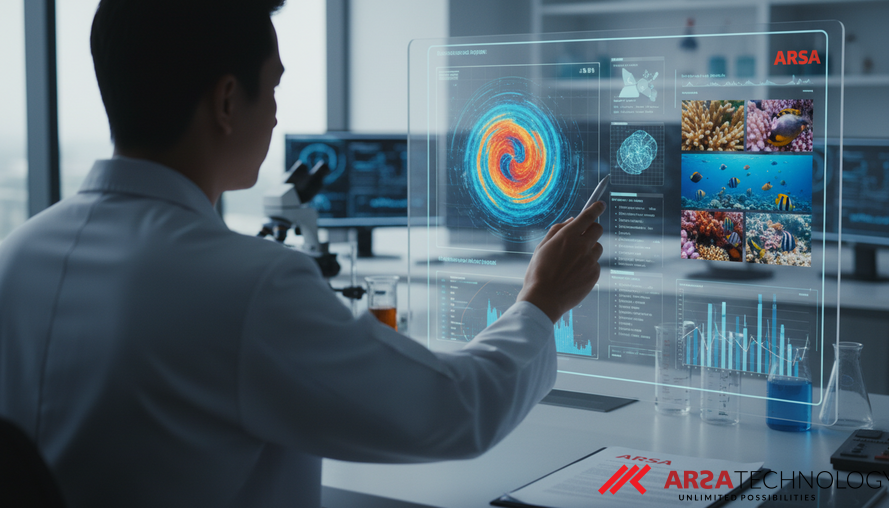
The world's oceans, covering over 70% of our planet, are vital regulators of global climate, indispensable ecosystems for biodiversity, and crucial engines for economic activity. Despite their immense importance, a vast majority of marine environments remain unexplored and poorly understood. Decades of advancements in ocean observation technologies have generated a wealth of data, from sonar measurements to complex oceanographic imagery and scientific texts. However, leveraging this data with Artificial Intelligence (AI) has been hindered by a significant "data bottleneck"—until now. Researchers have introduced OCEANPILE, a pioneering large-scale multimodal corpus designed to bridge this gap and accelerate the development of advanced marine AI.
The Ocean's Data Dilemma for AI
Despite the rapid progress of Multimodal Large Language Models (MLLMs)—AI systems capable of processing and understanding various data types like text, images, and audio simultaneously—their application in ocean science has been limited. The core issue lies in the nature of existing ocean data. This information is highly fragmented, scattered across numerous disparate sources like scientific literature, engineering reports, and observational instruments. Furthermore, ocean data inherently presents challenges: it's multimodal (e.g., sonar, images, text), often high-noise, and typically "weakly labeled," meaning it lacks consistent, high-quality annotations that AI models need for effective training. This makes it difficult to integrate knowledge and apply domain-specific reasoning.
General-purpose MLLMs, while powerful, struggle with the nuances and distinct semantic spaces of marine science. Sonar acoustic signatures, visual features in underwater imagery, and technical concepts in scientific texts represent fundamentally different kinds of information. This "modality gap" and semantic misalignment prevent these models from developing the deep, specialized understanding required for complex marine intelligence tasks. Existing marine datasets, such as traditional sonar datasets or underwater object image datasets, were simply not built for the comprehensive training needs of modern MLLMs. This has created an urgent need for a unified, well-aligned, and large-scale multimodal dataset specifically tailored for ocean science.
Introducing OCEANPILE: A Foundation for Marine AI
To overcome these challenges, researchers at Zhejiang University have developed OCEANPILE, a comprehensive and meticulously curated multimodal corpus (Source: arXiv:2605.00877). This groundbreaking initiative aims to provide the essential data substrate for developing powerful, domain-specific MLLMs for marine intelligence. OCEANPILE systematically integrates dispersed and heterogeneous oceanographic data into a unified, open-access resource, ensuring scientific validity and alignment across diverse modalities.
The corpus is structured into three key components:
- OCEANCORPUS: This foundational component is a vast collection of multimodal oceanographic data, unifying sonar data, underwater imagery, marine science visuals, and scientific text from authoritative sources. It comprises over 5 billion tokens for model pre-training.
- OCEANINSTRUCTION: A high-quality instruction dataset containing approximately 140,000 domain-specific instruction pairs. This dataset is synthesized using a novel pipeline guided by a hierarchical Ocean Concept Knowledge Graph, designed to support supervised fine-tuning and the development of instruction-following capabilities in AI models.
- OCEANBENCHMARK: A manually curated evaluation benchmark consisting of 1,469 specialized samples for rigorous and standardized assessment of marine intelligence tasks.
Building a Robust Marine Data Pipeline
The creation of OCEANPILE involved specialized data processing techniques to ensure the scientific integrity and contextual richness of oceanographic information. A multi-stage quality control process was established to guarantee validity and semantic alignment across all modalities. This meticulous approach addresses the inherent heterogeneity of ocean data, ensuring that the complex relationships within marine environments are preserved for AI models to learn effectively.
Unlike general web content, OCEANPILE aggregates data exclusively from specialized marine sources, including scientific literature, processed sonar data, biological imagery, and curated content from academic papers. This domain-adapted processing pipeline is crucial for training AI models that can accurately interpret and reason about complex marine phenomena. For companies like ARSA Technology, which has been experienced since 2018 in developing and deploying practical AI solutions, such a specialized corpus is invaluable for building highly accurate and reliable systems for diverse applications.
Impact and Future Implications for Ocean Science
Experimental validation has already demonstrated significant performance improvements for MLLMs trained on the OCEANPILE data. This indicates that the corpus is successfully empowering AI models to understand and interpret marine data with unprecedented accuracy, leading to more robust domain-specific reasoning capabilities. The public release of all OCEANPILE datasets is a major step forward, fostering collaborative research and accelerating innovation in marine artificial intelligence.
The development of domain-specific MLLMs, fueled by datasets like OCEANPILE, holds immense potential for various sectors:
- Environmental Monitoring: Better understanding of climate regulation, marine biodiversity, and ecosystem health, enabling more effective conservation strategies.
- Resource Management: Enhanced insights into underwater resources, supporting sustainable fishing, energy exploration, and mineral extraction while minimizing environmental impact.
- Public Safety and Defense: Improved analysis of sonar and underwater imagery for navigation, surveillance, and security in marine environments.
- Logistics and Shipping: Smarter routing, hazard detection, and operational optimization for maritime activities.
For enterprises and governments seeking to leverage advanced AI in these critical areas, this new data foundation means more precise and actionable intelligence. Imagine AI Video Analytics systems capable of identifying subtle changes in marine life populations from underwater footage, or AI Box Series devices deployed on autonomous underwater vehicles providing real-time assessments of ocean health. Such advances pave the way for a deeper understanding and more effective stewardship of our oceans.
The availability of such a comprehensive and high-quality dataset will enable AI developers and researchers to move beyond generalized models and build truly specialized solutions. This not only enhances the accuracy and reliability of marine AI but also ensures that future innovations are grounded in scientifically validated data, unlocking new possibilities for discovery and sustainable management of the ocean's vast resources.
To explore how advanced AI and IoT solutions can transform your operations in marine or other critical sectors, and to discuss the development of custom AI solutions tailored to your specific needs, we invite you to contact ARSA team.