Unlocking Research-Level Math: How Agentic AI Systems Tackle Complex Proofs
Explore Research Math Agents (RMA), an AI framework that navigates complex mathematical research problems with multi-agent collaboration, literature grounding, and iterative refinement, surpassing current LLM capabilities.

AI's Next Frontier in Mathematics: Beyond Competition to Research
Artificial intelligence has made remarkable strides in various domains, with mathematical reasoning long standing as a pinnacle challenge. Early successes saw AI systems conquering competition-style math problems, often relying on precise symbolic manipulation and relatively short, self-contained logical chains. However, the world of research-level mathematics presents a qualitatively different hurdle. These problems demand extensive, long-horizon reasoning, deep understanding of existing literature, the ability to formalize assumptions, and iterative refinement of complex proofs. They are not merely about finding a known solution quickly but about forging new mathematical pathways.
While existing AI approaches have leveraged formal theorem proving systems and advanced Large Language Model (LLM)-assisted verification for well-defined problems, these tools often fall short when faced with the open-ended, exploratory nature of mathematical research. The need to interpret specialized definitions, identify relevant prior results, construct intermediate lemmas, and develop novel proof strategies necessitates a more sophisticated, adaptive AI framework.
Understanding Research-Level Mathematical Problems
Unlike the constrained environment of math competitions, research-level mathematical problems are characterized by their inherent complexity and ambiguity. They rarely come with a clear, pre-defined path to a solution. Instead, solving them involves:
- Long-Horizon Reasoning: Requires many intricate logical steps, often spanning numerous pages of deductions.
- Literature Grounding: Demands consulting and understanding vast bodies of existing mathematical research, theorems, and definitions.
- Iterative Proof Refinement: The process of proving is not linear; it involves proposing hypotheses, attempting proofs, identifying logical gaps, and repeatedly refining the approach based on feedback.
- Constructive Techniques: Often requires building new mathematical objects or methods, rather than simply applying existing ones.
These demands go beyond what a single-pass AI generation or generic critique system can typically provide. The challenge lies in simulating the multi-faceted cognitive process a human mathematician undertakes when breaking new ground.
The Architecture of Research Math Agents (RMA)
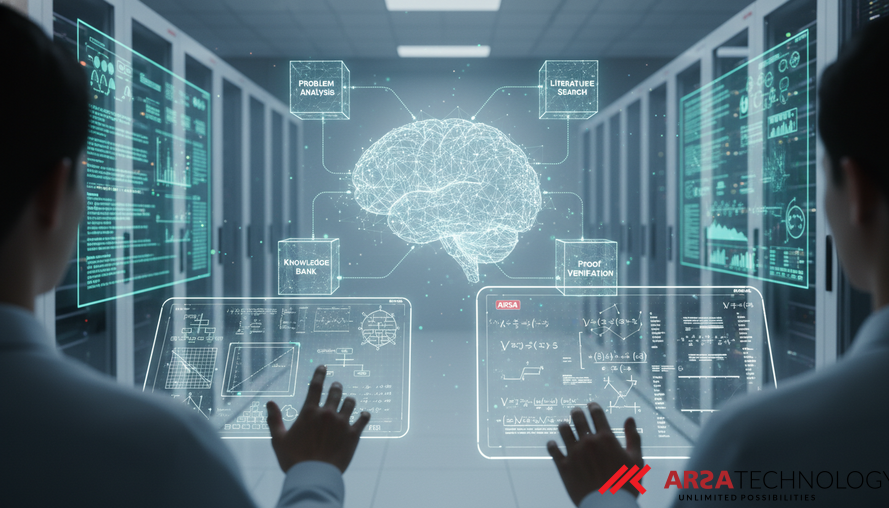
To address the unique demands of research-level mathematics, a novel agentic framework called Research Math Agents (RMA) has been developed. Unlike simpler AI systems, RMA decomposes the complex task of proof solving into a set of specialized, interacting modules, each designed for a specific aspect of the mathematical research process. These modules include:
- Problem Analysis: To break down the initial problem statement, interpret specialized definitions, and formalize assumptions.
- Literature Search and Understanding: To find and comprehend relevant prior research, theorems, and known results that could aid in the proof.
- Knowledge-Bank Construction: To build and organize a repository of retrieved information, making it readily available for subsequent reasoning steps.
- Proof Verification: To rigorously check the logical soundness and correctness of candidate proofs or intermediate steps.
These specialized components are not isolated but are coordinated by a trio of intelligent agents: the Initializer, Proposer, and Verifier. This multi-agent system operates through a shared, structured memory, enabling seamless information exchange and collaborative problem-solving. Such modular and collaborative design can be highly effective in tackling intricate tasks, akin to how ARSA Technology leverages modular Custom AI Solutions for enterprise-specific challenges, integrating different AI components to achieve comprehensive outcomes.
How RMA Refines Proofs: A Multi-Round Collaboration
The core strength of RMA lies in its multi-role, multi-round workflow, which mimics the iterative nature of human mathematical research. This process is orchestrated as follows:
- Initializer Agent: Begins by producing an initial draft of the proof. It also populates the shared memory with a detailed problem analysis, summaries of relevant literature, and organized knowledge entries from the literature search module.
- Proposer Agents: Continuously refine the evolving proof. They identify logical gaps, invoke relevant specialized modules (e.g., literature search for missing information), and develop new arguments or intermediate lemmas.
- Verifier Agents: Play a critical role by evaluating the current state of the proof against a "Proof Commandment Module" (a set of rigorous logical standards). They provide structured feedback, highlighting errors, inconsistencies, or areas that require further development.
This dynamic interaction ensures that candidate proofs are iteratively generated, refined, and verified. The shared disk-based memory acts as a central hub, containing the problem's current state, literature summaries, knowledge entries, the evolving proof state, and all accumulated feedback. Strict read/write permissions ensure that Proposers only update the proof, Verifiers only update feedback, and all changes are meticulously logged with agent and round identifiers. This systematic approach allows for robust error detection and repair, methodical exploration of alternative strategies, and ultimately, the construction of sound mathematical proofs.
RMA's Performance Against Leading AI Systems
The effectiveness of RMA was rigorously tested on the "First Proof" benchmark, a collection of ten research-level mathematical problems specifically curated by expert mathematicians. This benchmark is designed to evaluate AI systems on their ability to perform true mathematical research, not just solve pre-defined problems. The results were compelling:
RMA significantly outperformed strong baseline AI systems, including OpenAI's GPT-5.2R and Google DeepMind's Aletheia. While GPT-5.2R provided solutions that sometimes exhibited minor issues like "reference hallucinations" (invented citations) and produced looser bounds, and Aletheia struggled to yield successful outputs within time limits for some problems, RMA successfully solved eight out of the ten research problems. Critically, the proofs generated by RMA were evaluated by experts as being more logically sound and readable. These findings, as detailed in the paper RMA: an Agentic System for Research-Level Mathematical Problems, underscore the power of a structured, iterative, and multi-agent approach to complex problem-solving. ARSA, for its part, also emphasizes precision and reliability, with solutions like the ARSA AI API achieving 99.7% accuracy in critical applications like face recognition and liveness detection, demonstrating a commitment to robust AI performance in enterprise environments.
Business Implications and Future of AI-Assisted Research
The advancements showcased by RMA extend far beyond the realm of pure mathematics. The ability of an AI system to engage in long-horizon reasoning, grounded in vast knowledge bases and refined through iterative feedback, has profound implications for various industries and scientific disciplines.
For enterprises, this means the potential for AI to tackle previously intractable problems in areas such as:
- Scientific Discovery: Accelerating research in fields like material science, drug discovery, and theoretical physics by automating the generation and verification of complex hypotheses and proofs.
- Advanced Engineering: Optimizing complex system designs, such as analog circuits, or developing new algorithms that require deep theoretical understanding and rigorous validation.
- Software Engineering: Automating the generation and formal verification of complex code, leading to more robust and secure software.
- Strategic Decision-Making: Providing highly structured and rigorously reasoned insights for complex business strategies.
The underlying principles of RMA—modular reasoning, multi-agent collaboration, and iterative refinement—are transferable to any domain requiring advanced, systematic problem-solving. This approach reduces the cost and time associated with complex R&D, mitigates risks by improving the logical soundness of solutions, and drives innovation by enabling the exploration of new ideas with unprecedented rigor and speed. For organizations seeking to implement such advanced, deployable AI capabilities in their operations, ARSA Technology has been experienced since 2018 in developing tailored AI and IoT solutions across various industries, translating complex technical requirements into practical, profitable business outcomes.
Conclusion: Accelerating Discovery with Advanced AI
The Research Math Agents (RMA) framework represents a significant leap forward in AI's capacity for complex reasoning. By moving beyond well-scoped problems to tackle the open-ended challenges of research-level mathematics, RMA demonstrates that AI can be a powerful partner in fundamental discovery. Its agentic architecture, comprising specialized modules and a collaborative, iterative workflow, allows it to generate logically sound and readable proofs, outperforming other advanced LLM systems. This innovation not only pushes the boundaries of artificial intelligence but also paves the way for a future where AI actively contributes to scientific breakthroughs and complex problem-solving across diverse industries.
To learn how advanced AI solutions can transform your enterprise operations and accelerate your path to discovery, we invite you to explore ARSA's comprehensive solutions and contact ARSA for a consultation.
Source: RMA: an Agentic System for Research-Level Mathematical Problems