URoPE: Universal AI for Cross-View and 3D Geometric Intelligence
Discover URoPE, a groundbreaking AI technique revolutionizing computer vision by enabling universal relative position embedding across diverse geometric spaces. Enhance 3D object detection, view synthesis, and depth estimation.

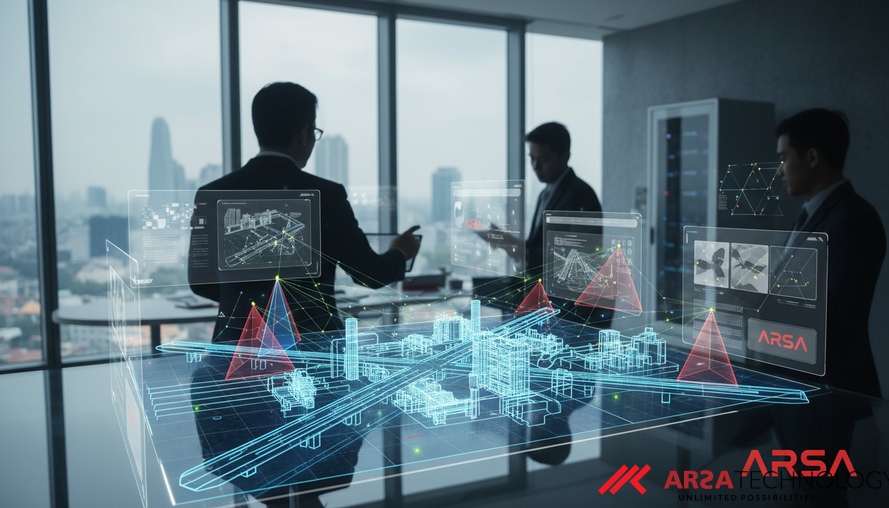
In the rapidly evolving landscape of artificial intelligence, Transformers have emerged as a dominant architecture, particularly in computer vision for tasks ranging from generating new perspectives to detecting objects in complex 3D environments. These powerful models excel at understanding context within data, but they face a unique challenge: how to effectively process and understand spatial relationships when data originates from different viewpoints, coordinate systems, or even entirely different geometric dimensions—such as 2D images and 3D points. This is where the concept of positional encoding becomes critical.
Traditional methods for encoding positional information within Transformers often fall short when dealing with these diverse geometric spaces. While a standard approach like Rotary Position Embedding (RoPE) works well for fixed 1D sequences or regular 2D/3D grids, it struggles with the nuances of cross-view geometric reasoning. Imagine trying to understand the 3D distance between objects captured by two different cameras: pixels that might be physically close in a 3D scene could appear far apart in their respective 2D camera feeds. This limitation has spurred the development of more sophisticated solutions, and a recent innovation called URoPE offers a universal answer. The research, titled "URoPE: Universal Relative Position Embedding across Geometric Spaces," introduces a novel way to extend positional encoding for complex vision tasks, as detailed in its publication on arXiv.
The Foundation: Understanding Positional Encoding
To grasp the innovation of URoPE, it’s essential to first understand how Transformers handle positional information. Transformers are inherently "permutation invariant," meaning they treat all input elements equally, regardless of their order. While this is beneficial for many tasks, it’s problematic for sequential or spatial data where order and position are crucial. Positional embeddings are the mechanisms that inject this vital spatial context into the model.
There are two main types: absolute and relative positional embeddings. Absolute embeddings assign a unique position to each element, but they can struggle with generalization to sequences or spaces longer than those seen during training. Relative positional embeddings, on the other hand, encode the relationship between elements, offering superior generalization. Rotary Position Embedding (RoPE) is a particularly effective relative embedding that uses rotation matrices to implicitly encode relative positions in query and key pairs, becoming a mainstream choice in modern Transformer architectures due to its efficiency and performance. However, RoPE's standard application is limited to a single, flat coordinate space, making it inadequate for scenarios demanding complex geometric understanding across views or dimensions.
Addressing the Cross-Geometric Challenge with URoPE
The fundamental problem URoPE addresses is how to determine where the 3D content represented by a "key" token (e.g., a pixel from a source camera view) would appear within the "query" token's image plane (e.g., another camera view). Existing methods often try to encode camera geometry and intra-image positions separately or rely on complex, inefficient attention mechanisms. URoPE takes a different approach by directly using projective geometry to establish cross-view correspondences within a single, shared coordinate system—the query image plane.
Here's a simplified explanation:
- For a "key" pixel in a source camera view, URoPE traces a 3D line (called a "camera ray") extending from the camera through that pixel into the scene.
- Along this ray, URoPE samples several hypothetical 3D points at predefined "depth anchors" (think of these as fixed distances from the camera).
- Each of these sampled 3D points is then projected from 3D space onto the 2D plane of the "query" camera, taking into account the relative position and orientation of the two cameras and the query camera's internal properties (intrinsics). This gives a depth-conditioned pixel coordinate in the query image.
- Finally, standard 2D RoPE is applied between the query location and these projected key locations, creating a geometry-aware relative positional bias that remains consistent across different camera views and geometric spaces.
Overcoming Depth Ambiguity with Multi-Head Attention
A significant hurdle in cross-view projection is depth ambiguity: a single pixel in one camera view actually corresponds to an entire line of possible 3D points in space, which then projects as a line in another camera’s view. URoPE cleverly resolves this with "depth-anchored multi-head attention." This means different attention "heads" (sub-components within the Transformer's attention mechanism) are assigned different fixed depth anchors. Each head essentially forms a hypothesis about the depth of the object. By combining the outputs of these multiple heads, the system can collectively cover correspondences from near-field to far-field objects. This design ensures that URoPE remains fully compatible with highly optimized attention kernels like FlashAttention, crucial for efficient, real-time AI processing.
Universal Applications and Business Impact
One of URoPE's most compelling attributes is its universality. Without needing task-specific modifications, this projective RoPE formulation serves as a plug-in positional encoding across a wide array of geometric tasks, demonstrating consistent improvements.
**1. Novel View Synthesis:** This involves generating new images of a scene from different viewpoints based on a limited set of existing images.
- Business Impact: Revolutionizes virtual reality, augmented reality, and 3D content creation for product visualization, architectural walkthroughs, and virtual tourism, offering more realistic and consistent digital experiences.
**2. 3D Object Detection and Tracking:** Identifying and following objects in a 3D space, often from multiple 2D camera feeds.
- Business Impact: Critical for autonomous vehicles, robotics, and advanced surveillance systems. In smart cities, this can power intelligent traffic management, while in industrial settings, it can enhance safety by monitoring equipment and personnel. For example, ARSA Technology leverages advanced AI Video Analytics for object detection and tracking in solutions like the AI BOX - Traffic Monitor, which could benefit from such robust geometric reasoning.
**3. Stereo Depth Estimation:** Accurately determining the distance of objects from cameras using multiple viewpoints.
- Business Impact: Essential for robotics navigation, industrial automation, quality control, and augmented reality applications. Improved depth accuracy leads to safer operations, more precise robotic manipulation, and better environmental understanding for machines.
By consistently improving performance across these diverse benchmarks, URoPE establishes itself as a powerful, general-purpose geometric position encoding. Its parameter-free nature, combined with its invariance to global coordinate system choices, makes it a robust and flexible component for next-generation AI systems, reducing development complexity and accelerating deployment in various industries.
ARSA Technology: Deploying Advanced AI in the Real World
Innovations like URoPE underscore the continuous advancements in AI that enable more sophisticated and reliable enterprise solutions. At ARSA Technology, we are dedicated to bridging advanced AI research with operational reality. Our experienced since 2018 team specializes in designing, building, and deploying AI solutions that deliver measurable impact in security, operations, and decision intelligence.
From enhancing security protocols with precise 3D object detection to optimizing traffic flow and improving industrial safety, the integration of cutting-edge positional encoding techniques like URoPE can significantly bolster the performance of AI systems. For organizations aiming to transform their operations with reliable and scalable AI, understanding and adopting these foundational innovations is key.
Ready to explore how advanced AI and IoT solutions can transform your enterprise operations? Discover ARSA Technology’s range of products and services, and contact ARSA today for a free consultation to engineer your competitive advantage.