Virtual Reality for Industrial Training: Safer, Faster, Better Learning Outcomes
The landscape of industrial training is undergoing a profound transformation. Traditional methods — classroom instruction followed by…
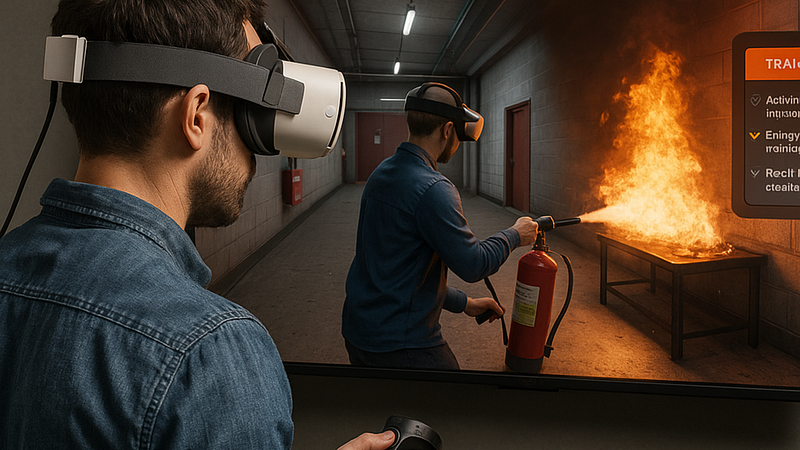
The landscape of industrial training is undergoing a profound transformation. Traditional methods — classroom instruction followed by on-the-job training — while effective to a degree, have inherent limitations in terms of safety, scalability, and knowledge retention. Virtual Reality (VR) technology is emerging as a revolutionary solution to these challenges, offering immersive, interactive training experiences that yield superior results across multiple metrics.
At ARSA Technology, our ANIYATA VR solution represents the cutting edge of this emerging field, providing industrial organizations with customized virtual training environments that replicate real-world scenarios with unprecedented fidelity and educational value.
The Limitations of Traditional Industrial Training
Before exploring the benefits of VR training, it’s important to understand the challenges associated with conventional industrial training approaches:
Safety Risks
Many industrial environments involve inherent hazards. Training new personnel in these environments creates risks for both trainees and equipment. Examples include:
- Heavy machinery operation
- Chemical handling procedures
- Working at heights or in confined spaces
- Emergency response scenarios
- Electrical system maintenance
The consequences of mistakes during training can be severe, ranging from equipment damage to serious injury or even fatality.
Cost and Resource Constraints
Traditional training is resource-intensive:
- Production downtime when equipment is used for training
- Material waste during practice sessions
- Wear and tear on expensive equipment
- Dedicated training staff requirements
- Limited number of trainees that can be accommodated simultaneously
Consistency Challenges
Traditional training often suffers from inconsistency:
- Variations in instructor quality and methods
- Differences in available equipment for training
- Weather or facility constraints affecting training conditions
- Inability to reproduce exact emergency or failure scenarios
Limited Exposure
Time and resource constraints often limit the breadth of scenarios trainees can experience:
- Rare but critical failure scenarios
- Emergency situations
- Unusual operating conditions
- Equipment variations
The ANIYATA VR Solution: Transforming Industrial Training
ANIYATA VR addresses these limitations by creating immersive, interactive virtual environments that replicate industrial settings with remarkable detail and interactivity. Using advanced VR technology, trainees engage with photorealistic simulations that respond to their actions in real-time, creating a powerful learning experience that transfers effectively to real-world performance.
Core Features of ANIYATA VR
- Photorealistic Environments: Highly detailed digital recreations of actual industrial settings, from factory floors to offshore platforms, mining operations to chemical plants.
- Interactive Equipment Simulations: Functional virtual replicas of machinery, tools, and control systems that respond realistically to user actions.
- Physics-Based Interactions: Accurate simulation of physical properties including weight, friction, fluid dynamics, and mechanical behaviors.
- Scenario Programming: The ability to create diverse training scenarios including normal operations, maintenance procedures, troubleshooting, and emergency responses.
- Performance Tracking: Comprehensive monitoring and assessment of trainee actions, decisions, and outcomes.
- Multi-User Capabilities: Collaborative training environments enabling team exercises and instructor-guided sessions.
- Adaptable Difficulty: Progressive challenge levels that adapt to trainee proficiency.
The Benefits: Safer, Faster, Better Learning
Enhanced Safety
The most immediate benefit of VR training is the elimination of physical risk:
- Trainees can make mistakes without consequences to themselves or equipment
- Dangerous scenarios can be experienced safely
- Emergency response can be practiced in realistic conditions
- Hazardous tasks can be repeated until mastery is achieved
A major chemical manufacturing company implemented ANIYATA VR for hazardous material handling training and reported a 87% reduction in training-related incidents within the first year.
Accelerated Skill Development
Research consistently shows that VR training accelerates the learning curve:
- Studies indicate skill acquisition is up to 40% faster compared to traditional methods
- Retention rates improve by approximately 75% due to the immersive experience
- Muscle memory develops through realistic motion-tracked interactions
- The psychology of “learning by doing” is leveraged effectively
A mining operation that implemented ANIYATA VR for equipment operator training reduced their time-to-competency by 63% while improving assessment scores by 28%.
Consistency and Standardization
VR training ensures every trainee receives exactly the same high-quality experience:
- Standardized procedures are demonstrated consistently
- Performance is measured against uniform benchmarks
- Regional variations in training are eliminated
- Best practices are encoded directly into the simulation
Unlimited Scenario Exposure
Perhaps the most powerful advantage of VR training is the ability to experience any scenario on demand:
- Rare equipment failures that might occur once in decades
- Emergency situations too dangerous to recreate in reality
- Seasonal or weather-dependent conditions regardless of actual conditions
- Equipment variations without needing physical access to each variant
Cost Efficiency
While the initial investment in VR training systems represents a significant commitment, the return on investment typically becomes apparent quickly:
- Elimination of production downtime for training purposes
- No material waste during practice
- No wear and tear on actual equipment
- Reduced instructor requirements for basic skills
- Ability to train larger groups simultaneously
- Decreased time-to-competency for new employees
A large manufacturing organization calculated that their ANIYATA VR implementation paid for itself within 9 months through reduced training costs and accelerated workforce deployment.
Real-World Applications
ANIYATA VR has been successfully deployed across numerous industrial sectors:
Manufacturing
- Machine operation and maintenance
- Assembly line procedures
- Quality control processes
- Changeover procedures
- Robotics integration
Oil and Gas
- Drilling operations
- Platform safety procedures
- Equipment maintenance
- Emergency response
- Confined space operations
Mining
- Heavy equipment operation
- Underground navigation
- Blasting procedures
- Safety protocols
- Maintenance routines
Chemical Processing
- Process control operations
- Safety procedures
- Equipment maintenance
- Hazardous material handling
- Emergency containment
Construction
- Crane operation
- Scaffolding assembly
- Heavy equipment utilization
- Safety procedures
- Specialized tool operation
Case Study: Petrochemical Emergency Response
A major petrochemical facility implemented ANIYATA VR to enhance their emergency response training. The facility created a digital twin of their actual plant, complete with all critical systems, equipment, and potential hazard points.
The VR system allowed them to simulate various emergency scenarios including:
- Chemical spills
- Fires in different facility areas
- Explosion risks
- Multiple casualty situations
- Cascading failure events
Response teams could practice their protocols in a realistic environment that replicated the exact layout, equipment, and procedures of their facility. The system tracked key performance metrics including:
- Response time
- Protocol adherence
- Communication effectiveness
- Resource allocation
- Decision quality under pressure
Within six months of implementation, the facility conducted a surprise emergency drill that demonstrated a 47% improvement in response time and a 62% improvement in protocol adherence compared to their pre-VR baseline. Management attributed these improvements directly to the intensive, realistic practice enabled by the ANIYATA VR system.
Implementation Approach
Successfully deploying VR training requires a thoughtful, phased approach. At ARSA Technology, we employ a structured methodology:
1. Needs Assessment and Environment Capture
- Detailed analysis of training requirements
- Digital scanning of physical environments
- Documentation of equipment specifications
- Identification of key procedures and scenarios
2. Virtual Environment Development
- Creation of photorealistic 3D models
- Programming of interactive elements
- Physics implementation
- User interface design
3. Scenario Development
- Designing progressive learning paths
- Creating standard operating procedure simulations
- Developing emergency and edge-case scenarios
- Establishing assessment metrics and benchmarks
4. Integration and Testing
- Hardware setup and configuration
- System integration with existing training infrastructure
- Pilot testing with selected trainees
- Refinement based on feedback
5. Full Deployment and Ongoing Support
- Trainer certification
- Phased rollout to trainee groups
- Continuous improvement through usage data
- Regular updates and expansion
The Future of Industrial VR Training
As VR technology continues to advance, several emerging trends promise to further enhance the effectiveness of industrial training:
1. Haptic Feedback Evolution
Advanced haptic systems that simulate physical resistance, texture, and even temperature will create even more realistic training experiences.
2. AI-Driven Adaptive Training
Artificial intelligence will increasingly personalize the training experience, adjusting scenarios and difficulty based on individual learning patterns and progress.
3. Expanded Sensory Simulation
Integration of additional sensory elements including smell, temperature, and environmental effects will further enhance immersion.
4. Digital Twin Integration
More comprehensive integration with operational digital twins will allow training scenarios based on real-time or historical operational data from actual facilities.
5. Remote Collaborative Training
Enhanced networking capabilities will enable more sophisticated remote training, with experts guiding trainees from anywhere in the world.
Conclusion
The industrial training landscape is at an inflection point. Virtual reality technology has matured to a level where it now offers definitive advantages over traditional training methods across numerous metrics: safety, effectiveness, efficiency, consistency, and cost.
ANIYATA VR represents ARSA Technology’s commitment to pushing the boundaries of what’s possible in industrial training. By creating immersive, interactive environments that replicate real-world conditions with unprecedented fidelity, we’re enabling a new paradigm in workforce development — one that produces better-prepared workers in less time and at lower cost, while eliminating the safety risks inherent in traditional training approaches.
As organizations continue to navigate increasingly complex operational environments, those that embrace virtual reality training will gain significant advantages in workforce capability, operational safety, and organizational agility. The future of industrial training has arrived, and it’s virtual.
This article is part of Machine State — ARSA Technology’s official publication exploring intelligent systems and future tech.
Written by Hilmy Izzulhaq
Founder @ ARSA Technology — 7 years building AI Vision & IoT solutions in heavy industry, parking, and smart city.