Advancing Fluid Dynamics: How Conservation-Informed AI is Redefining CFD Accuracy
Explore CoFINN, an innovative AI framework integrating conservation physics into neural networks for superior compressible flow prediction, enhancing accuracy and mitigating traditional AI limitations in critical engineering.

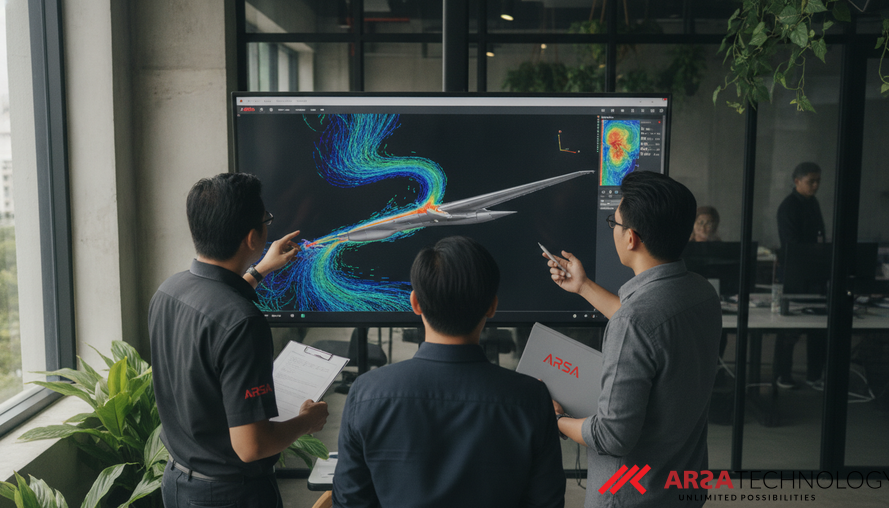
The simulation of complex physical phenomena, particularly in fluid dynamics, has long been a cornerstone of engineering design and innovation. From optimizing aircraft performance to improving industrial processes, understanding fluid flow is critical. While traditional computational fluid dynamics (CFD) methods offer high fidelity, they are often computationally intensive. The advent of artificial intelligence (AI), especially deep learning, promised faster approximations, but faced a fundamental challenge: generating physically accurate results. A recent development, Conservation Flux Informed Neural Networks (CoFINN), presents a significant leap forward by embedding the foundational laws of physics directly into the AI training process, overcoming key limitations of purely data-driven models.
The Challenge of Physical Fidelity in AI-Driven Simulations
Traditional machine learning models, particularly Convolutional Neural Networks (CNNs), have demonstrated remarkable speed in approximating fluid flow fields. They can learn intricate mappings from geometric inputs or flow conditions to corresponding flow field outputs, treating these as image-like data. This approach offers substantial computational speedups, making them attractive for iterative design and optimization studies in fields like aerodynamic engineering. However, their reliance on pixel-wise similarity metrics during training means they are not inherently constrained by the underlying physical laws governing fluid motion.
This purely data-driven approach can lead to visually plausible, yet physically inconsistent, predictions. For instance, a model might predict a flow field that looks correct but violates the strict conservation of mass, momentum, or energy throughout the domain. Such inconsistencies become particularly critical in regions with strong physical interactions, like shock waves or boundary layers. Small inaccuracies in predicted pressure or velocity can cascade into significant violations of conservation principles, leading to substantial errors in derived engineering quantities such as lift and drag. As Thomas Wagenaar's Master's thesis highlights, traditional Physics-Informed Neural Networks (PINNs) often struggle with highly compressible flows due to an "entropy failure mode," where they attempt to find an isentropic (constant entropy) solution to problems that are fundamentally non-isentropic, especially across discontinuities like shock waves (Wagenaar, 2023). Another challenge, the "slip boundary condition failure mode," can lead to non-physical "zero-velocity regions" at surfaces, indicating the AI is finding an easier, albeit incorrect, solution to boundary constraints.
CoFINN: Integrating Conservation Laws into Deep Learning
CoFINN addresses these fundamental limitations by directly embedding finite-volume conservation physics into the deep learning framework. Unlike conventional PINNs that enforce differential-equation residuals at specific points, CoFINN adopts a finite-volume perspective, mirroring modern CFD methodologies. It reinterprets the output of a CNN as a structured computational grid, where each pixel represents a finite-volume cell. Conservation consistency is then enforced through sophisticated numerical flux calculations across the interfaces between these "pixels" or cells.
This innovative approach trains the neural network not just against reference data, but also against discretized conservation-law residuals computed directly from the predicted flow field itself. By computing intercell fluxes using advanced Riemann solvers (like the Godunov-type HLLC solver), CoFINN ensures that the model minimizes violations of the same conservation principles that govern high-fidelity CFD solvers. This transforms the neural network from a mere image-processing system into a physically-aware predictive model, guiding it towards solutions that are not only visually accurate but also adhere to discrete conservation behavior throughout the domain (Do˘gan et al., 2026).
Enhanced Accuracy and Business Impact
The practical significance of CoFINN is profound, particularly in engineering applications where precision and reliability are paramount. Evaluated on transonic flow prediction around airfoils, including challenging conditions with shock waves and high angles of attack, CoFINN has demonstrated marked improvements. Specifically, it has been shown to reduce drag prediction error by up to 34% at extreme angles of attack and by approximately 15% on average across various test conditions. These improvements are especially notable in situations with limited training data, where the conservation-based loss acts as an effective physical regularizer, allowing the model to generalize better even without extensive datasets.
For businesses, this translates into several key advantages:
- Faster, More Reliable Design Cycles: Engineers can rapidly prototype and optimize designs, reducing the need for costly and time-consuming physical tests or full-scale CFD simulations.
- Reduced Risk in Critical Applications: In aerospace, automotive, and turbomachinery, accurate aerodynamic force prediction is crucial for safety and performance. CoFINN’s enhanced physical consistency reduces the risk of deploying designs based on flawed simulations.
- Optimized Resource Allocation: Improved accuracy in limited-data scenarios means organizations can achieve reliable results with smaller, more targeted datasets, optimizing data collection efforts and computational resources.
- Broader Applicability: The architecture-agnostic and extensible nature of CoFINN means it can be applied to a wider range of physical systems governed by conservation laws, opening new avenues for AI-driven simulation across diverse industries.
ARSA Technology: Delivering Practical AI for Complex Challenges
ARSA Technology, with over seven years building AI since 2018, specializes in deploying practical AI solutions for government, defense, and enterprise clients across the Asia Pacific. Our expertise in Vision AI, IoT, and edge AI systems means we understand the critical need for solutions that are not only efficient but also deeply reliable and physically consistent. While CoFINN is a research framework, its principles align with ARSA's commitment to delivering production-ready AI that solves real-world operational problems.
For example, implementing advanced simulation techniques like those informed by CoFINN could augment existing AI Video Analytics Software, allowing for more precise environmental monitoring in smart cities, or enhancing the predictive maintenance capabilities of industrial IoT deployments. Our AI Box Series, designed for rapid, on-site deployment and edge processing, could serve as a powerful platform for deploying computationally intensive, physics-informed AI models where low latency and data sovereignty are paramount. Furthermore, ARSA's Custom AI Solutions can tailor such sophisticated AI models to specific client needs, addressing unique challenges in sectors demanding precision, scalability, and measurable ROI.
The development of conservation flux informed neural networks represents a significant step towards creating AI models that truly "understand" and respect the underlying physics of the world. By integrating fundamental conservation laws directly into the learning process, CoFINN enables a new generation of AI-driven simulations that are both fast and physically faithful, paving the way for more accurate, efficient, and reliable engineering in an increasingly complex world.
Sources:
Do˘gan, A. H., Deniz, M., Alemdar, H., & U˘gra¸s Baran, Ö. (2026). CoFINN: Conservation Flux Informed Neural Networks for Physics Problems Governed by Conservation Laws. arXiv preprint arXiv:2607.06587*.
- Wagenaar, T. (2023). Physics-informed neural networks for highly compressible flows: Assessing and enhancing shock-capturing capabilities (Master's thesis). Delft University of Technology.
Discover how ARSA Technology is engineering intelligence into operations for mission-critical enterprises. To learn more about our AI and IoT solutions and how they can transform your business, contact ARSA today.