AI-Powered Confidential Document Classification: Enhancing Enterprise Security with Retrieval Augmented Classification
Discover how Retrieval Augmented Classification (RAC) offers a secure and efficient AI approach for classifying confidential documents, mitigating risks of data leakage and simplifying continuous knowledge updates.

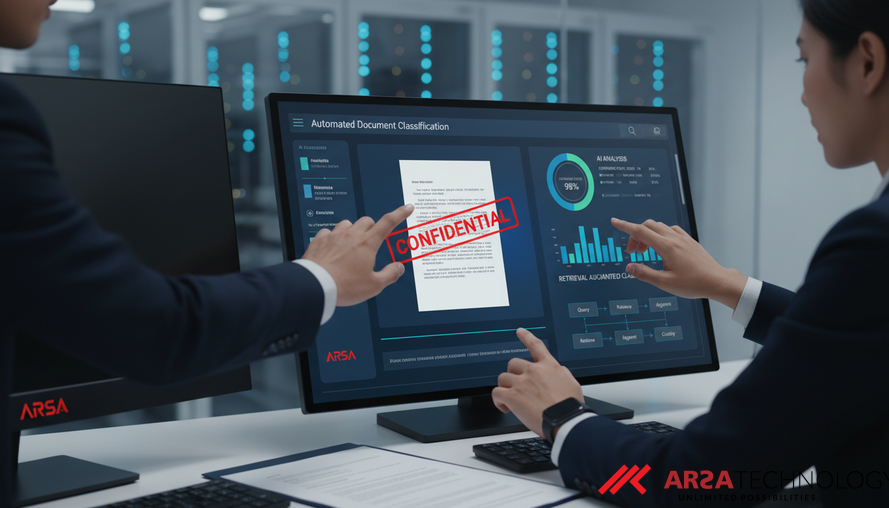
The Critical Challenge of Confidential Document Management
In today's interconnected enterprise landscape, the continuous inflow and outflow of documents pose significant challenges, particularly when those documents contain confidential information. Unauthorized disclosure of sensitive data can lead to substantial financial losses, reputational damage, and severe regulatory penalties. Studies indicate that data breaches, often stemming from insider attacks, can result in losses nearing USD 5 million per incident. To counter these threats, organizations typically rely on document classification systems that assign access levels and dictate handling procedures. However, manual classification is labor-intensive, prone to human error, and frequently results in inconsistent or subjective labeling.
Automating the classification of confidential documents is a complex endeavor. Traditional machine learning models and even advanced large language models (LLMs) struggle with issues like data scarcity, class imbalance (where certain confidentiality levels are under-represented), and the varying lengths of real-world documents. More critically, fine-tuning LLMs means embedding sensitive information directly into the model's weights, creating a risk of information leakage and requiring expensive, time-consuming retraining whenever new data or policies emerge. These limitations compromise the reliability and agility of deployed systems. To address these critical challenges, a new methodology, Retrieval Augmented Classification (RAC), offers a robust and security-preserving pathway, as detailed in recent research (Chang et al., ICONI 2025).
Understanding Retrieval Augmented Classification (RAC) for Enhanced Security
Retrieval Augmented Classification (RAC) is an innovative AI approach designed to enhance classification efficiency and security, particularly for sensitive data like confidential documents. Unlike traditional fine-tuning, where an AI model learns directly from a dataset by adjusting its internal parameters, RAC leverages an external knowledge base or "vector store." This store contains pre-labeled examples of documents, each converted into a numerical representation (an embedding) that captures its meaning.
When a new document requires classification, RAC doesn't try to classify it based solely on internal model weights. Instead, it queries this external vector store to retrieve similar, previously classified examples. These relevant examples are then dynamically provided to a Large Language Model (LLM) alongside the new document. The LLM then uses this "augmented" context to make a classification decision. This method significantly reduces parameter-level leakage, as sensitive content remains outside the core LLM's trainable weights and within your controlled external store. This design is inherently privacy-by-design, making it highly suitable for applications requiring strict data governance and regulatory compliance, such as those that ARSA Technology builds for ARSA AI API or custom AI solutions.
RAC's Performance Against Real-World Hurdles
The effectiveness of RAC was rigorously tested against real-world operational challenges, particularly class imbalance and context-length constraints, using the WikiLeaks US Diplomacy corpus. This dataset, comprising diplomatic cables from 2003 to 2010, realistically reflects the imbalanced nature and sensitive text characteristics of actual document archives. The study compared RAC against traditional supervised fine-tuning (FT) under identical conditions, consolidating document labels into standard categories: "Unclassified," "Confidential," and "Secret."
The findings underscore RAC's stability and robust performance. On balanced datasets, RAC performed comparably to fine-tuning. However, RAC demonstrated superior stability and equivalent performance on unbalanced data, achieving approximately 96% accuracy on both original (unbalanced) and augmented (balanced) sets. With appropriate prompt engineering, it reached up to 94% F1 score. In contrast, fine-tuning achieved 90% F1 when trained on balanced data, but its performance dropped to 88% F1 when exposed to the original, unbalanced dataset. This highlights RAC's resilience to common data imperfections. The underlying RAC pipeline utilized advanced components such as ChromaDB for vector indexing, BAAI/bge-m3 for dense vector embeddings, and BAAI/bge-reranker-base for refining search results before the final classification by OpenAI GPT-4.1. The source paper for these findings can be found at arxiv.org/abs/2604.08628.
Practical Advantages and Deployment Realities
The operational benefits of RAC, especially for enterprises dealing with confidential documents, are substantial. A key advantage is its ability to incorporate new data immediately via reindexing the external vector store, bypassing the time-consuming and costly retraining cycles typically required for fine-tuned models. This agility ensures that classification systems remain up-to-date with evolving knowledge bases and security policies without downtime or significant resource expenditure.
Furthermore, RAC's inherent architecture minimizes the risk of sensitive data leakage, as content is not deeply ingrained into the model's parameters. This provides enterprises with greater control over their data, aligning with stringent data sovereignty and compliance requirements like GDPR and HIPAA. For organizations needing robust, on-premise solutions to maintain full data ownership and operate in air-gapped or restricted environments, platforms like the ARSA AI Box Series offer pre-configured edge AI systems that can host such secure classification workflows. This makes RAC an ideal choice for government, defense, healthcare, and financial sectors where data integrity and privacy are paramount.
Future-Proofing Document Security with AI
The study's contributions — a well-defined RAC-based classification pipeline, empirical evidence of its superior stability against class imbalance and context length, and actionable guidance for governed deployments — pave the way for a more secure and efficient approach to managing confidential information. RAC provides a practical path to strong classification by keeping sensitive content out of model weights and under your direct control, remaining robust as real-world conditions evolve in terms of class balance, data volume, context length, or governance requirements.
As an AI and IoT solutions provider experienced since 2018, ARSA Technology understands the complexities of deploying mission-critical AI systems across various industries. By integrating advanced techniques like Retrieval Augmented Classification, businesses can transform their document management into an intelligent, proactive, and highly secure operation.
Ready to explore how advanced AI can enhance your enterprise's document security and operational efficiency? We invite you to a free consultation with the ARSA team to discuss tailored AI and IoT solutions for your specific needs.