AI-Powered Forecasting: Revolutionizing Emergency Department Operations Through Predictive Boarding Time Analytics
Explore how advanced AI forecasting models can predict emergency department boarding times, enabling hospitals to proactively manage congestion, reduce costs, and significantly improve patient care.

The Persistent Challenge of Emergency Department Overcrowding
Emergency departments (EDs) worldwide face an ongoing battle against overcrowding. This critical issue leads to a cascade of negative effects, including delays in patient care, increased operational costs, potential adverse patient outcomes, and significant strain on healthcare systems. A key indicator of this congestion is "ED boarding time," which measures how long admitted patients remain in the ED waiting for an inpatient bed. When patients board for extended periods, they occupy treatment rooms, reducing the department's capacity to care for new arrivals. This not only impacts patient flow from arrival to disposition but has also been linked to higher mortality and morbidity rates.
Traditionally, hospitals have relied on reactive measures, such as activating "Full Capacity Protocols" (FCPs), only after overcrowding has become severe. While such protocols help manage immediate crises, they don't prevent them. The financial implications are also substantial; a recent study revealed that the average daily cost for a medical-surgical patient boarding in an ED was significantly higher than for comparable inpatient care, underscoring the urgent need for more efficient solutions.
Defining ED Boarding Time: A Critical Operational Metric
To truly address ED overcrowding, it’s essential to understand the core metrics. ED boarding time is precisely defined as the period beginning when a treating physician requests an inpatient bed and ending when the patient finally leaves the ED for transfer to that inpatient unit. This interval often represents a major bottleneck in the entire patient flow process. Prolonged boarding times create a ripple effect, exacerbating waiting times for new patients, delaying diagnoses and treatments, and ultimately impacting the overall quality and safety of care delivered.
The financial strain is considerable, as ED resources are used inefficiently. Imagine treatment rooms, nurses, and equipment tied up by patients who technically should no longer be in the ED. This not only costs more per patient but also limits the hospital's ability to generate revenue from new admissions. Moving beyond reactive measures to a proactive stance requires sophisticated tools that can anticipate these challenges.
Leveraging AI for Proactive Operational Insights
The shift from reactive to proactive management in emergency departments is being driven by advanced data-driven approaches, particularly predictive analytics powered by Artificial Intelligence. By anticipating congestion before it escalates, hospital administrators can make timely operational adjustments. This involves treating patient flow metrics (PFMs) as a time-series process, where historical data, along with external contextual factors like weather, holidays, and major local events, are used to forecast future conditions. These external factors are crucial as they often influence patient demand.
While prior research has explored various aspects of ED congestion using statistical methods or by predicting aggregated metrics like arrival counts or boarding volumes, a significant innovation lies in directly modeling and forecasting ED boarding time as a continuous outcome. This provides a more granular and actionable prediction. Recent advancements in deep learning, specifically models like Decomposition-based Linear (DLinear) and Normalization-based Linear (NLinear), have shown superior performance in handling complex time-series data, making them ideal for this task.
Developing a Multi-Horizon Forecasting Framework
A comprehensive approach to forecasting ED boarding time involves predicting across multiple future horizons. Recent research, such as the paper "An Integrated Forecasting Prototype for Emergency Department Boarding Time to Support Proactive Operational Decision Making" by Vural et al. (Source: https://arxiv.org/abs/2605.18839), developed and evaluated such a framework to predict ED boarding time at 6, 8, 10, 12, and 24-hour intervals. This multi-horizon capability is crucial, offering both short-term tactical insights and medium-term strategic planning opportunities.
The framework utilized real-world operational data from a university hospital, integrating it with external datasets covering weather patterns, federal holidays, and local events that might influence ED volume. Boarding time was aggregated hourly by summing patient boarding minutes and averaging across boarded patients present during each hour, creating a continuous and dynamic metric. The deep learning models, DLinear and NLinear, were specifically chosen for their ability to excel in time series forecasting, outperforming traditional statistical methods. Importantly, these models were also rigorously evaluated under scenarios of extreme congestion, ensuring their reliability when insights are most critical. Such a robust forecasting system can significantly enhance a hospital's ability to manage patient flow. ARSA Technology specializes in developing custom AI solutions that integrate diverse data sources and deploy advanced machine learning models to solve complex operational challenges.
From Prediction to Practice: The MLOps Advantage
Accurate predictions are only valuable if they can be seamlessly integrated into daily operations. This is where Machine Learning Operations (MLOps) becomes indispensable. MLOps refers to the practices and tools that enable the efficient deployment, monitoring, and maintenance of machine learning models in production environments. The research highlighted this crucial translational step by developing an MLOps web application prototype.
This prototype was designed to automate and streamline key stages, including:
- Data Ingestion: Automatically extracting and processing real-time operational and contextual data.
- Feature Generation: Creating the necessary features from raw data for the AI models.
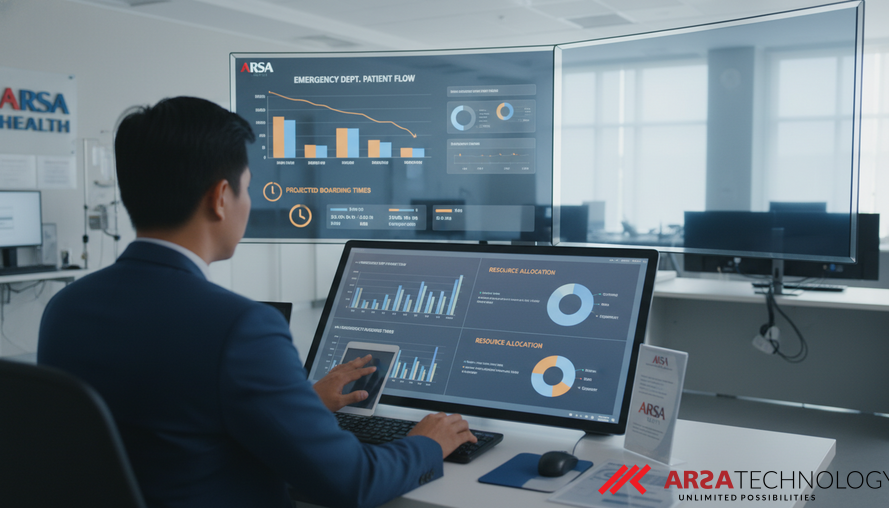
- Forecast Visualization: Presenting complex AI predictions in clear, actionable dashboards for operational users.
- Experimentation: Allowing for testing and refining models within the application environment.
- Model Retraining: Ensuring models remain accurate and relevant over time by automatically updating them with new data.
By providing an integrated application environment, this MLOps prototype bridges the gap between theoretical AI models and practical, real-world deployment. It allows hospitals to move beyond mere prediction to proactive intervention, ultimately supporting faster decision-making and continuous improvement. Implementing such robust, real-time analytics can be achieved through platforms like the ARSA AI Box Series, which offers pre-configured edge AI systems for rapid, on-site deployment, or through comprehensive AI Video Analytics software that transforms raw data into actionable intelligence.
Business Implications: Driving Efficiency and Improving Patient Outcomes
The practical application of AI-powered ED boarding time forecasting delivers profound business and operational benefits for healthcare enterprises. Foremost among these is significant cost efficiency. By proactively managing patient flow, hospitals can reduce the extended boarding times that incur higher costs, optimize resource allocation, and enhance the overall capacity utilization of both ED and inpatient units. This translates into measurable ROI by reallocating staff more effectively and increasing patient throughput.
Beyond cost, the impact on patient safety and quality of care is paramount. Earlier detection of potential congestion allows staff to intervene proactively, ensuring patients receive timely treatment and reducing the risk of adverse outcomes associated with long waits. Hospital administrators gain improved operational visibility and control, while medical staff can focus on critical care rather than managing bottlenecks. For patients, this means faster access to care, reduced waiting times, and a better overall experience. This type of strategic technology transformation enhances operational reliability and supports compliance requirements by embedding intelligence directly into hospital processes.
The Future of Smart Healthcare Operations
The integration of advanced AI forecasting and robust MLOps practices offers a powerful pathway to transform emergency department operations. By moving from reactive crisis management to proactive, data-driven decision-making, hospitals can significantly mitigate overcrowding, optimize resource utilization, reduce costs, and ultimately deliver superior patient care. The ability to predict critical metrics like boarding time with accuracy and deploy these predictions seamlessly into an operational environment represents a monumental step forward for smart healthcare.
Organizations looking to implement such transformative AI and IoT solutions to enhance operational intelligence and improve outcomes can explore a free consultation with the ARSA team to discover how practical AI can be deployed, proven, and made profitable.