Driving Innovation: The Power of Edge Deep Learning in Computer Vision and Medical Diagnostics
Explore how Edge Deep Learning transforms computer vision and medical diagnostics. Learn about optimized AI on edge devices, real-time applications, and future trends. Discover ARSA's practical AI solutions.

Introduction to Edge Deep Learning
The rapid evolution of artificial intelligence (AI) and the Internet of Things (IoT) is fundamentally reshaping how we interact with technology and process data. At the forefront of this transformation is Edge Deep Learning (Edge DL), a groundbreaking paradigm that brings powerful AI capabilities directly to the source of data generation. Instead of relying solely on distant cloud servers, Edge DL enables devices to perform complex computational tasks locally, leading to instantaneous insights, enhanced data privacy, and robust operational efficiency. This shift is revolutionizing various sectors, most notably computer vision and medical diagnostics, where real-time analysis and immediate decision-making are critical.
This article, drawing insights from a comprehensive survey by Xu, Khan, Song, and Meijering, delves into the foundational principles and transformative potential of Edge Deep Learning (Source: arXiv:2605.06714). We will explore the technical advantages of deploying deep learning models on edge devices, categorize diverse hardware platforms, and examine strategies for optimizing neural networks for resource-constrained environments. By highlighting practical applications across computer vision and focusing intently on medical diagnostics, we aim to demonstrate the profound impact of this technology in real-world scenarios, stimulating further advancements in intelligent edge solutions.
The Foundation of Edge Deep Learning
Edge computing is a distributed computing paradigm that brings computation and data storage closer to the data sources, such as IoT devices or local networks, rather than sending everything to a central cloud. This proximity offers several significant benefits, including reduced latency, which means faster response times for critical applications. For instance, an autonomous vehicle needs to react in milliseconds, not seconds, to avoid an obstacle, a feat only possible with processing at the "edge." Edge computing also bolsters security and privacy by processing sensitive data locally, minimizing its exposure during transmission to the cloud. Furthermore, it enhances scalability and enables distributed processing, allowing large-scale deployments without overwhelming centralized infrastructure.
Deep Learning (DL), particularly advanced Convolutional Neural Networks (CNNs), has made incredible strides in processing visual data. These powerful models can identify objects, analyze behavior, and even diagnose conditions from images and videos with remarkable accuracy. However, modern DL models are often computationally intensive, requiring significant processing power that traditionally resides in data centers or cloud environments. Deploying these complex models on resource-constrained edge devices – which often have limited power, memory, and processing capabilities – poses a significant challenge. Edge DL addresses this by optimizing deep learning algorithms to run efficiently on these local devices, creating a synergy that leverages the speed and privacy of edge computing with the intelligence of deep learning. ARSA Technology leverages these principles to deliver robust AI Video Analytics solutions that operate effectively at the edge.
Hardware Platforms for Edge AI
The successful implementation of Edge Deep Learning heavily relies on selecting the right hardware. Edge devices vary significantly in their capabilities, power consumption, and cost, necessitating a nuanced approach to hardware selection. These platforms can be broadly categorized based on their performance and typical usage scenarios. Options range from low-power microcontrollers for simple sensor data processing to powerful embedded GPUs and specialized AI accelerators (ASICs) designed for complex deep learning inference.
For applications demanding high-throughput video processing or multiple concurrent AI tasks, more robust hardware, such as industrial PCs with dedicated GPUs, might be necessary. Conversely, for mobile or ultra-low-power applications, highly optimized chipsets or even custom-designed System-on-Chips (SoCs) are preferred. Understanding the trade-offs between computational power, energy efficiency, size, and cost is paramount for operational effectiveness. ARSA Technology offers versatile edge AI systems like the ARSA AI Box Series, which provides pre-configured hardware and software combinations suitable for various deployment needs, from compact Mini PC models to high-density server models capable of processing numerous camera streams.
Optimizing Deep Neural Networks for Edge Devices
To enable deep neural networks (DNNs) to run efficiently on edge devices, specific optimization strategies are employed, broadly falling into two categories: lightweight model design and model compression techniques. Lightweight model design involves creating neural network architectures from the ground up that are inherently more efficient, requiring fewer computational resources and parameters. Examples include MobileNet and EfficientNet, which are designed to achieve high accuracy with a significantly smaller footprint, making them ideal for mobile and edge deployments.
Model compression techniques, on the other hand, take existing, often larger, DL models and reduce their size and computational demands without a significant loss in performance. Key methods include:
- Quantization: This involves reducing the precision of the numerical values (weights and activations) within the neural network, often from 32-bit floating-point numbers to 8-bit integers. This dramatically cuts down memory usage and speeds up computation.
- Pruning: This technique identifies and removes redundant connections or neurons within the network, effectively "thinning" it out. The pruned network then requires fewer operations, leading to faster inference.
- Knowledge Distillation: Here, a smaller "student" model learns to mimic the behavior of a larger, more complex "teacher" model. The student model, being less complex, can then be deployed to edge devices while retaining much of the teacher's performance. These optimization methods are crucial for achieving the real-time performance and efficiency required for practical Edge DL applications.
Transformative Applications in Computer Vision
The convergence of edge computing and deep learning is rapidly transforming computer vision across a multitude of industries. In smart cities, Edge DL powers real-time traffic monitoring systems that can detect vehicle types, classify them, and analyze congestion, enabling authorities to optimize traffic flow and respond to incidents instantly. ARSA provides specialized solutions like the AI BOX - Traffic Monitor to achieve this. Industrial automation benefits immensely from Edge DL, utilizing computer vision for tasks such as automated quality control, where AI can detect defects on production lines in real-time, and safety compliance monitoring, identifying if workers are wearing appropriate Personal Protective Equipment (PPE). The AI BOX - Basic Safety Guard is an example of such a safety solution.
Retail environments leverage Edge DL for advanced analytics, including footfall tracking, dwell time analysis, and queue management, providing valuable insights to optimize store layouts and staffing. The AI BOX - Smart Retail Counter is designed for these types of applications. Beyond these, Edge DL is vital in autonomous driving for real-time object detection and scene understanding, in logistics for tracking inventory, and in environmental monitoring for detecting changes in ecosystems. The ability to process visual data locally means that critical decisions can be made instantly, reducing reliance on bandwidth-intensive cloud communication and ensuring privacy where needed.
Revolutionizing Medical Diagnostics with Edge AI
Perhaps one of the most impactful applications of Edge Deep Learning is in medical diagnostics. This field demands high accuracy, real-time feedback, and strict data privacy, making it an ideal candidate for edge AI deployment. Traditional medical image analysis can be time-consuming and resource-intensive, often requiring specialized personnel and centralized computing infrastructure. Edge DL accelerates this by enabling instant analysis of medical images and patient data directly at the point of care. This capability dramatically enhances diagnostic efficiency and patient safety, especially in remote or under-resourced areas.
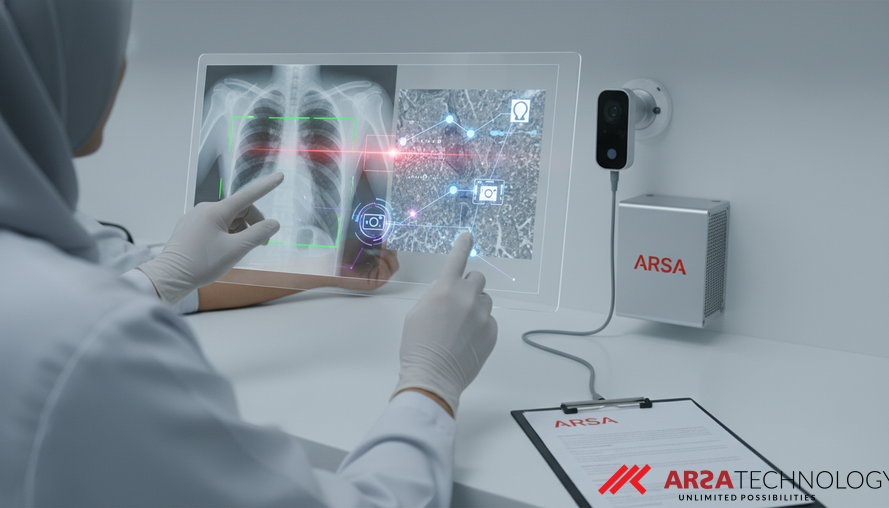
For example, AI-powered systems on edge devices can analyze X-rays, MRI scans, or pathology slides in real-time, flagging potential anomalies for immediate review by clinicians, significantly reducing the turnaround time for critical diagnoses. Remote patient monitoring also benefits from Edge DL, with devices continuously analyzing vital signs and behavioral patterns, issuing alerts for critical changes without transmitting sensitive data to the cloud unnecessarily. According to Polaris Market Research, the global edge computing in healthcare market, valued at USD 5.28 billion in 2023, is projected to reach USD 12.9 billion by 2028, underscoring the rapid growth and investment in this sector. Solutions such as ARSA's Self-Check Health Kiosk exemplify this trend, offering autonomous health screenings, including Romberg tests, blood pressure, and oxygen saturation measurements, directly to patients while integrating with cloud-based health records for physician review and population health management. These innovations provide instantaneous feedback, enhance diagnostic efficiency, improve patient safety, and increase accessibility to healthcare, all while adhering to stringent privacy regulations like GDPR and HIPAA.
Challenges and Future Directions
Despite its immense potential, the adoption of Edge Deep Learning faces several challenges that researchers and practitioners are actively addressing. Energy efficiency remains a critical concern, as edge devices often operate on limited power budgets, especially in mobile or remote deployments. Ensuring the robust security and privacy of AI models and data on distributed edge devices is also paramount, requiring sophisticated encryption, access control, and tamper-detection mechanisms. Regulatory compliance, particularly in sensitive sectors like healthcare, presents complex hurdles that demand careful consideration in system design and deployment.
Future directions in Edge DL are focused on overcoming these obstacles and expanding its capabilities. This includes continued innovation in specialized hardware designed for even greater efficiency and processing power. Advances in federated learning, where models are trained collaboratively on distributed edge devices without centralizing raw data, promise to enhance privacy and data sovereignty further. The development of more explainable AI (XAI) models at the edge will improve trust and transparency in AI-driven decisions. As ARSA Technology, experienced since 2018, continues to advance its offerings, the focus remains on engineering intelligent edge deep learning solutions that are accurate, scalable, and privacy-by-design, ready to meet the evolving demands of various industries.
Conclusion
Edge Deep Learning represents a pivotal shift in the deployment of AI, moving computational intelligence closer to where data is generated. This paradigm not only enhances response speeds and operational efficiency but also significantly improves data privacy and security across diverse applications. From streamlining industrial automation and optimizing smart city infrastructure to revolutionizing medical diagnostics with real-time analysis at the point of care, Edge DL is proving to be a transformative force. As technologies mature and optimization techniques become more sophisticated, the scope for intelligent edge solutions will continue to expand, driving unprecedented levels of automation and insight in our increasingly connected world.
To explore how Edge Deep Learning and other practical AI solutions can transform your operations, we invite you to contact ARSA for a free consultation.
Source: Xu, Y., Khan, T. M., Song, Y., & Meijering, E. (2025). Edge Deep Learning in Computer Vision and Medical Diagnostics: A Comprehensive Survey. Artificial Intelligence Review, 58(3), 93. Updated version with corrections in the text and references. (arXiv:2605.06714v1 [cs.CV] 7 May 2026)