Empowering Students: The TACO Framework for Human-AI Cognitive Partnership in Education
Discover the TACO (Think–Ask–Check–Own) framework, a practical model for students to effectively regulate AI use, fostering cognitive partnership rather than substitution in learning.

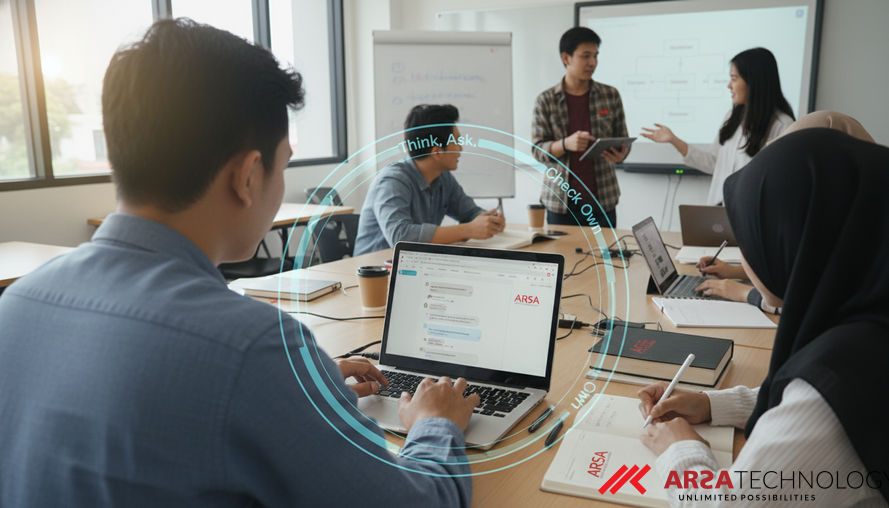
In an era where generative AI (GenAI) is becoming an ubiquitous companion in educational settings, a critical challenge has emerged: how do we ensure students leverage AI as a cognitive enhancer rather than a shortcut that bypasses genuine thinking? Research consistently indicates that learners intellectually grasp this distinction, often affirming that "AI should not replace thinking." Yet, a significant gap persists between this conceptual awareness and its practical application in daily learning routines. This article, drawing insights from a study on Hong Kong secondary students (Source: Students Know AI Should Not Replace Thinking, but How Do They Regulate It? The TACO Framework for Human-AI Cognitive Partnership), delves into this awareness-regulation gap and introduces a practical framework designed to bridge it: TACO (Think–Ask–Check–Own). By shifting the focus from mere ethical understanding to concrete cognitive regulation, we can cultivate a dynamic human-AI partnership in education.
The Dual Nature of Generative AI in Learning
Generative AI tools have rapidly integrated into academic life, offering students a powerful suite of capabilities from brainstorming and drafting to summarizing complex concepts. Their benefits are undeniable: they can enhance efficiency, improve accessibility, and provide immediate support. For example, GenAI can help overcome writer’s block, quickly generate summaries of lengthy texts, or explain difficult subjects in simpler terms, thus potentially reducing extraneous cognitive load – the mental effort spent on non-essential tasks. This allows students to focus more on deeper learning and critical analysis, provided the AI is used strategically.
However, alongside these advantages come significant concerns. The very efficiency that makes AI appealing can also lead to what researchers term "substitution drift," where AI becomes a substitute for effortful learning. Students might use AI to generate entire paragraphs, essays, or even full answers, bypassing critical cognitive processes such as goal setting, strategy formulation, and self-reflection—all vital components of self-regulated learning (SRL). This overreliance can lead to "hallucinations" (AI generating false information), deskilling, and academic integrity issues, including plagiarism or "AI-giarism." The challenge lies not in students’ lack of awareness of these risks, but in their struggle to operationalize effective regulation during actual AI use.
Bridging the Awareness-Regulation Gap
The core problem isn't that students are unaware of the risks of overreliance on AI; rather, it’s that this awareness rarely translates into consistent, structured regulation during practical application. Many studies reveal that while students can articulate concerns about bias, plagiarism, and deskilling, they still frequently use GenAI for tasks that could substitute for their own cognitive effort. This is akin to knowing that "eating cake every day is unhealthy" yet struggling to resist it under stress or temptation. Similarly, under academic pressure, students might default to the most efficient AI use pattern, even if it means outsourcing core cognitive work.
This phenomenon is exacerbated by several psychological factors. The Dunning-Kruger effect suggests that individuals with low ability in a task often overestimate their competence. When AI produces polished-looking output, students might mistakenly believe they "know" the material, even without engaging in the deep cognitive work necessary for durable learning. Furthermore, the "fluency heuristic" can lead learners to perceive easily processed information as more accurate, making AI's quick and articulate responses seem inherently correct. This illusion of understanding, coupled with time constraints and heavy workloads in high-pressure educational environments, often leads students to bypass critical evaluation, thereby increasing the risk of superficial learning. Without clear, repeatable routines for interacting with AI, students are left to navigate a complex cognitive landscape on their own.
Understanding the Foundations of Human-AI Cognition
To grasp why regulating AI use is critical, it helps to consider established learning theories. Sociocultural accounts emphasize that learning is deeply mediated by tools; AI, as a powerful tool, reshapes how learners engage with tasks. Distributed cognition extends this by viewing cognition not as solely "in the head," but distributed across people, artifacts, and environments. When AI becomes part of a student's workflow, it effectively becomes part of their extended cognitive system. Activity theory further highlights that tool use is always goal-directed and embedded within a broader activity system, meaning AI's impact is shaped by learning goals, classroom rules, and the division of labor between student and machine.
Self-regulated learning (SRL) theory outlines how effective learners cycle through forethought (planning), performance (strategy and monitoring), and self-reflection (evaluation and adaptation). GenAI has the potential to support SRL by aiding in planning or providing feedback, but it also carries the risk of undermining SRL if it becomes a shortcut that bypasses essential cognitive cycles. Moreover, cognitive load theory warns that while AI can reduce extraneous mental load, it can also remove germane processing – the effortful thinking crucial for deep learning. These theoretical perspectives underscore that the fundamental question is not whether GenAI is used, but how its use supports or displaces genuine learning and metacognitive engagement.
Introducing the TACO Framework: A Structured Partnership
To address the awareness-regulation gap, the study proposes the TACO framework: Think–Ask–Check–Own. This process-oriented model provides students with a structured, repeatable routine for interacting with AI, ensuring it acts as a cognitive partner rather than a replacement for thinking.
Think: Before engaging with AI, students are encouraged to pause and think* independently. This involves activating prior knowledge, outlining their own ideas, formulating initial hypotheses, and identifying areas where they truly need assistance. The goal is to establish a baseline of personal understanding and generate original thoughts, preventing AI from becoming the default starting point. Ask: Only after independent thinking, students then ask* AI specific, well-defined questions. This isn't about asking for complete answers but for specific support: clarifying concepts, generating diverse perspectives, brainstorming examples, or refining language. The interaction should be strategic, focused on expanding rather than replacing their initial thoughts. Check: Critical evaluation is paramount. Students must check* the AI's output rigorously. This involves verifying factual accuracy, assessing logical coherence, identifying potential biases or "hallucinations," and comparing the AI's response against their own initial thoughts and other reliable sources. This stage fosters metacognition, requiring students to reflect on the validity and relevance of the AI-generated information. Own: Finally, students own* the learning. This means integrating the verified AI output into their own understanding, rephrasing it in their own words, connecting it to existing knowledge, and articulating why it is relevant. It involves personalizing the information and being able to confidently explain it without relying on the AI. This step ensures that the knowledge becomes truly theirs, demonstrating legitimate understanding and accountability.
Implementing Human-AI Partnership in Practice
Implementing the TACO framework necessitates a shift in pedagogical approaches, moving beyond warnings about AI misuse to actively teaching structured interaction routines. This involves explicit instruction, modeling, and opportunities for guided practice where students apply TACO in various learning scenarios. Educational institutions can integrate this framework into curriculum design, assessment rubrics, and AI literacy programs.
For instance, an assignment might require students to submit not only their final output but also their initial "Think" notes and a "Check" log detailing their AI interactions. This promotes transparency and holds students accountable for their cognitive engagement. Developing robust, adaptable AI and IoT solutions is crucial for enabling such sophisticated educational environments. Providers like ARSA Technology, an AI & IoT solutions provider experienced since 2018, specialize in designing custom AI solutions that meet specific operational and ethical demands for institutions and enterprises. For developers building advanced educational platforms, integrating secure identity and analytical capabilities via ARSA AI API could provide the foundational infrastructure needed for such regulated learning environments.
The TACO framework offers a learner-grounded approach to sustaining AI as a dynamic cognitive partner. It provides a concrete mechanism for students to manage the boundary between assistance and outsourcing, fostering genuine learning and equipping them with essential skills for an AI-integrated future. By empowering students with such practical tools, educators can confidently navigate the complexities of AI in education, ensuring technology truly enhances human capability rather than diminishing it.
Source: Chan, Cecilia Ka Yuk. (2026). Students Know AI Should Not Replace Thinking, but How Do They Regulate It? The TACO Framework for Human–AI Cognitive Partnership. arXiv preprint arXiv:2604.18737.
Ready to explore how advanced AI and IoT solutions can support innovative educational frameworks or transform your enterprise operations? Visit our solutions pages or contact ARSA for a free consultation.